



Related Features

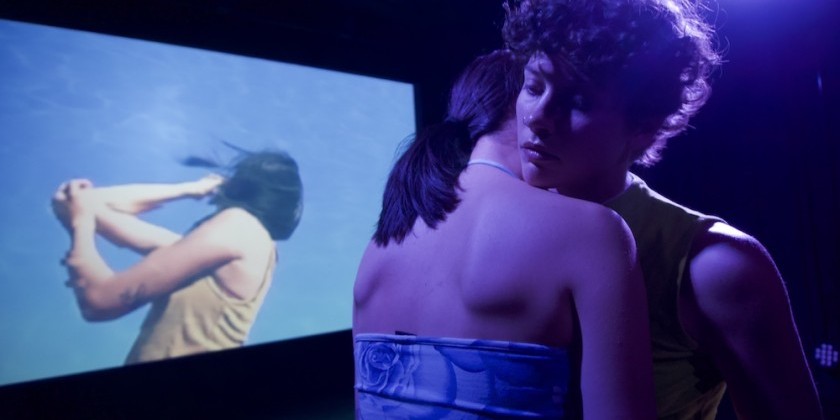
IMPRESSIONS: Audrey MacLean Performance Projects' "The Dance Show" at Arts on Site
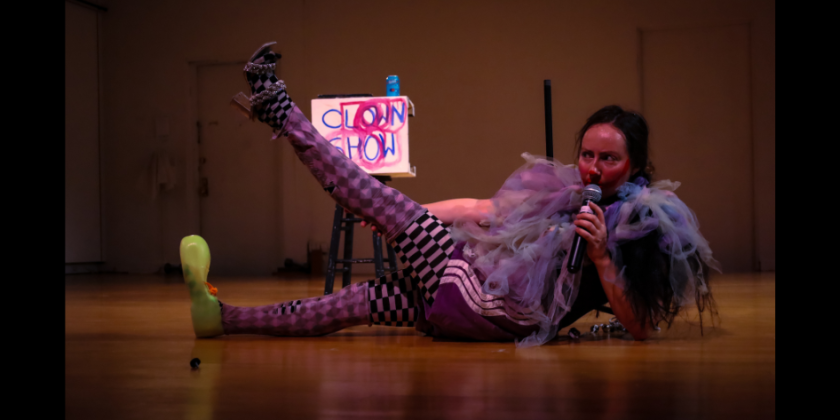
IMPRESSIONS: Cornfield Dance in "Scrambled Stages" at Arts on Site
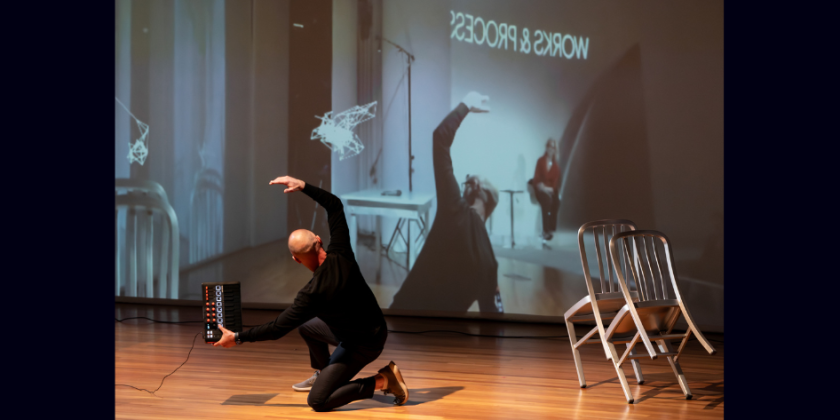
IMPRESSIONS: Stephanie Saywell & Helen Wicks at Arts On Site


By Catherine Tharin
View Profile |
More From This Author
Published on April 29, 2026
Helen Wicks in "Radio Vision." Photo: BeccaVision
A Split Bill of Dance and Theater, Featuring Live Music
Stephanie Saywell & Helen Wicks at Arts On Site
Matryoshka
Choreography by Stephanie Saywell
Performed by Hanna Golden and Dahyun Kim
Sound: Text by Kit Haggard, Voiceover by Stephanie Saywell, Fawn by Tom Waits
Let’s Hear It For The Boy (World Premiere)
Created by Stephanie Saywell
Made in collaboration with and performed by Grayson Bradshaw
Sound: Holding Out for a Hero by Bonnie Tyler, Audio excerpted from Video Match: 80s Dating Video Montage, Bedded deep in long-term memory by The Caretaker, Call Me by Blondie
Radio Vision (NYC Premiere)
Choreography and Performance by Helen Wicks
Text: Oral History with Joseph Gershenson by American Film Institute, Interviewed by Irene Atkins Kahn
Sound: 3 Pieces for Cello and Piano (1914) by Nadia Boulanger played by Lydia Rhea (cello) and Amber Scherer (piano), Mentone Productions 1933-39 musical shorts with supervision by Joseph Gershenson, Sound Design by Simon Victor Linsteadt (includes 1950s broadcast TV, The Pawnbroker, Quincy Jones, interviews of Boulanger students Philip Glass and Igor Stravinsky), Le Chant des Oiseaux (1909) by Nadia Boulanger
April 7 - 8, 2026
Stephanie Saywell and Helen Wicks shared an hour-long evening at Arts On Site, an intimate stage well-suited to their solo and duet program. Both artists draw on performance lineages that extend beyond concert dance, including circus, clowning, vaudeville, aerial, gymnastics, and theater, while grounded in modern dance training.
Stephanie Saywell’s two works explore forms of intimacy shaped by distance rather than direct encounter. Matryoshka (named for Russian nesting dolls), performed by Hanna Golden and Dahyun Kim to text by Kit Haggard, recounts a familiar, though unsettling New York City tale in which apartment dwellers spy on one another. In Matryoshka, the woman observed becomes a performer for the woman voyeur.

The dancers occupy separate planes of the stage, one upstage and the other downstage, alternating movement and stillness. Both travel fully across the space. Kim, dressed entirely in blue, lunges deeply and moves with grounded weight. A recurring, arresting gesture brings her to her knees, with her back to the audience, hands cupped behind her back, one gently resting inside the other. The shape echoes the nesting quality of the work’s title, one identity within another.
Golden, dressed in red, awakens to the old-timey sound of Fawn by Tom Waits. Her movement contrasts Kim’s groundedness with sharp passé steps, a hand at her forehead, and her head tipping back. At moments, she prances lightly across the stage with her fingers pressed closely together.
Haggard’s text gives voice to the voyeur: “I watch her put her stockings on. She takes her time. She does this for me. She knows I can see across from the apartment. We are nesting dolls.” The story is told as an obsession. The figure observed is married to a man who, the narrator notes with disdain, leaves his socks on when the couple makes love, an image that intensifies the voyeur’s fixation. She speaks about scratching out his existence. "Those are the black stockings you put on for me, for me," she declares.

After a moment of silence, both sit on the floor. Golden rises and sends a kiss toward Kim before exiting. Left alone, Kim swivels to the floor on her stomach before pressing upward into a handstand balanced at the shoulders. She returns to the cupped hands gesture and sends her own kiss outward.
The piece brought to mind an experience that left me with the opposite reaction. Years ago, a stranger told me he had been observing me in my kitchen from a distant building. What I had assumed was private suddenly felt exposed. In Haggard’s story, looking becomes a form of longing, recasting voyeurism as intimacy rather than intrusion. In life, that gaze can feel invasive; here it is staged as reciprocal, even eroticized.
Saywell’s second work of the evening, Let’s Hear It For The Boy (world premiere; the song, part of the 1984 Footloose soundtrack, played during the break), shifts from voyeurism to courtship. Performed by Grayson Bradshaw, the solo follows a man searching for connection through a dating site. Bradshaw appears in a slightly rumpled coat and pants, glasses perched on his face, an unassuming figure whose striped, blue-and-yellow socks add a comical note. He begins with his back to the audience. Turning suddenly, he lip-syncs to Holding Out for a Hero by Bonnie Tyler, rushing forward as his hips swing side to side. The bravado collapses when the music cuts and a phone rings. “Hi, Mom,” he answers.

A sequence of recorded voices follows, recalling the awkward candor of 1980s video dating services. “My name is Bill. I play guitar.” “I'm Fred. How about a nice bath with champagne and candles?” Bradshaw reacts with elastic expressions, eyes widening, mouth stretching into a grin, then tightening in dismay. A physical theater artist and clown, he illustrates unseen suitors with gestures: skipping in circles, zigzagging across the stage, miming flight, wiping away a tear, and smelling his breath.
Later, to a scratchy loop of nostalgic music drawn from the work of The Caretaker, he makes his own appeal. “I’m looking for a nice guy,” he calls out. When a response arrives, purple light fills the stage and Call Me by Blondie bursts forth as he strikes a triumphant pose. Let’s Hear It For The Boy leans on recognizable tropes of loneliness and performance, but resists settling into a single emotional register. Amusing throughout, at times this dance is funny.

Saywell’s work reaches toward something singular. It operates within a tight frame that feels logical and deliberate. Across both dances, Saywell has found a distinctive language of her own; what remains is how far she can push and expand, perhaps loosen and 'shake out', what is already there. She has the boldness and the tools to do so.
Helen Wicks presented Radio Vision (NYC premiere), a solo constructed as an assemblage that brought together music, text, and objects across the stage.
Beginning with live piano (Amber Scherer) and cello (Lydia Rhea) to Nadia Boulanger’s 3 Pieces for Cello and Piano (1914), (live music is always welcome), Wicks lay upstage with a large vintage suitcase resting on her torso and a thick coil of red rope wrapped around her midsection. Her face was marked by blue makeup, her hair piled high, evoking an off-kilter Hollywood figure. She rolled downstage with the suitcase in precarious balance, then uncoiled the rope into an oval boundary around herself and the suitcase. Within this space, she moved through a sequence of actions, riding the suitcase like a horse, balancing, and turning upside down.

Wicks pulled strips of film from a reel-to-reel device housed in the suitcase, wrapping the strips around her legs and wrists, swirling and kicking them into the air. A red light saturated the stage as she shifted into a spoken sequence referencing television and Hollywood production, followed by a tray of Jello that she ate while stepping rhythmically across the stage. A recorded a cappella performance of Le Chant des Oiseaux (1909) by Nadia Boulanger, played as she continued developing the work. At times, she stood on the bench or twirled the rope overhead. Props spread into a scattered landscape of suitcase, rope, bench, and film.
Wicks holds the stage with a compelling physical presence, her movement precise and assured. As a gymnast and aerialist, tempered by somatic studies, she demonstrates a high degree of control. Drawing on a lineage that includes her grandparents’ work in Yiddish theater as well as vaudeville, the piece accumulates objects, images, and references into a shifting field of associations. Meaning remains diffuse, however, leaving the viewer to assemble connections that never quite cohere.
.jpg)