

Related Features
IMPRESSIONS: GRAHAM 100 at New York City Center (Part 2)
IMPRESSIONS: GRAHAM 100 at New York City Center (Part 1)
IMPRESSIONS: "Martha Graham: Collaborations" at The Church Sag Harbor through March 22, 2026

By Robert Johnson
View Profile |
More From This Author
Published on February 17, 2026
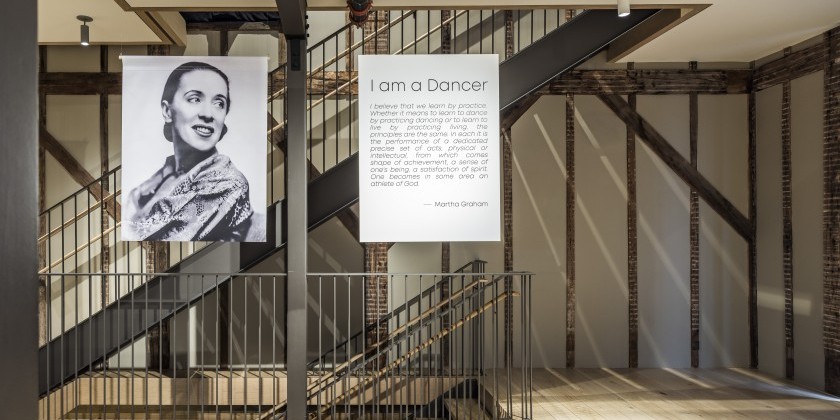
Photo: Martha Graham collaborations
January 18 to March 22, 2026
The Church, 48 Madison Street, Sag Harbor, New York, NY
Open Thursday - Monday, 11 a.m. to 5 p.m.
Curated by Oliver Tobin
Concept by Executive Director Sheri L. Pasquarella
Exhibition Coordinator: Joe Jagos
Graphic Designers: Virginia Edwards and Maria Lavazzo
Costume Installation: Kim Profaci
As long as her dancing body sustained her, the late choreographer Martha Graham [1894-1991] placed herself center-stage, giving heroic performances that made her and her creations world-famous. She magnetized the public in a long series of starring roles, including the woman distorted by grief in Lamentation, the ingenuous Bride of Appalachian Spring, and the murderous protagonist of Clytemnestra, among many others. Often her works portrayed a woman’s search for herself, and her struggle for personal growth. Yet, while she remained the focal point, in reality, Graham was rarely alone.
Now a museum exhibition reminds us of the many people-some major artists in their own right-who clustered around Graham and supported her vision. Curated by archivist and former dancer Oliver Tobin, this show, Martha Graham: Collaborations, pictures Graham among her family, her teachers, partners, and fellow dancers, and illustrates the contributions of designers and composers whom she commissioned. The exhibition, which opened on January 18th 2026, remains on view at The Church in Sag Harbor, NY through March 22nd 2026; and visiting Sag Harbor is a wonderful way to kick-off what ought to be a national celebration of this preeminent American artist, as the Martha Graham Dance Company observes its 100th anniversary in 2026.
At the start of the exhibition, antique photographs seem fixed to the wall with paper corners, as in an album. Here we see Graham in the bud. Her father, George Graham, was an “alienist,” or psychologist; and in an early family grouping, his deep-socketed eyes seem to read us searching for symptoms, while her mother avoids looking at the camera and her baby sister tilts her head flirtatiously. In this photo, Graham herself is a stout 3-year-old pouting defiantly, her tiny arm draped around her father’s neck. She is Daddy’s girl, as her choreographed psychodramas and her insight into the human condition would later reveal. Within a few years of this snapshot, the child has blossomed into a white-robed debutante, self-possessed and distant, taking her elegance for granted; while a tassel hanging from one sleeve looks ahead to the Orientalism of her early dancing career.
In California, the young woman fell under the spell of Ruth St. Denis and Ted Shawn, the barnstorming American moderns who ransacked the Far East for imagery, and who composed fantasy dances that were sexy and self-consciously aesthetic. Photos portray “Miss Ruth” in her dual roles of siren and saint, showing off her curves one minute, and then reclining with her eyes raised heavenward. In another image, the Denishawn Company gathers on a lawn, the youngsters looking uncomfortable outdoors, their jazz-age hairstyles oddly matched with Grecian tunics. Martha Graham, however, had found her calling, and, in another photo, we see her pressed ecstatically against her partner, Shawn, in the Spanish-flavored Malagueña, not forgetting to lead with her prettily arched foot.
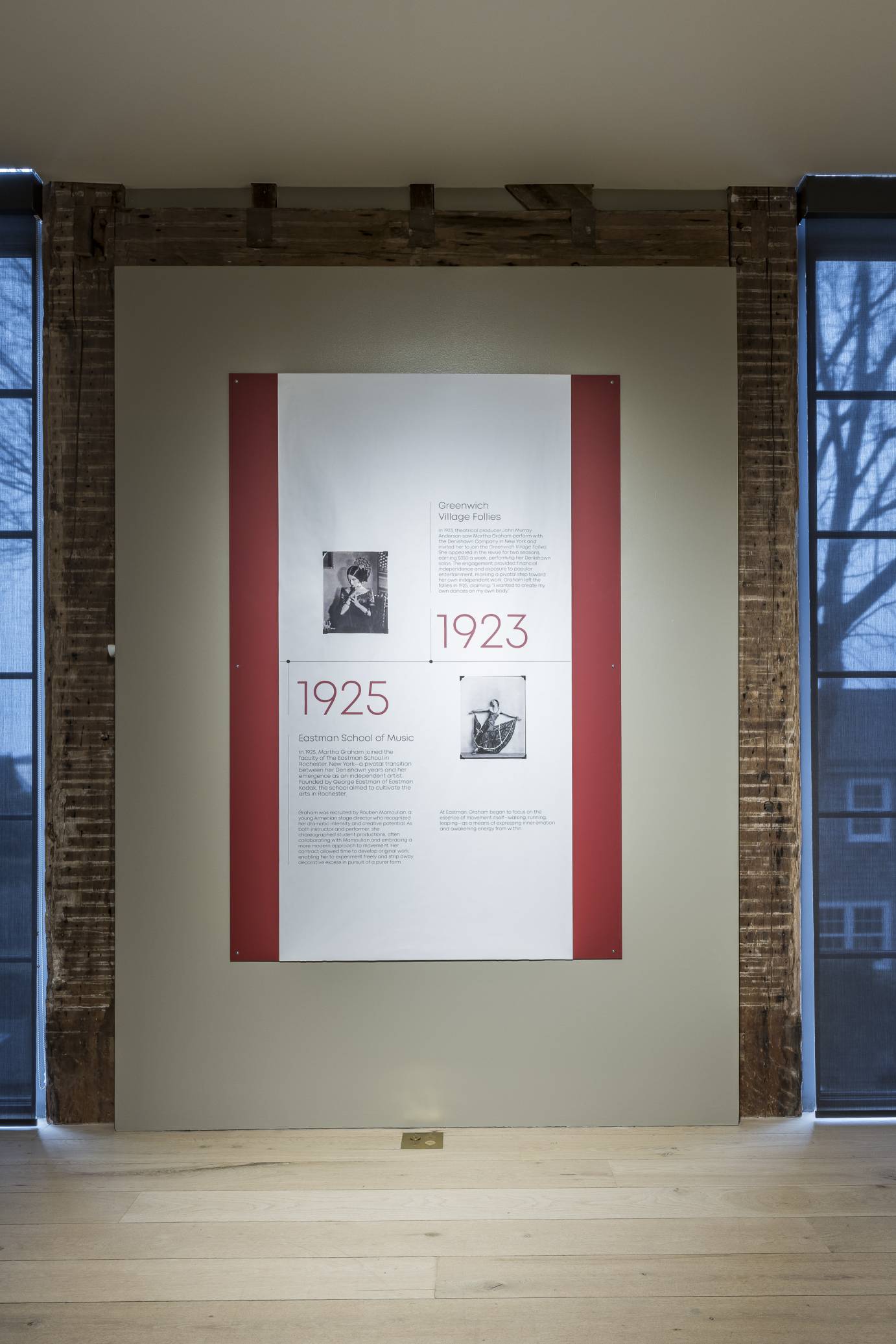
Other pictures nearby show Graham in ersatz Chinese and Javanese costumes, extending the Denishawn repertoire, but by 1926, the year she formed her own company in New York, she began to undergo a transformation. A remarkable film contrasts an excerpt from her early group piece The Flute of Krishna, with the solo Tanagra. While the first is a perfumed intrigue, with shapely women in pajamas prancing against a rose-colored background, the second shows Graham heavily draped and staggering with emotion. Though both pieces use veils as props, in Krishna the veils are purely decorative while in Tanagra they have become an expressive tool. Graham is already developing her own style and a flamboyant theatrical personality.
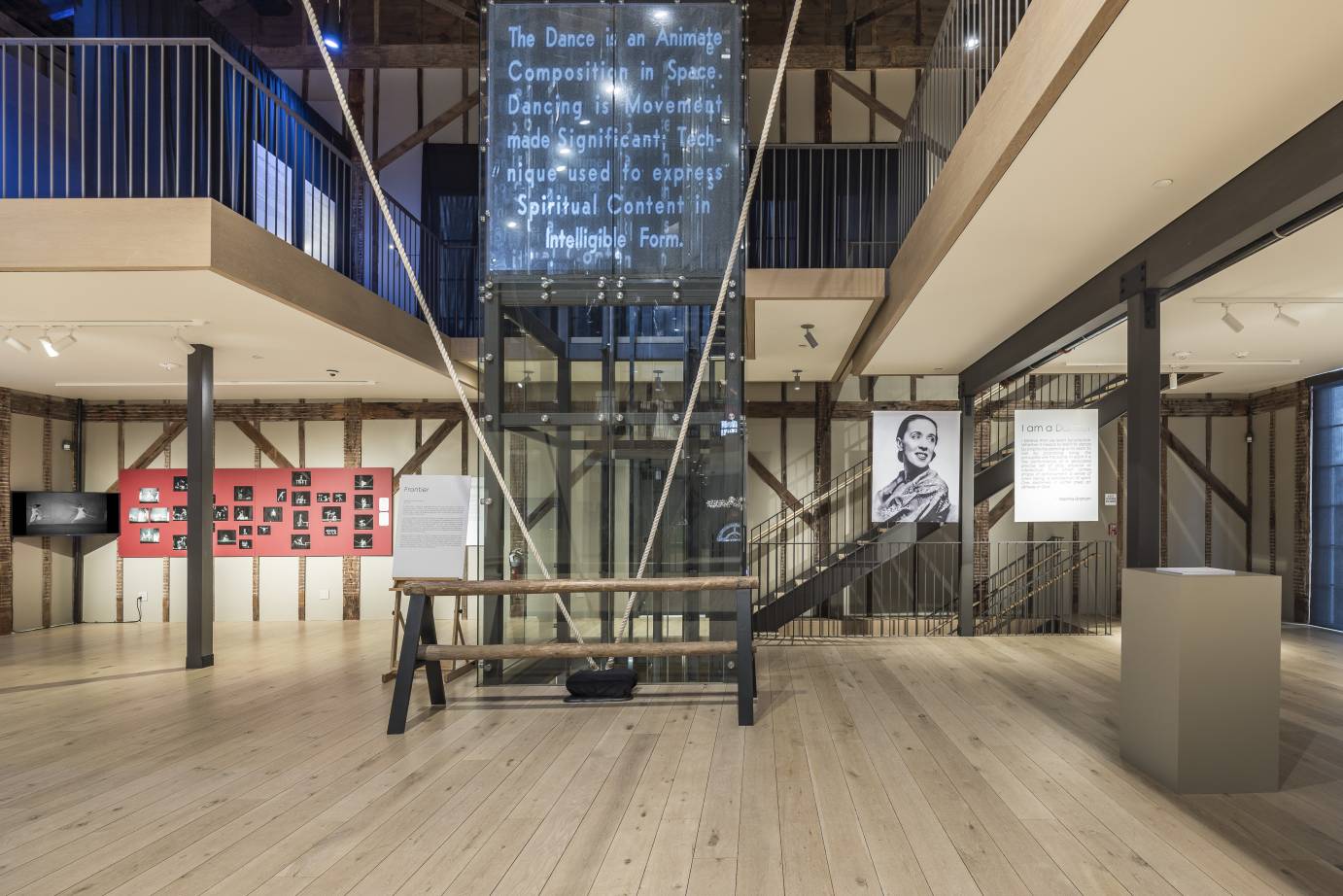
From here, the exhibition skips to the 1930s, displaying the spare but space-defining set for Frontier — the first of Graham’s many, fruitful collaborations with sculptor Isamu Noguchi. A designer of evocative, Surrealist props, Noguchi would create spatial playgrounds that prompted the choreographer to move in new ways, and helped her to realize her dramatic visions. Nearby we meet Graham’s partners in art and life. She inherited Louis Horst, her company’s music director, from Denishawn. Ten years her senior, the devoted Horst composed musical scores for Graham, offered advice, and provided a sounding board for her ideas, while developing his own system of dance composition. The brash young Erick Hawkins was the first male dancer to join Graham’s company. A fox in the henhouse, he provided a male template for her choreography and was an emotional sparring partner, briefly sweeping her off her feet. A former classics student, Hawkins also kindled her interest in the ancient Greeks.
Another fascinating film shows Graham’s early company in excerpts from Chronicle, a 1936 work built around the human tragedy of war. Athletic, but raw, the women perform mechanically, and at times appear to be sleepwalking. The diamond-hard style of Graham’s later years has not yet crystallized, though in nearby photos we see that Graham herself, in Chronicle, in Deep Song, and Immediate Tragedy, displayed a clear sense of dramatic purpose and mastery over her surroundings.
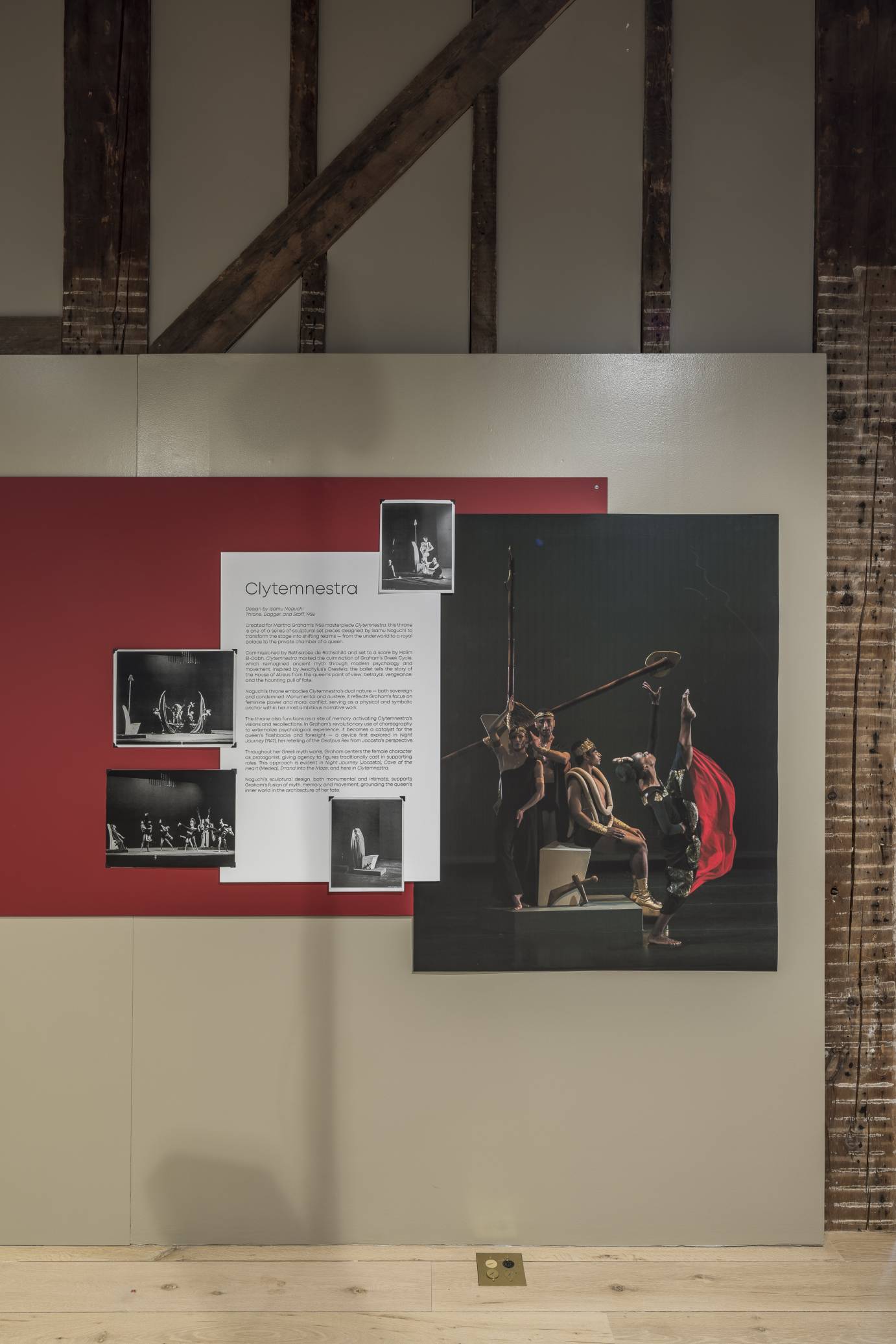
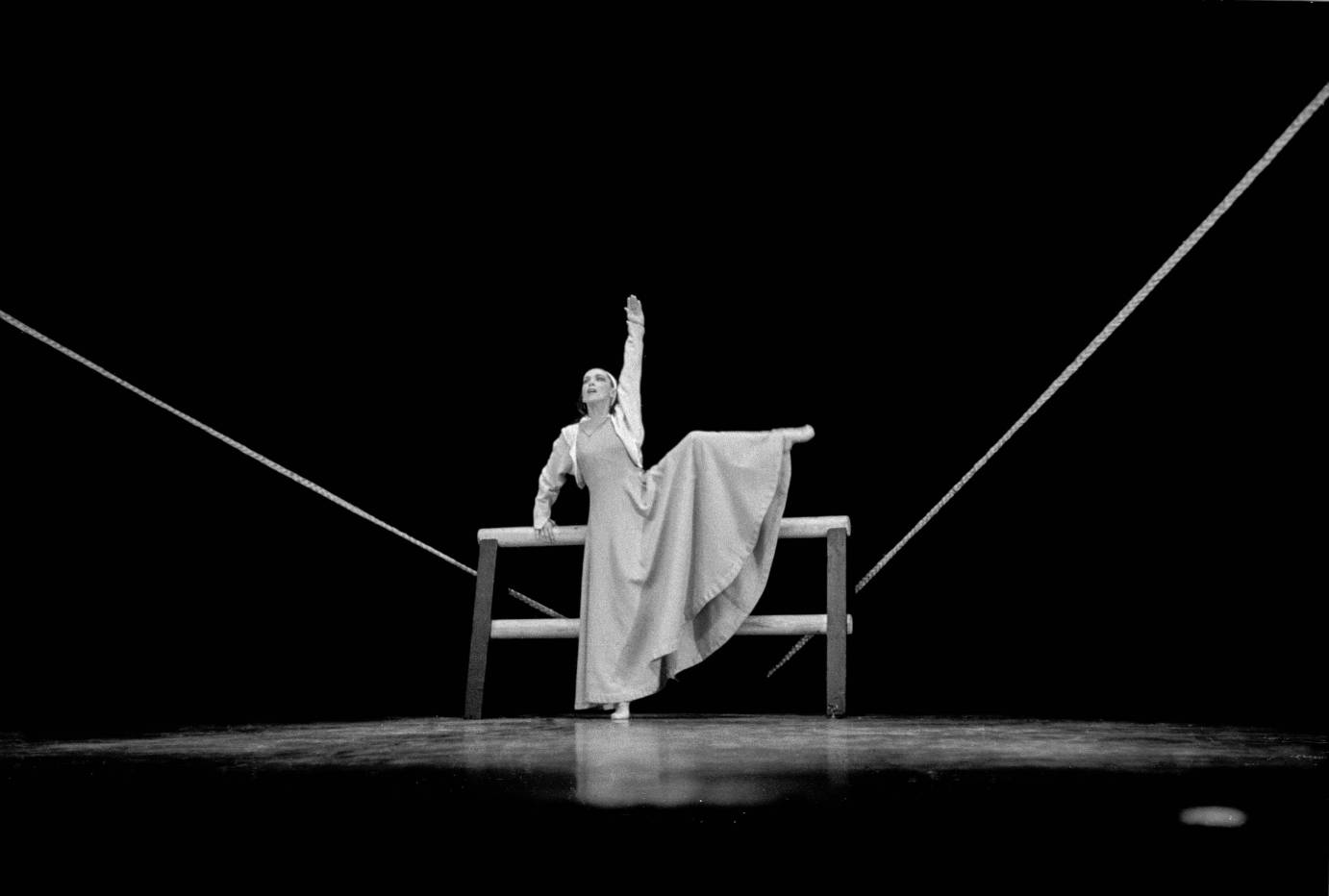
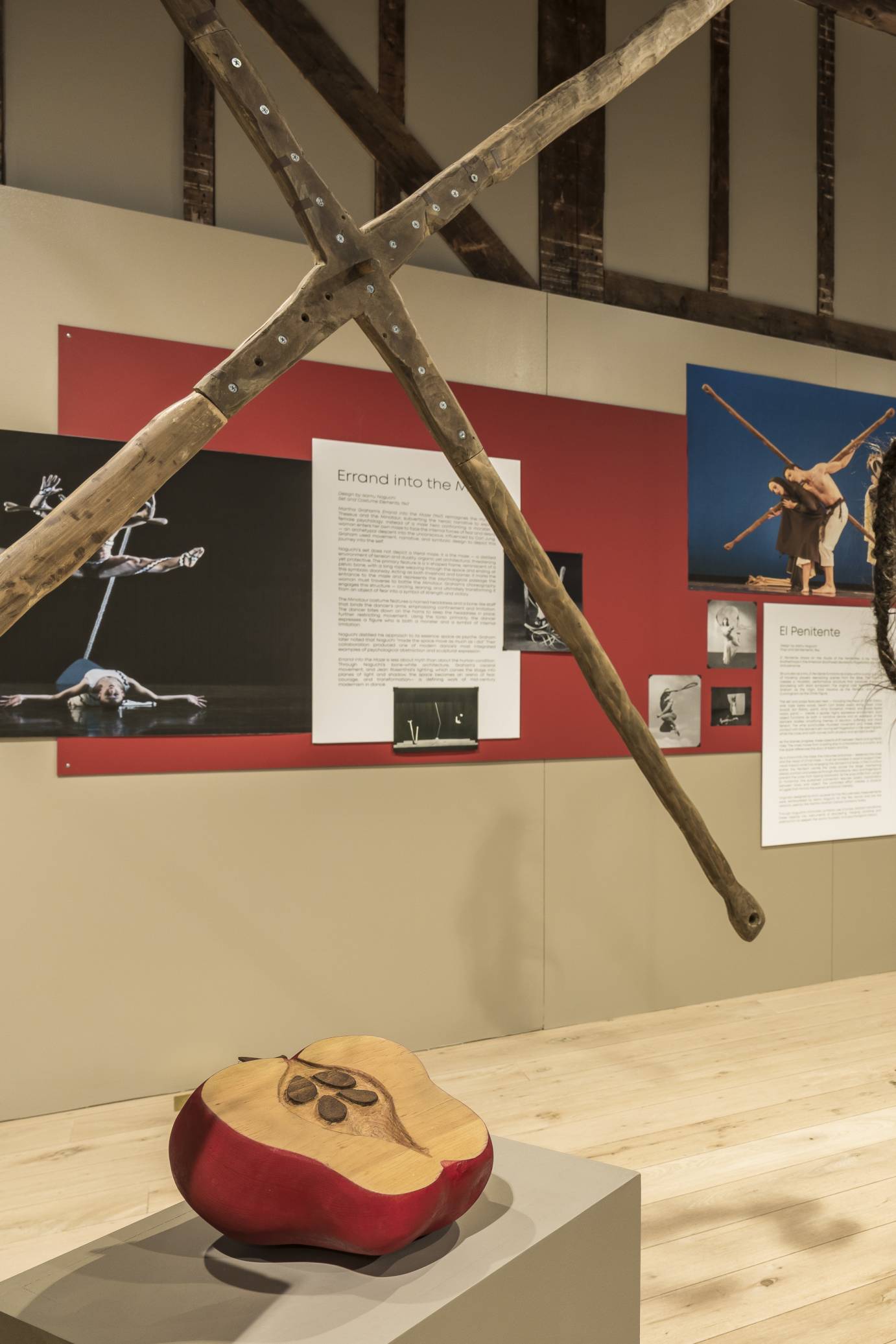
The upstairs gallery zooms in on three additional collaborations with Noguchi, allowing closeup inspection of remarkable set pieces from Errand Into the Maze (1947), El Penitente (1940), and Clytemnestra (1958). On display are the “pelvic” doorway from Errand Into the Maze, and the rope which the terrified heroine uses to secure it; along with the horned headpiece and yoke belonging to her antagonist, the minotaur-like Creature of Fear. A nearby photograph shows these props in action, while a text panel explains that the difficulty of manipulating props and costumes adds a layer of complexity to Graham’s dances, coloring the performers’ interpretation of their roles and demanding virtuosity.
While Errand Into the Maze is psychodrama, reinterpreting Greek myth in the context of Freudian analysis, El Penitente uses a ritual of the American Southwest as the springboard for a modern mystery play. Here we find a ghostly Christ Figure mask with its stylized crown of thorns; half a wooden apple; the Penitent’s cross; and the horsehair knout he uses to beat himself. The players’ ramshackle “death cart,” has slats so loosely held together that the cart itself seems ready to expire. Less eloquent but eminently functional is the throne of the House of Atreus, from Clytemnestra, a gleaming bronze knife tucked under the seat where it will come in handy. Nearby photographs show the choreographic tableaux of which the throne is but a part: dramatic scenes representing the Rape of Troy and the Execution of Agamemnon.
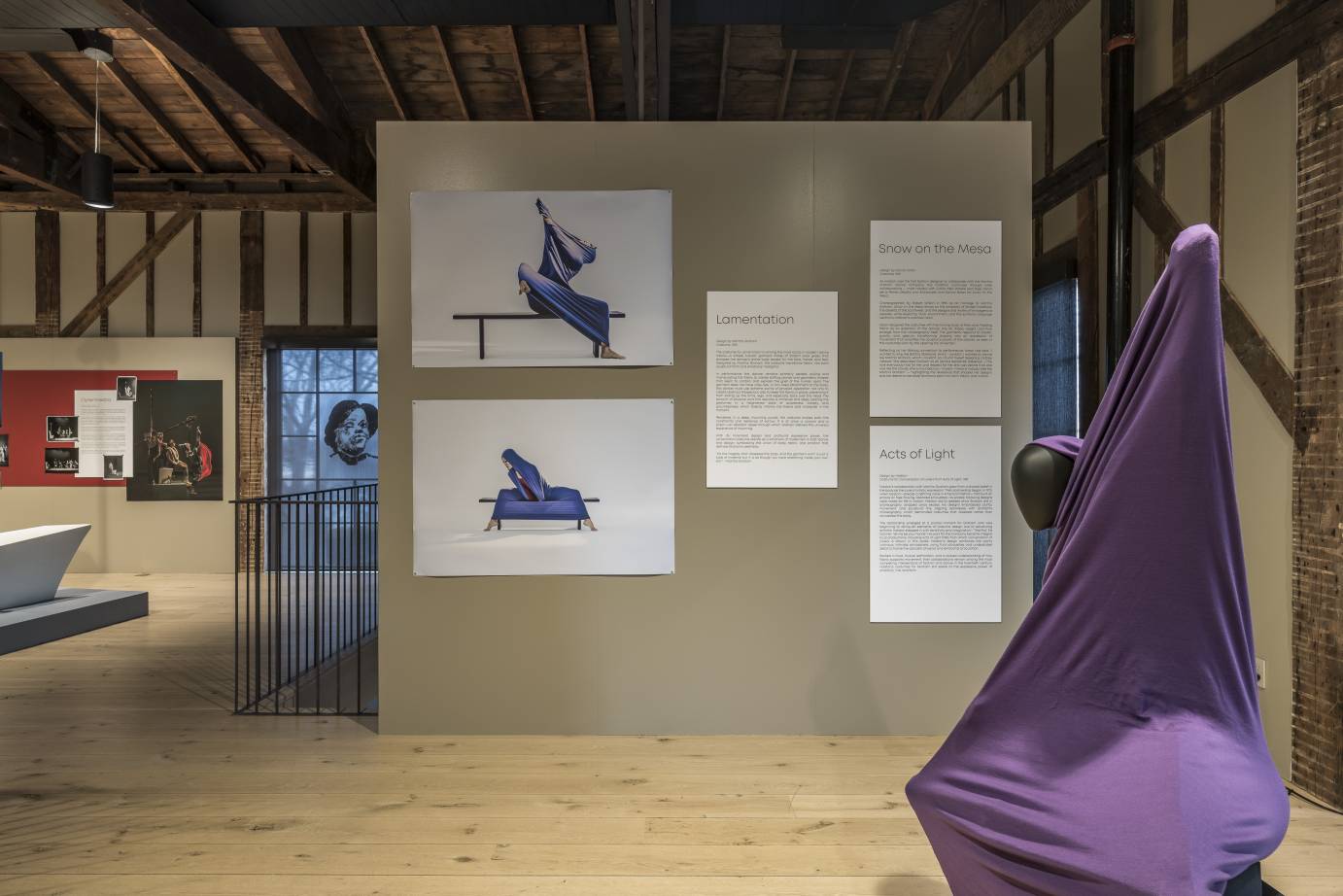
Also on the second floor of the exhibit are costumes cleverly mounted by puppeteer Kim Profaci to show their dynamic potential. Here we encounter the famous, stretchable tube dress that Graham designed for herself in Lamentation, a Cubist distillation of grief. Flying overhead like the spirit of the night is Donna Karan’s sparkling and diaphanous costume from Snow in the Mesa, Robert Wilson’s posthumous tribute to Graham. A suspended mannequin shows how Halston intended the sexy, red sash that he designed for Acts of Light to hang down during an overhead lift.
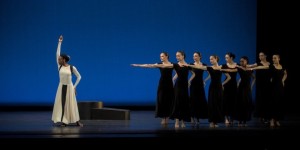
The costumes for Heretic seem relatively plain, depending on the dancers to animate them: the non-conforming protagonist, all in white, extends her arms with pieces of fabric hanging from the sleeves like flags of truce, while the black-clad figure representing the ensemble assaults her with arms raised to strike, her knee stretching the skirt to form a blade-like angle.
Surely there are more interesting costumes in the Graham repertory than those from Heretic — the flower-like white gown of Primitive Mysteries, for instance; the flaring Nautch skirt of Serenata Morisca; or Medea’s snake-patterned dress and blood-red cord in Cave of the Heart. The theme of Heretic felt personal to Graham, however. Choosing an independent dance career in an age when women were expected to be home-makers was tantamount to heresy, she believed. Yet the central conflict between the individual and the group is so essential to the practice of modernism (see Peter Gay’s book Modernism: The Lure of Heresy), and recurs so often in American history as the conscience-stricken defy social orthodoxies, that Heretic shows Graham at her most acute. The choreographer has a distinguished place in a long line of American rebels and free-thinkers, from Anne Hutchinson to Angelina Grimké, and from Henry David Thoreau to Muhammad Ali. Despite its modernist abstraction, Heretic is as intrinsically American in its outlook and its morals as Frontier or Appalachian Spring, and the current exhibition helpfully projects a film of it near the costumes.
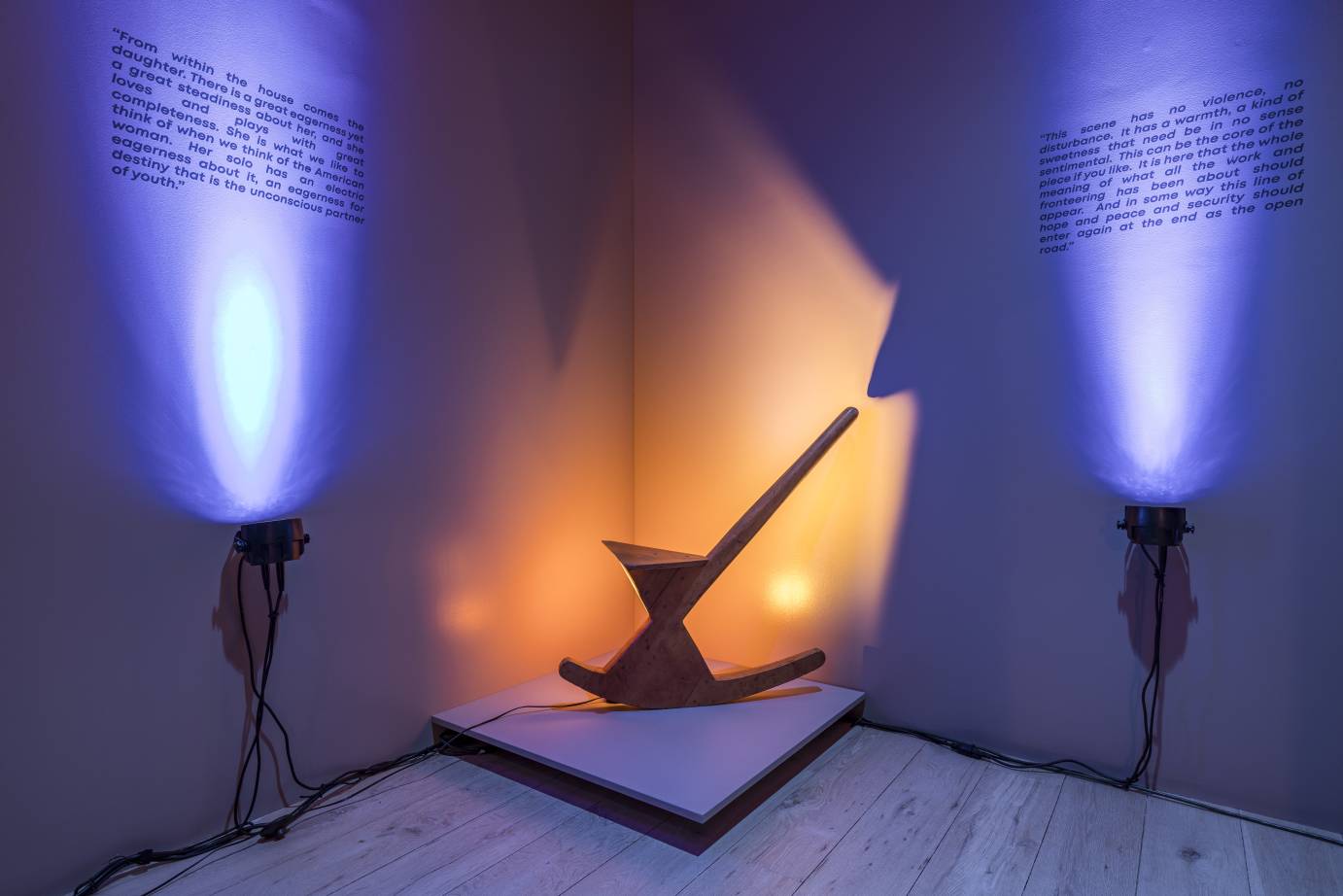
Appalachian Spring, of course, could not be ignored, and this celebrated collaboration between Graham and composer Aaron Copland appears at the other end of the second-floor gallery. In a curtained booth saturated with a special shade of atmospheric blue light (called “Rosenthal Blue” after lighting designer Jean Rosenthal), visitors can listen to the music and read some of Graham’s instructions to Copland. In Appalachian Spring, she was aiming for “gentleness without sentimentality” and hoped to achieve “the universal without being symbolic.” Blurring past and present, she imagined “a place where the first fence has just gone up,” but seen in memory.
Graham’s most constant collaborators, of course, were her dancers, and the exhibition includes a video reel with interviews in which several of them recall the experience of working with her. Curiously, the men have more to say about her choreographic process, while the women emphasize her qualities as a performer. For David Wood, Graham’s dancers were “catalysts” rather than collaborators; while Mark Ryder describes the choreographer as guided by flashes of intuition. Robert Cohan says she used symbolic objects as “keys” to open psychic doorways; and he praises her inventive use of props. Graham could take a simple piece of cloth and transform it into a pathway, or a veil. Stuart Hodes watched Graham struggle to create, and admires the integrity that led her ruthlessly to discard material that might have been beautiful, but did not serve her immediate purpose or guide her next steps.
Mary Hinkson speaks of Graham’s brilliant sense of timing, and of the “jagged edge” that made her performances exciting. Jane Dudley recalls Graham’s exceptional physical strength, while Linda Hodes, who played opposite Graham in Deaths and Entrances, describes feeling herself sucked into Graham’s fantasy world. Graham’s immense concentration exerted a force like gravity.
While her choreography depends upon contrast for its effects, some of her dancers sensed that she was aiming for transcendence. Pearl Lang speaks of learning how to simulate flight by tilting off-center and rediscovering a balance that was liberating. According to Helen McGehee, there is a mid-point of equilibrium between contraction and release, when the body is in suspension. Graham, she says, was always seeking this beautiful but unreachable center.
Museum exhibitions offer a terrific opportunity to see dance in a new light, and to approach the subject when it isn’t running away. The best way to appreciate Graham’s towering achievement, however, is to watch her company in action; and the centerpiece of this year’s tributes will be the Martha Graham Dance Company’s centennial performances, April 9 - 12, at New York City Center, featuring revivals of Night Journey, Chronicle, Appalachian Spring, and Diversion of Angels, plus recent commissions.
A host of other activities will take place in New York, April 17 - 19, during GRAHAM100 Gala Weekend, including events at the company’s new studios at 1501 Broadway; and the New York Public Library for the Performing Arts will present materials from its Graham collection in an exhibition that opens there on May 20. Before any of that, however, PBS will broadcast a two-part series taking viewers behind-the-scenes at the Graham company. Titled Martha Graham Dance Company: We Are Our Time, the series will air on March 27 and April 3. For a full list of ways to celebrate, visit marthagraham.org/events.