
Related Features
IMPRESSIONS: Christos Papadopoulos Presents “Larsen C” at Powerhouse Arts
IMPRESSIONS: Mette Ingvartsen Rolls Into Powerhouse Arts with "Skatepark"
IMPRESSIONS: Hofesh Shechter Company in “Theatre of Dreams” at Powerhouse: International

By Cecly Placenti
View Profile |
More From This Author
Published on December 1, 2025
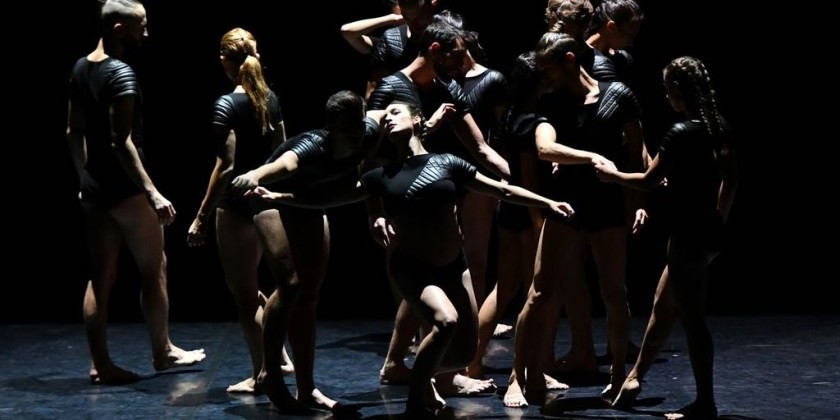
Photo by Steven Pisano
Choreography & Music: Hofesh Shechter
Lighting Design: Tom Visser
Costume Design: Osnat Keiner
Sound Technician: Amir Sherhan
Stage Manager: Leon Smith
Musicians: Yaron Engler, Sabio Janiak, James Keane
Dancers: Tristan Carter, Robinson Cassarino, Frédéric Despierre, Rachel Fallon, Cristel de Frankrijker, Mickaël Frappat, Justine Gouache, Zakarius Harry, Alex Haskins, Keanah Faith Simin, Juliette Valerio, and Chaney Vyent
As the audience chats and last minute arrivals find their seats, a man in a blue suit walks down an aisle of the mammoth performance space at Powerhouse Arts, a former power plant turned arts hub, as if in a trance. We notice him and the chatter dies down. A pulsing beat rises, muffled and far away. Like the man in blue, we are hypnotized. A small, low gap appears as he approaches the stage curtain and he looks back over his shoulder quizzically. I can almost feel the collective, silent response: “Do it.”
When he accepts this mysterious invitation, the world he enters is a madcap, reality-bending dreamscape...

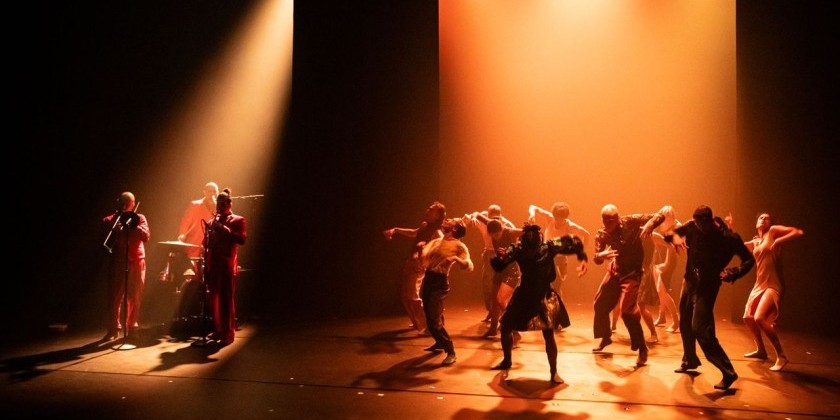
This is how Theatre of Dreams begins. The work unfolds as manic and disjointed as most dreams. Hofesh Shechter, the Israeli-born, German-based choreographer, composer, and former Batsheva company member, displays many of his trademark elements: a deafening, anamorphic score, dim lights, smoke that envelops the stage and creates an uneasy, other-worldly environment, and his definitive insectile, gestural movement language.
Theatre of Dreams is a world of darkness, filled with fragmented imagery and cacophonies of sound and texture. Through the innovative use of sliding black curtains and the shifting concentration of stage lights, we are allowed only glimpses of the action— some short snippets, others longer tableaux.
When the curtains crack open for the first time, the man in blue stands staring at us. The curtains close, then open again, just a crack. Now a whole group of dancers stand and stare before the blackout. Open again, and the group is dancing in slow motion, leaning back, arms lifted and pulsing to a deep bass line. Another group of dancers sweeps sideways across the stage, hunched and prowling like apes in a line that tricks the eye into believing the procession is endless. The group keeps dancing as if nothing is happening, but we see it all — we are the dreamers observing the dream. Blackout.

Shechter’s movement vocabulary — guttural, raw, and in defiance of any namable technique — requires authenticity and full commitment from each performer. His cast of thirteen does not disappoint. Across Theater of Dreams’ ninety minutes, these superb athlete-dancers barely pause. They appear from nowhere and disappear just as quickly. They slither on their stomachs like lizards and contort their spines as if their bones have dissolved. The speed and abandon of their dancing contradicts their ability to control and change dynamics on a dime, able to channel Shechter’s pounding, tribal energy and transmit it straight to our cores.
Quick flashes of disconnected imagery appear, often with barely enough time to register. Some are recognizable:a murder, a domestic argument, public nudity, a group running in place. Others are more abstract:a dancer grounded in a wide second position thrashing his upper body like seaweed caught in a fast current. When the man in blue appears again, he opens a second set of curtains farther upstage and crawls through. This peeling back of curtain layers becomes a theme and a metaphor, revealing new and seemingly impossible tiers of stage space that hold deeper levels of memory and sensation as the dreamer sinks deeper into the dream.

No matter the theme of Shechter’s work, community is always at its heart. His style is full bodied and otherworldly, yet at the same time his movements are powerfully evocative and familiar. Dancers look like people dancing at a club or a party, lost in the music and each other or happily tripping out on the positive vibes within themselves. They are not trained performers removed from their audience by years of technical instruction and rigor. (Although they absolutely are!) But they are also the best of what we each can be — unselfconscious, confident, relaxed, at home in our bodies.
At one point, the dancers amplify this kinship by inviting the audience to join them. At first surprisingly hesitant for a NYC crowd, the audience hardly stirs. The invitation comes again, this time with more vigor, and the crowd relaxes. Performers lead audience members to the edge of the stage and into the aisles and dance with them as the house lights come up. Most of the rest of us stand and sway in our seats. Everyone I can see is smiling.

When three musicians (Yaron Engler, Sabio Janiak, and James Keane) come onstage and start playing over the recorded score, the theme of layering is amplified. Curtains behind curtains, bodies entwined with bodies, and now sound over sound creates rich layers of texture. Unified yet disparate, these layers provide a recognizable yet zany narrative. A late night rave, a zombie flash mob, a sleepy slow dance — all made possible by Tom Visser’s lighting design, which lends the work a cinematic feel.

Near the end, the band breaks into a catchy, driving groove. Just when you think the dancers can’t push themselves any further, they reach a fever pitch in a long, untamed segment of perpetual motion. The exhilarating dance builds with such passion it seems about to climax and end on a euphoric high… except it doesn’t. Without an intermission, and more than one crowning moment that feels like an ending but isn’t, Theater of Dreams's only downfall is its length. Its repetitive movement motifs lose their initial power as the work crests and dips.
When the ending does come, its imagery still resonates. The dancers move in perfect unison, lunging and spinning until the music suddenly cuts out, the silence even more profound for the extreme volume that preceded it. The dancers settle too, decelerating and swaying as the lights fade and the dream resolves itself into darkness.
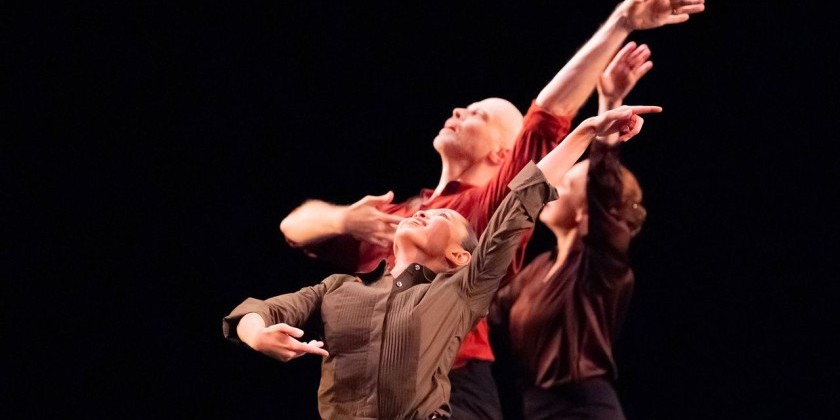
![IMPRESSIONS: Will Rawls' “[siccer]” at the Keith Haring Theatre at Performance Space New York](/images/features_large/20251119_WillRawls_siccer_PerformanceSpaceNY_WhitneyBrowne--55.jpg)