


Related Features

DAY IN THE LIFE OF DANCE: Marla Phelan's “Birth + Carnage” Threads Galaxies
IMPRESSIONS: Ashley Chen and Compagnie Kashyl at La MaMa Experimental Theatre Club

IMPRESSIONS: Jane Comfort at La MaMa Experimental Theatre Club's Ellen Stewart Theatre

By Robert Johnson
View Profile |
More From This Author
Published on April 16, 2026
Jane Comfort and Company. Photo: Steven Pisano
Jane Comfort and Company
Conception and Direction: Jane Comfort
Costumes: Liz Prince
Lighting Design: Amanda Ringger
Public Relations: Jennifer Lerner
Artificial Horizon (1983)
Text and Choreography: Jane Comfort
Music: Auchee Lee and Pamela Patrick
Performers: Liony Garcia, Paul Hamilton, Cori Marquis, Gabrielle Revlock, Darrin Wright, and Sarah Zucchero
Artificial Horizon was originally commissioned and presented by Dance Theater Workshop
Bites (1996)
Choreography: Jane Comfort
Music: Klimchak
Text: Newt Gingrich
Performers: Cori Marquis, Petra van Noort, Gabrielle Revlock, Harry Sukonik, Brandon Washington, Darrin Wright, Sarah Zucchero, Nancy Alfaro, and Jane Comfort
Bites was originally commissioned by Agnes Scott College and presented at the 91st St. Theater
The Gulf of America (World Premiere)
Choreography: Jane Comfort and Company
Music: Heather Christian
Song Track: Make me a Wave/From your Ripple
Wasteland* (*lyrics from TS Eliot’s “The Wasteland”)
Video Projections: Lianne Arnold
Dramaturgy: Anne Davison
Performers: Liony Garcia, Julian Grubman, Kenley Hardwick, Cori Marquis, Petra van Noort, Gabrielle Revlock, Kyle Sangil, Harry Sukonik, Darrin Wright, and Sarah Zucchero
Rehearsal Director: Luke Miler
March 19 - 22, 2026
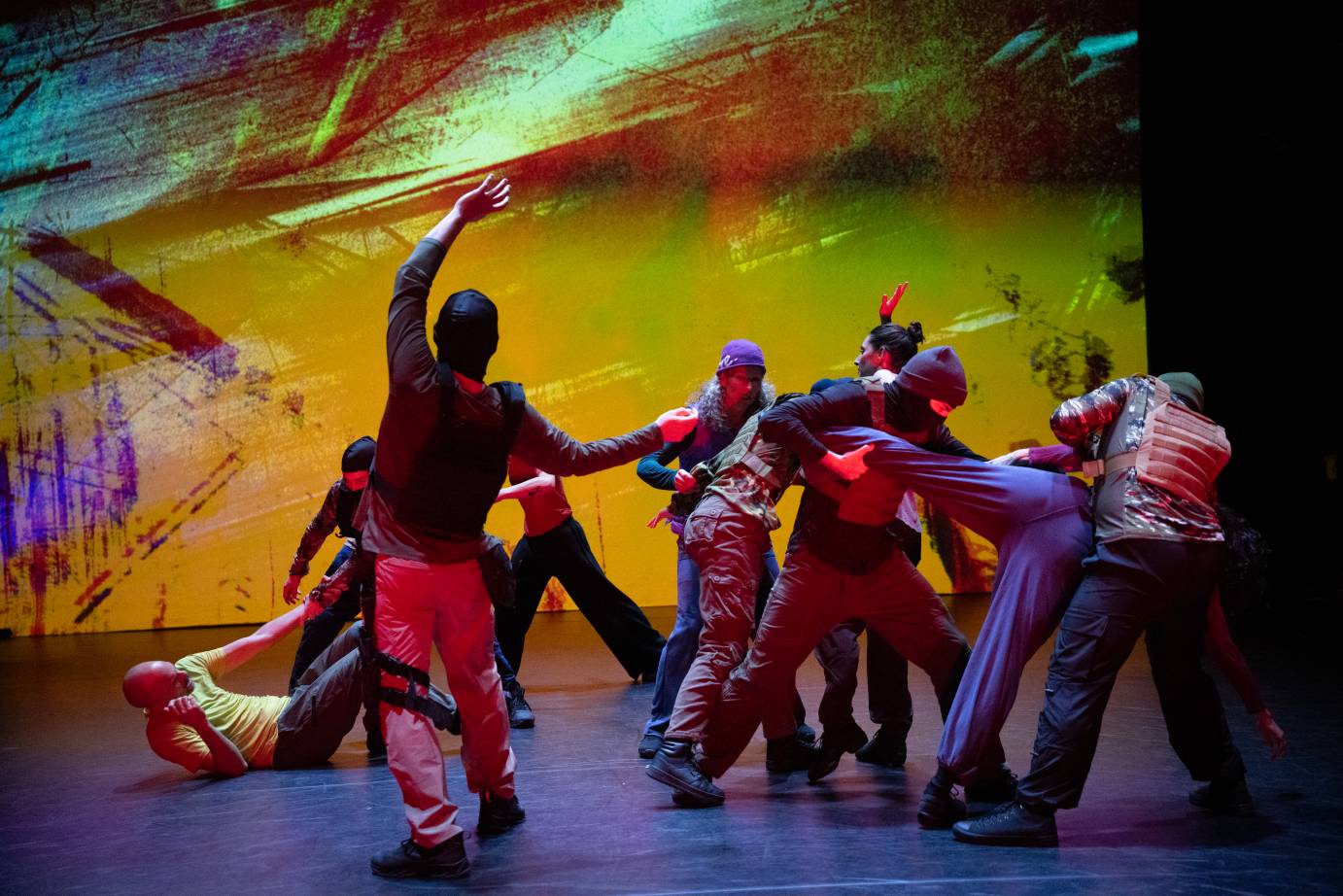
Frisky and irreverent, choreographer Jane Comfort makes no secret of her contempt for America’s decadent political Establishment. The Gulf of America, the premiere that her Jane Comfort and Company presented on March 19, in La MaMa ETC's Ellen Stewart Theatre, drew on recent events to portray a peaceful community assaulted by militarized police. The short, but mordant program also included Bites, a choice morsel of political satire from 1996; while an excerpt from Artificial Horizon (1983) recalled the Minimalist era of modern dance.
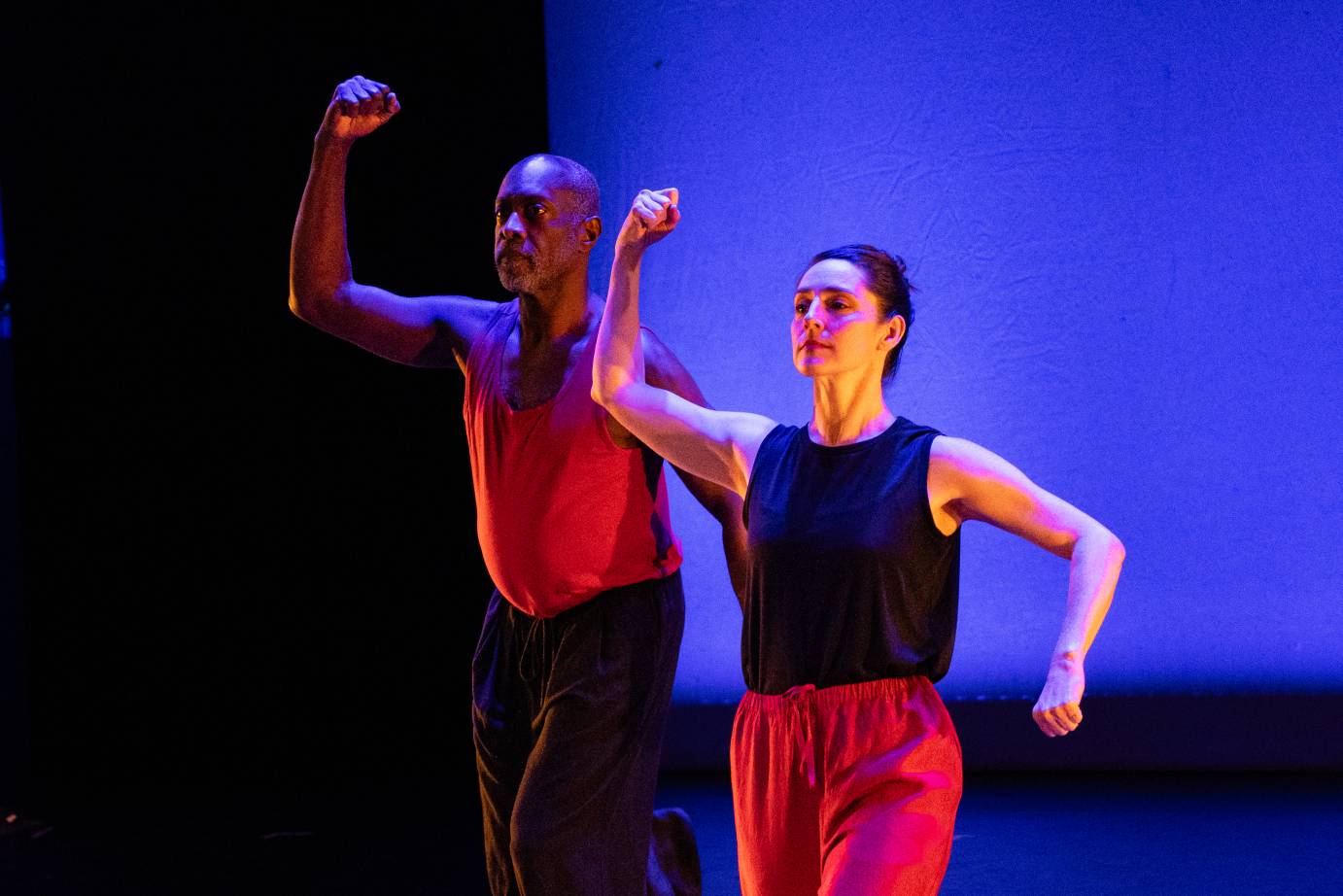
Paul Hamilton and Cori Marquis in Jane Comfort's Artificial Horizon. Photo: Steven Pisano
Drummers set the pace in Artificial Horizon, a playful exploration of rhythm that begins with Liony Garcia, Paul Hamilton and Cori Marquis standing at microphones downstage, and peppering the audience with repetitive phrases and gestures.
“That! What was that?!” one asks.
“It’s the weather,” another replies. And, more ominously, “It’s going to happen to you, right?” (As Comfort made this dance, the AIDS epidemic was spreading.)
Meanwhile, the dancers’ hands cut from side to side; and though their gestures are divorced from narrative, some look familiar. Palms up signifies a question they can’t answer. With one hand raised, they swear to tell the truth and nothing but the truth. Two hands raised is an armed robbery (“Stick ‘em up — I’ve got a gun”). After they back into the space, the rhythm infects their whole bodies. They wag their hips, and rock on their feet. They skip and prance, dancing parallel and following separate paths, scampering and filling the space.
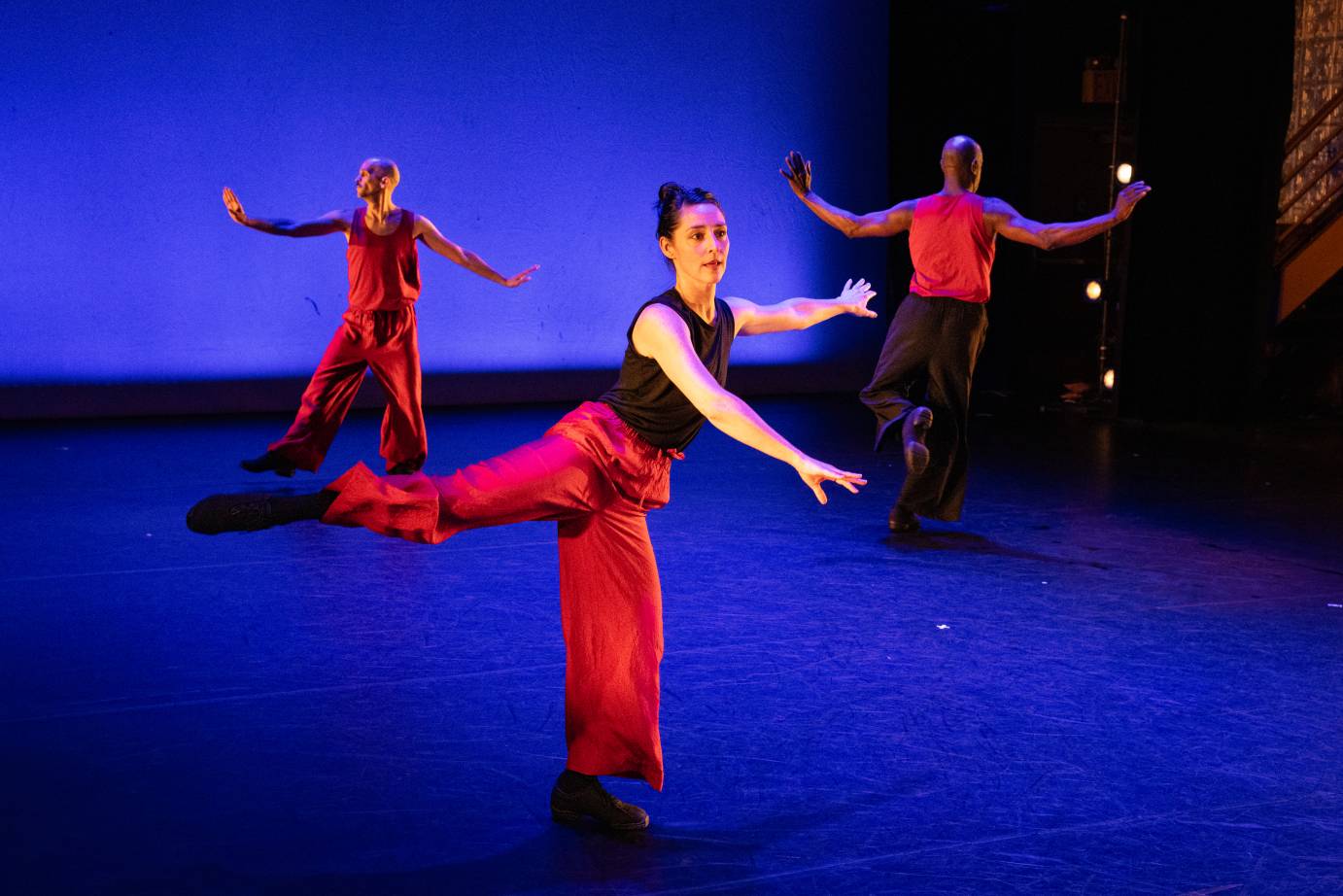
Liony Garcia, Cori Marquis and Paul Hamilton in Jane Comfort's Artificial Horizon. Photo: Steven Pisano
Three new dancers step up to the microphones, and begin giving orders: “Move this. Set that. Check this. Mark this.” Then, they, too, begin to travel. Skipping and dodging, they accent the movement with a sudden flinging gesture, or an arabesque. As the dance becomes increasingly buoyant, it carries us along on a satisfying current of rhythm. Couples manage to dance together without losing their independence. People circle one another warily. Then, the molecular structure of the piece appears to change; and the dancers fall into organized lines. A white light suddenly arrests them, flash-freezing them in silence.
Bites dates from a time — the mid ‘90s — when House Speaker Newt Gingrich led conservative Republicans in attacking welfare. Gingrich proposed a “Contract with America,” seeking to cut both taxes on capital gains and food for unwed mothers. If you missed that episode of our national soap opera, don’t worry. Gingrich’s ideas first emerged in the 19th century, when Puritanism mated with Social Darwinism giving birth to a misshapen philosophy that justifies cruelty and greed. That little monster is still with us today.
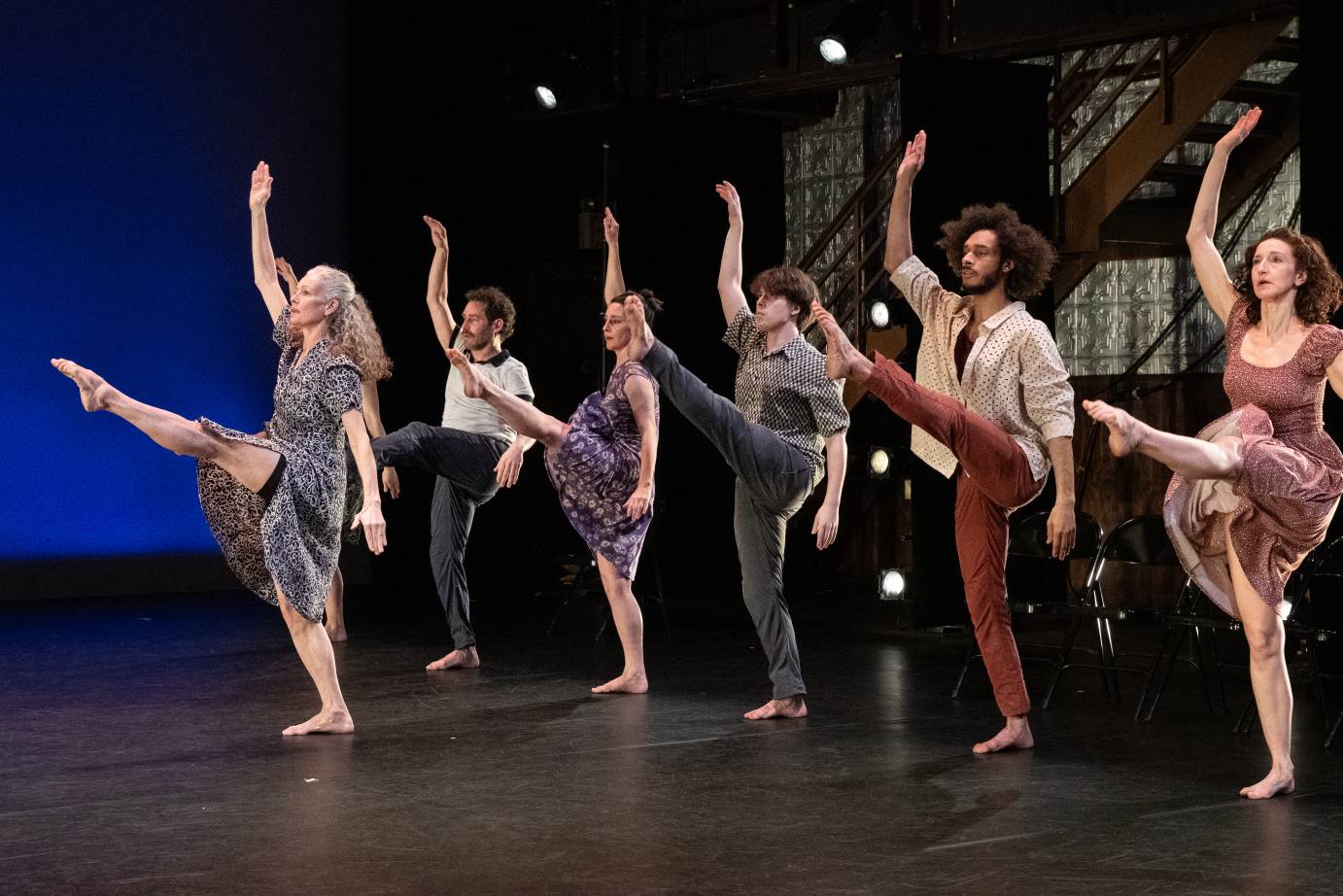
Petra van Noort, Darrin Wright, Cori Marquis, Harry Sukonik, Brandon Washington, and Gabrielle Revlock in Jane Comfort's Bites. Photo: Steven Pisano
In response, Comfort’s dance illustrates the problem of scarcity in a way that might thrill economic sociopath Thomas Malthus. Chairs line both sides of the stage, each row sufficient to accommodate the cast. There are enough seats for all.
As the dancers pass in waves from one side to the other, however, stage hands begin to remove the chairs creating an increasingly stressful situation. Individuals begin to scheme, hanging behind or stealing forward to grab a seat. One dancer installs himself on another dancer’s lap, and refuses to leave. Arguments ensue — first with the stage hands, and then in a general free-for-all. In a pathetic incident, Gabrielle Revlock falls and sprains her ankle. Darrin Wright, a Good Samaritan, helps her hobble along, but no one will give up his seat to her. She ends up riding on Wright’s back. Meanwhile, we hear Gingrich bloviate: “Why are we here? To sweat and to work!” Clearly, these people should all start their own businesses, if they want to sit down.
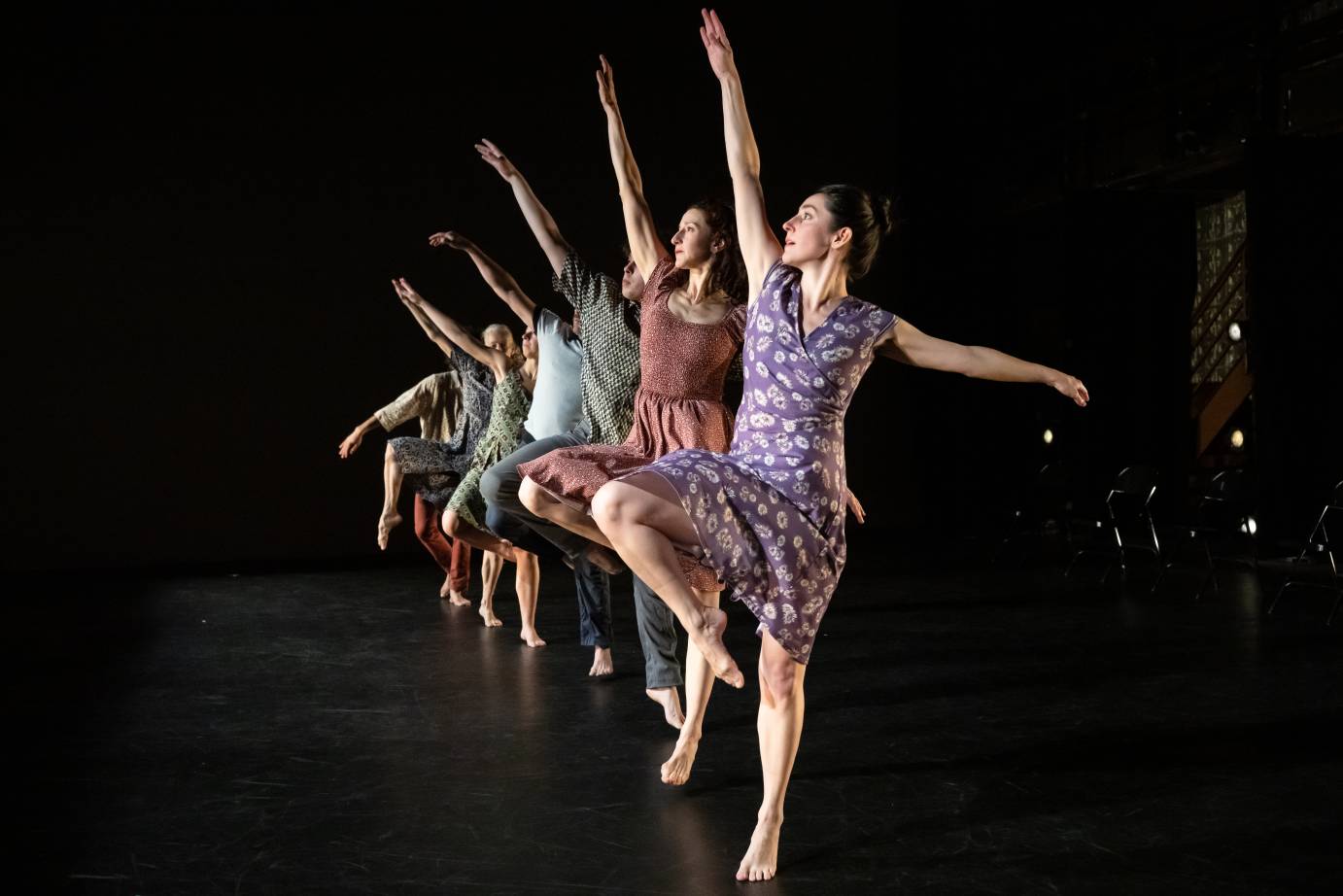
(Visible visages) Gabrielle Revlock and Cori Marquis in Jane Comfort's Bites. Photo: Steven Pisano
The key, of course, is understanding that the dire scarcity of chairs does not reflect the operation of natural laws. We are not witnessing natural selection, but artificial selection; and at some point, we should ask ourselves where all those chairs are going. Perhaps in 1996 Comfort was merely thinking of social programs axed, but more broadly Bite could illustrate an economic system in which banks make usurious loans that gradually suck the lifeblood from an economy. Bite is a humorous dance that encourages us to get serious, and take a closer look at our world.
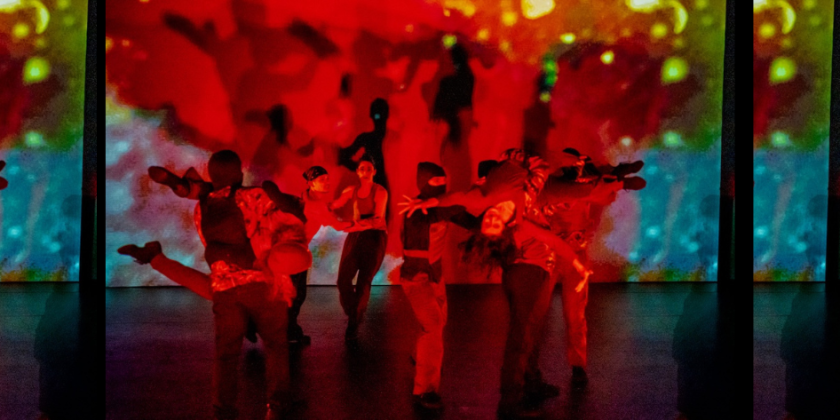
After this travesty, the new Gulf of America requires suspension of disbelief. We have just seen how dysfunctional our nation is, but now we must imagine a paradise waiting for Fascism to despoil it. As the piece opens, the cast goes about its business catching rhythms with a deft twist of one knee, or a lilting chassé step. We hear a piping voice, and birdsong. Dancers trade places peacefully, and form a snaking line. Gradually, the energy builds, and everyone is having a good time. Oppositions emerge, and then bodies fit together like puzzle pieces crossing and rolling over each other. The party could go on forever — Comfort will never run out of ideas — but, alas, someone is watching.
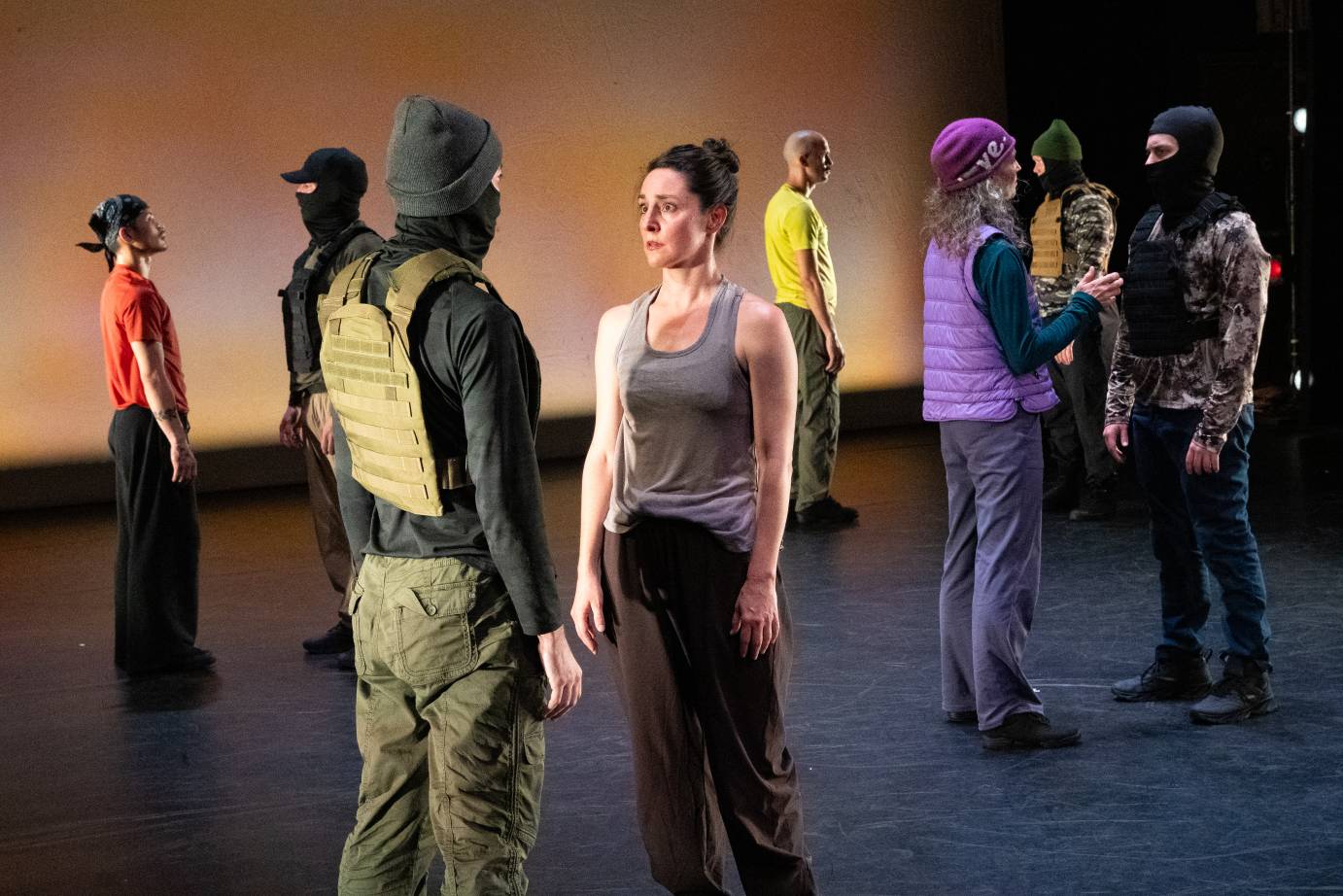
Signaling a change, a line of masked individuals in padded vests and combat fatigues forms downstage, shadows dirtying the backdrop. As they move in, first corralling and then dividing the dancers, we seem to witness the death of a living organism. From here, the piece descends inevitably into violence, as attackers and defenders go mano a mano. Because watching dancers pretend to beat each other up can’t compete with the fake violence in movies, the backdrop vomits lurid, scratchy patterns in yellow and red, and we hear a sound like the roar of an industrial beast. This scene is pathetic, and if it doesn’t have the melodramatic edge one might expect, perhaps it’s because Comfort doesn’t want us to experience hate (not even for the two minutes compulsory in Orwell’s 1984).
As the battle dies down, white-haired Petra van Noort pulls the mask from Harry Sukonik, her assailant, who grows sullen and retires. Unmasking the enemy is a great idea, but Comfort assumes that basic, human decency will then rise to the surface. Will it? We need to unmask our political leaders, not their foot-soldiers, and it’s far from clear that those in power have the emotional equipment to feel remorse, or even the ability, on their own, to halt their work of destruction.