


Related Features
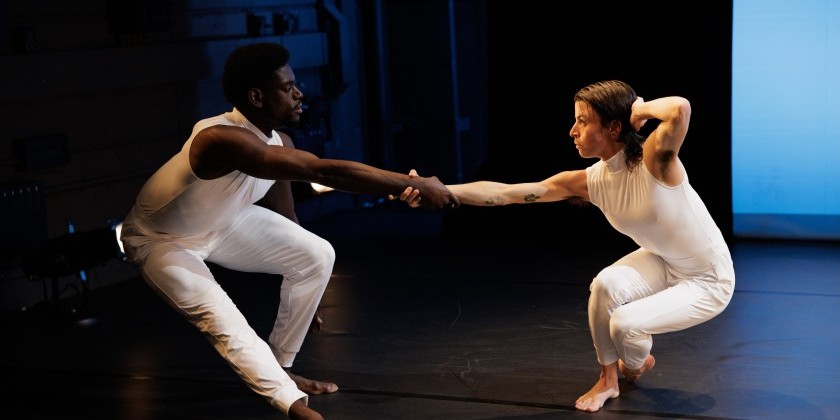
IMPRESSIONS: Jan Martens Presents "The Dog Days Are Over 2.0" at NYU Skirball
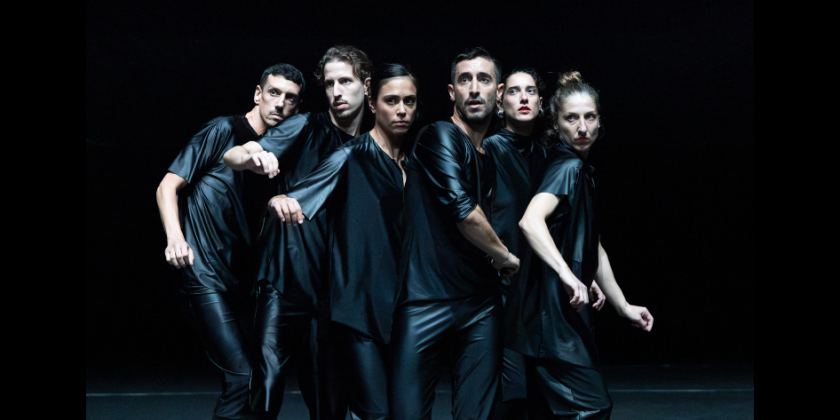
IMPRESSIONS: Trisha Brown Dance Company in “Dancing with Bob: Rauschenberg, Brown and Cunningham Onstage” at BAM
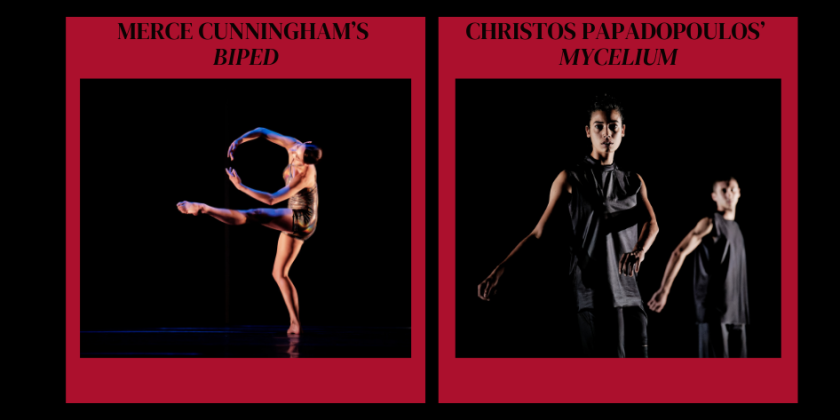
IMPRESSIONS: Lyon Opera Ballet in Merce Cunningham’s “BIPED” and Christos Papadopoulos’ “Mycelium”

By Sarah Cecilia Bukowski
View Profile |
More From This Author
Published on February 24, 2026
Lyon Opera Ballet. Photos: Agathe Poupeney
Presented by New York City Center and Dance Reflections by Van Cleef & Arpels
BIPED
Choreography: Merce Cunningham
Choreographic Assistants: Jamie Scott and Andrea Weber
Composer: Gavin Bryars
Lighting Design: Aaron Copp
Set & Holograms: Shelley Eshkar and Paul Kaiser
Costume Design: Suzanne Gallo
Dancers: Jacqueline Bâby, Eleonora Campello, Jeshua Costa, Maëlle Garnier, Paul Grégoire, Jackson Haywood, Marge Hendrick, Yeonjae Jeong, Almudena Maldonado, Éline Malègue, Amanda Peet, Ryo Shimizu, Alejandro Vargas, Kaine Ward
Musicians: Gavin Bryars (keyboard), Yuri Bryars (double bass), Audrey Riley (cello), James Woodrow (electric guitar), Caleb Burhans (viola)
Mycelium
Choreographer: Christos Papadopoulos
Choreographic Assistant: Georgios Kotsifakis
Composer: Coti K.
Lighting Design: Eliza Alexandropoulou
Costume Design: Angelos Mentis
Dancers: Jacqueline Bâby, Eleonora Campello, Noëllie Conjeaud, Jeshua Costa, Katrien De Bakker, Tyler Galster, Jau’mair Garland, Paul Grégoire, Jackson Haywood, Mikio Kato, Amanda Lana, Almudena Maldonado, Éline Malègue, Albert Nikolli, Amanda Peet, Leoannis Pupo-Guillen, Anna Romanova, Marta Rueda, Giacomo Todeschi, Kaine Ward
Saturday, February 21, 2026
These days we think a lot about dialogues of power between bodies and machines, often framed in terms of nature versus technology. But nature has always had technologies of its own — our bodies being among its array of spectacularly intricate organic machines — and to experience its complexities in operation through dance can be at once breathtaking, humbling, and confounding.
Lyon Opera Ballet’s double bill at City Center, presented by Dance Reflections by Van Cleef & Arpels, elicited such layered responses in the juxtaposition of Merce Cunningham’s rigorously faceted 1999 masterwork BIPED with the U.S. premiere of contemporary Greek choreographer Christos Papadopoulos’ darkly intricate Mycelium.
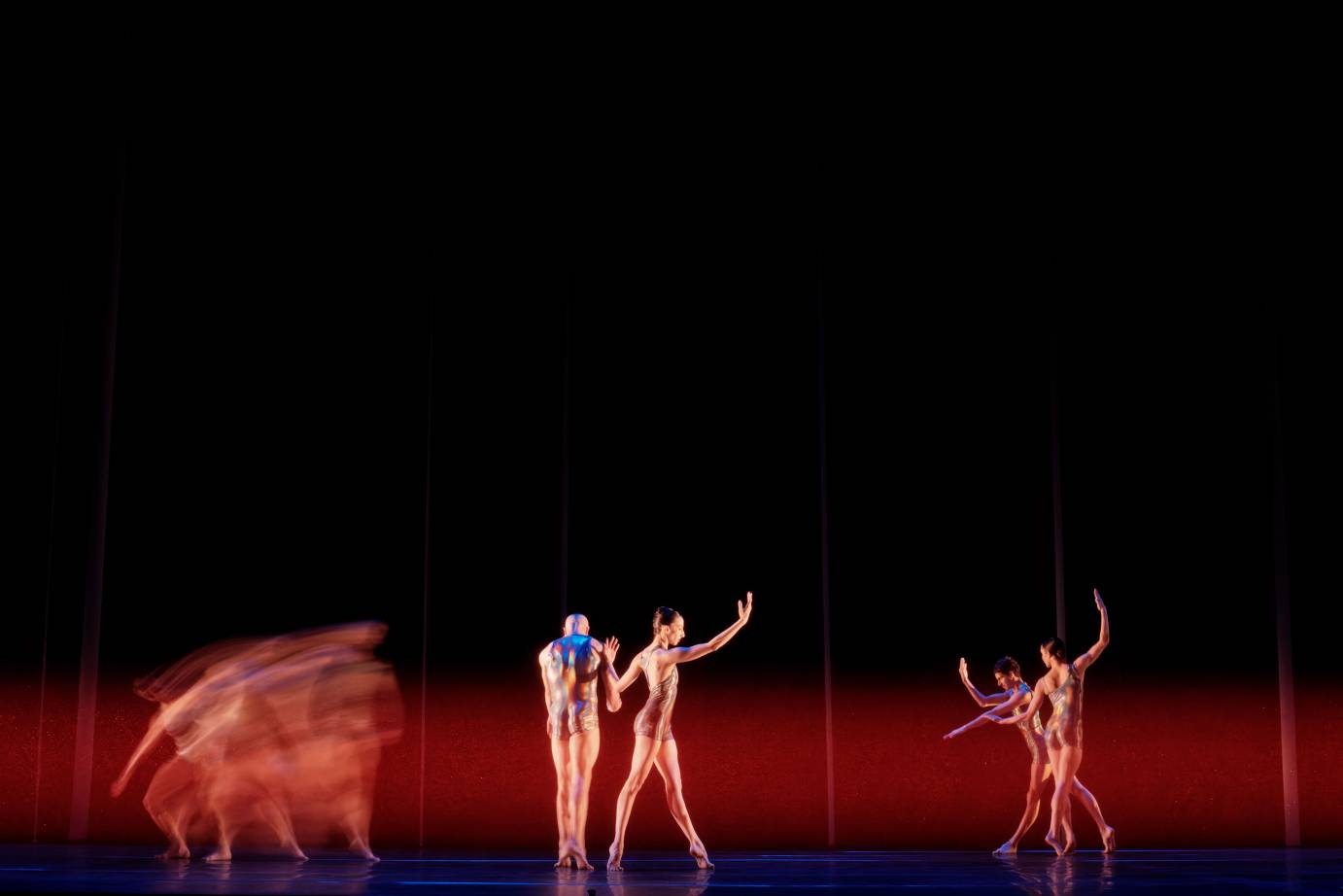
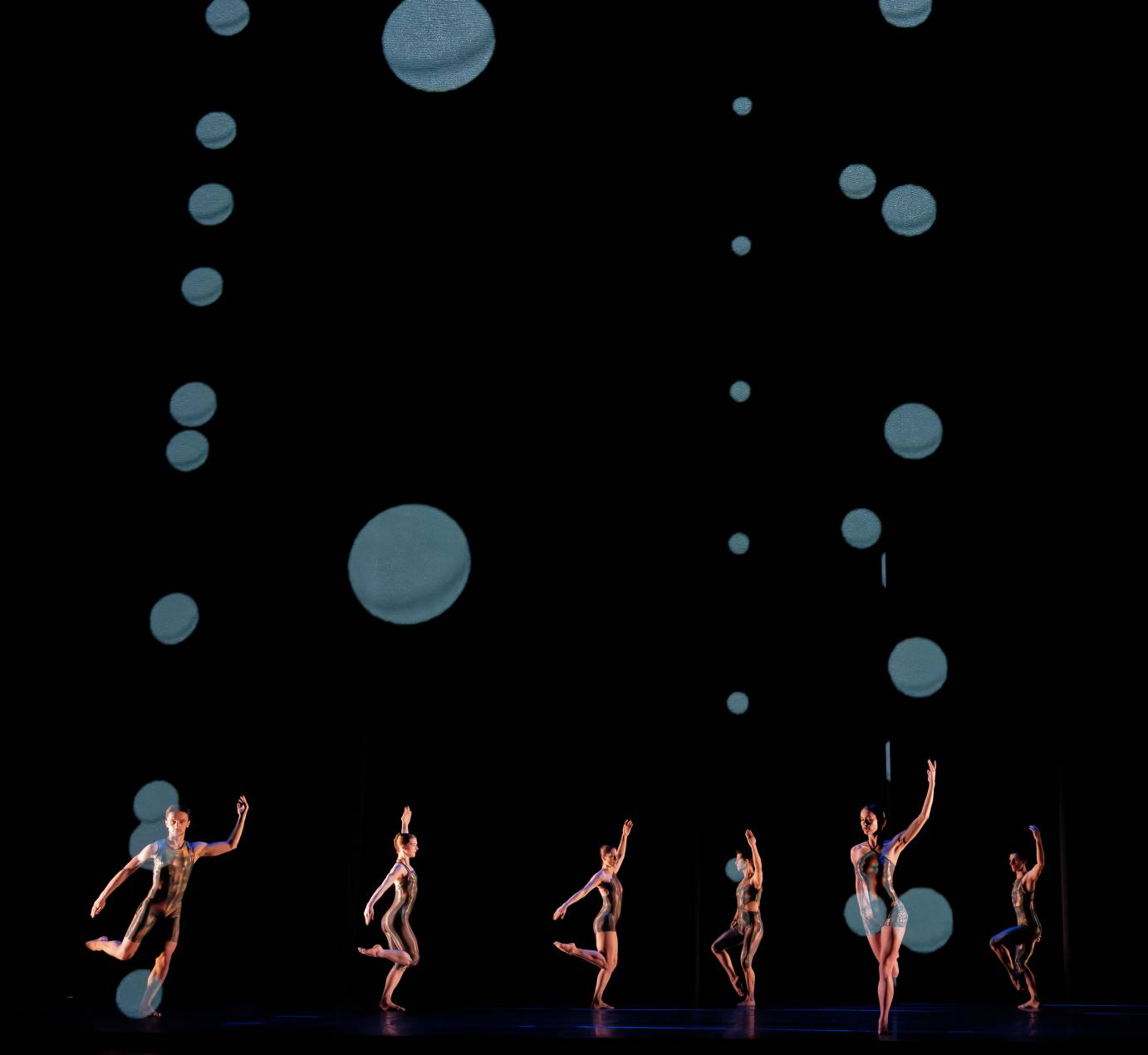
BIPED was revolutionary in its day for its layered use of technology: Cunningham used the 3D computer animation program DanceForms to develop phrase material for the work, and its design incorporated motion capture technology to project larger than life, abstracted holographic figures of dancers on a full-stage scrim in front of the stage. Together, these elements open new ways of seeing bodies in motion, and though their efforts are at times superhuman, the dancers remain supremely human in their endless physical potential and the sheer moral beauty of their fallibility.
Fallibility is key here. Cunningham’s work is, above all, about risk, and consequently, about failure. (Full disclosure: I attend Cunningham technique classes regularly and have danced in several repertory workshops and performance programs with the Cunningham Trust, including excerpts from BIPED — that is to say, I fail frequently, and by and large with verve, curiosity, and even glee. And I, too, have felt nervous and daunted in the face of Cunningham’s work.) So if the Lyon Opera Ballet dancers are not perfect, this is not only to be expected, it’s to be commended, particularly when risk is the animating feature of their failure. While this is not universally the case — only a handful among the cast of fourteen manages to fully inhabit the multidimensional range and depth of the Cunningham spine — the dancers approach the formidable work at hand with some measure of courage.
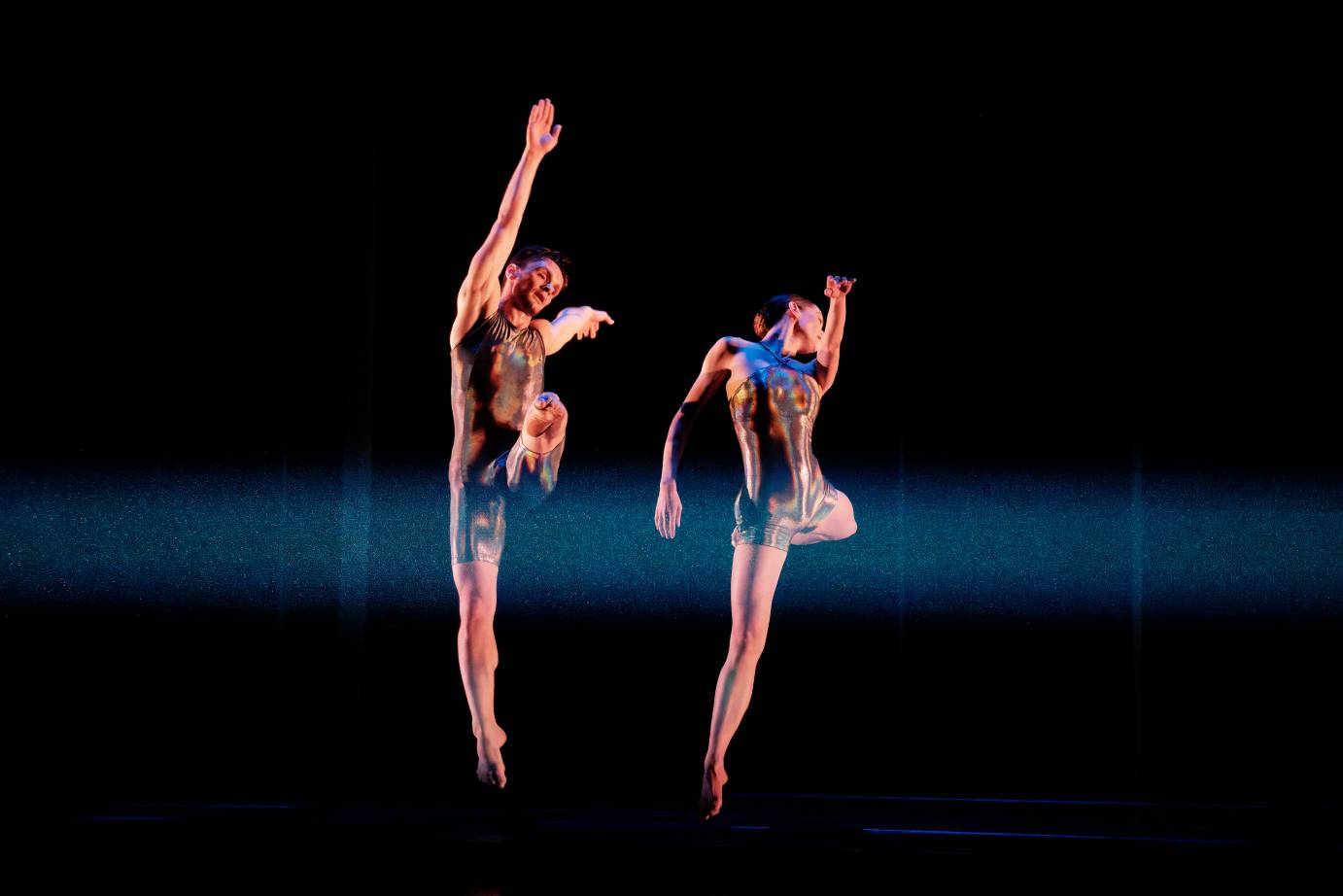
Courage is key as well: the courage to strive not for beauty, not for perfection, but for risk — and potential failure. Opportunities for failure crop up in abundance in the work’s utterly disjointed phrasework that breaks the body into independently articulable component parts operating on multiple planes and vectors simultaneously and in rapidfire succession. Limbs bristle at every imaginable angle, arms carried like antennae as legs take on striding triplets, jagged leaps, and deep lunges. The dancers flit about in Suzanne Gallo’s silvery iridescent unitards, hurtling and spinning through space to the plaintively hypnotic tones of Gavin Bryar’s score, played live by a quintet that included the composer himself on keyboard.
Flurries of solos spill into pairings that emerge and multiply into group sequences; twice, a line of five dancers appears from slits in the upstage scrim to execute dispersed unison phrases that highlight the precision engineering of difference over bland uniformity. Rhythmic rigor anchors the dance’s stuttering microstructures, with patterns and symmetries that rely on an accuracy of geometric intent — another element of Cunningham’s technique that might better hone the dancers’ approach.
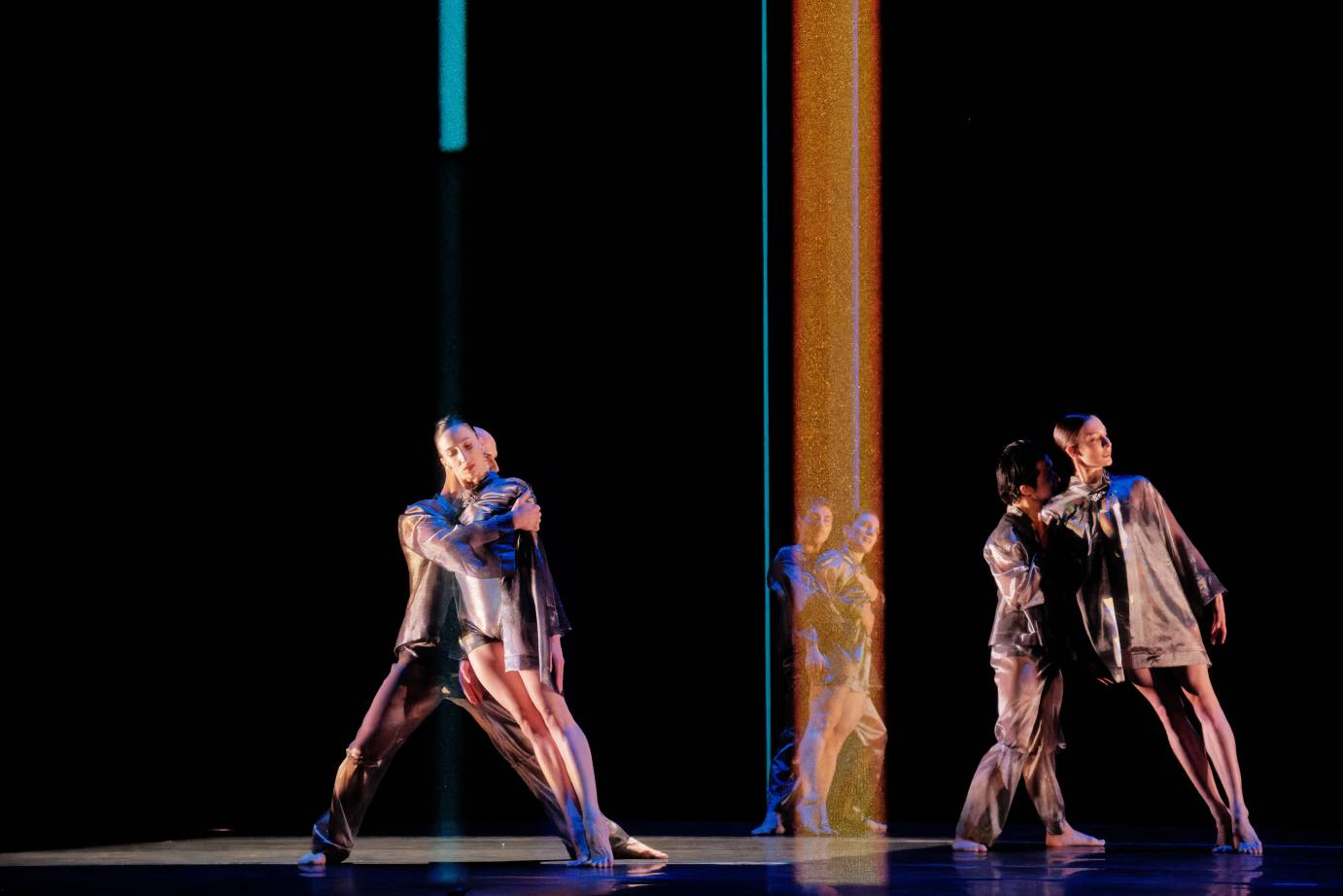
Along with this blizzard of kinetic invention, BIPED is perhaps best known for its set design components, created by digital media artists Shelley Eshkar and Paul Kaiser. The downstage scrim operates as a screen in the many meanings of the word: as a permeable boundary between performers and audience, as a surface for moving image projection, and in the way the screen is perhaps most ubiquitous to us today: as an interface. While the dancers don’t interact with their images, looking at the dance through the screen of the scrim becomes, perhaps unconsciously, an interactive viewing experience.
As the dance unfolds, it gradually transcends the initial impression of looking into an aquarium — awash in deep electric blue that pales at times to a stark, clear gray — and the projections, which often visualize dancers from impossible angles and ranges, subtly infiltrate the imagination. What might this dance look like from a bird’s eye view? What might it look like to a very brave ant crawling across the stage? What does it look like to the dancers themselves? Watching Cunningham’s work, as much as dancing it, is at its best an exercise in imagination, and BIPED continues to invite such wonder.
On the surface, Papadopoulos is worlds away from Cunningham in his approach to composing bodies and arranging space. While elements of his Mycelium are — again, on their surface — strikingly similar to his Larsen C, presented by the Powerhouse International Festival last October in Brooklyn, the choreographer deploys his visual and kinetic language to distinct ends in each work. Both are inspired by natural phenomena: Larsen C took on the climate change-driven breakup of an enormous Antarctic ice shelf, while Mycelium is something of a treatise on the intricate marvels of underground fungal networks.
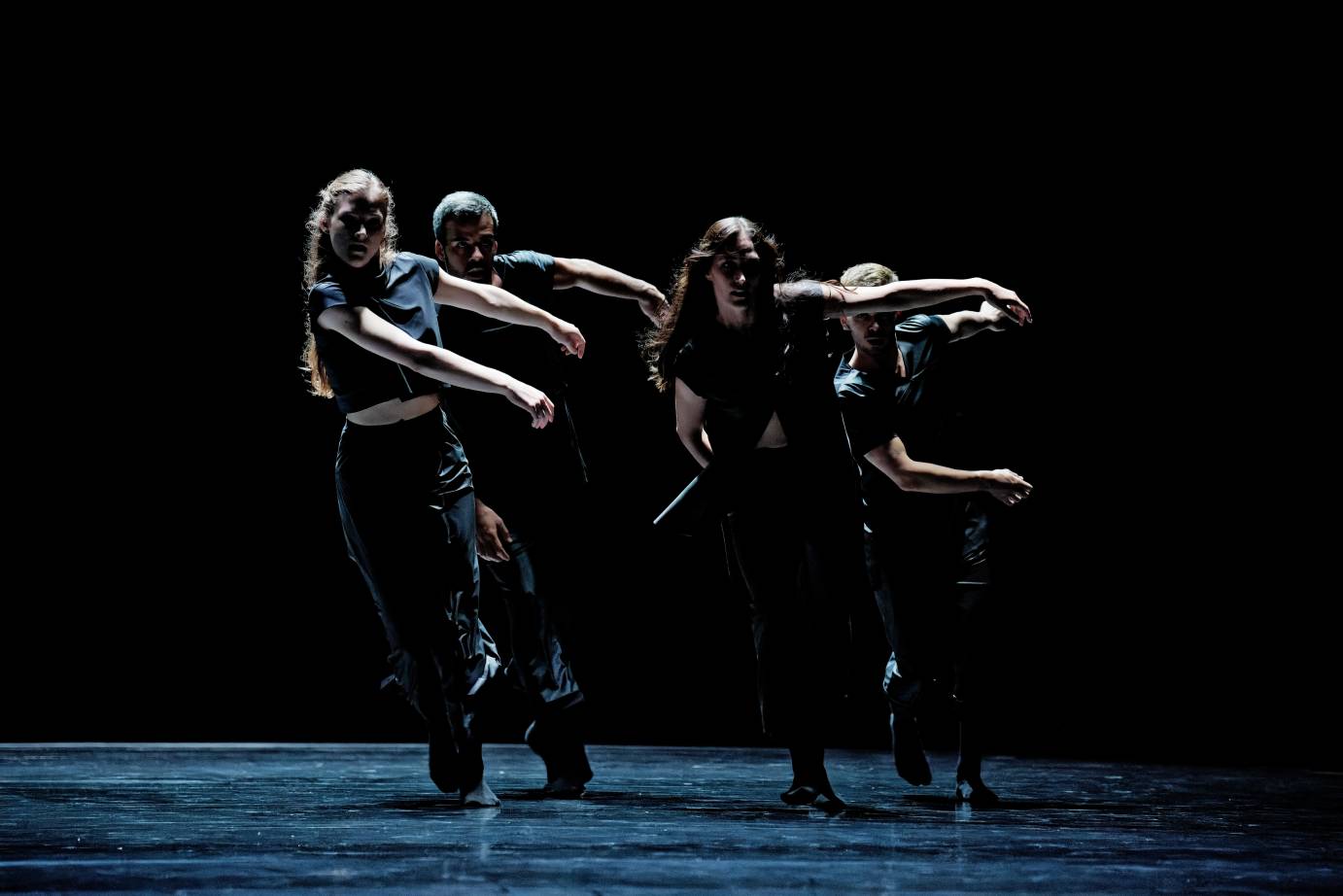
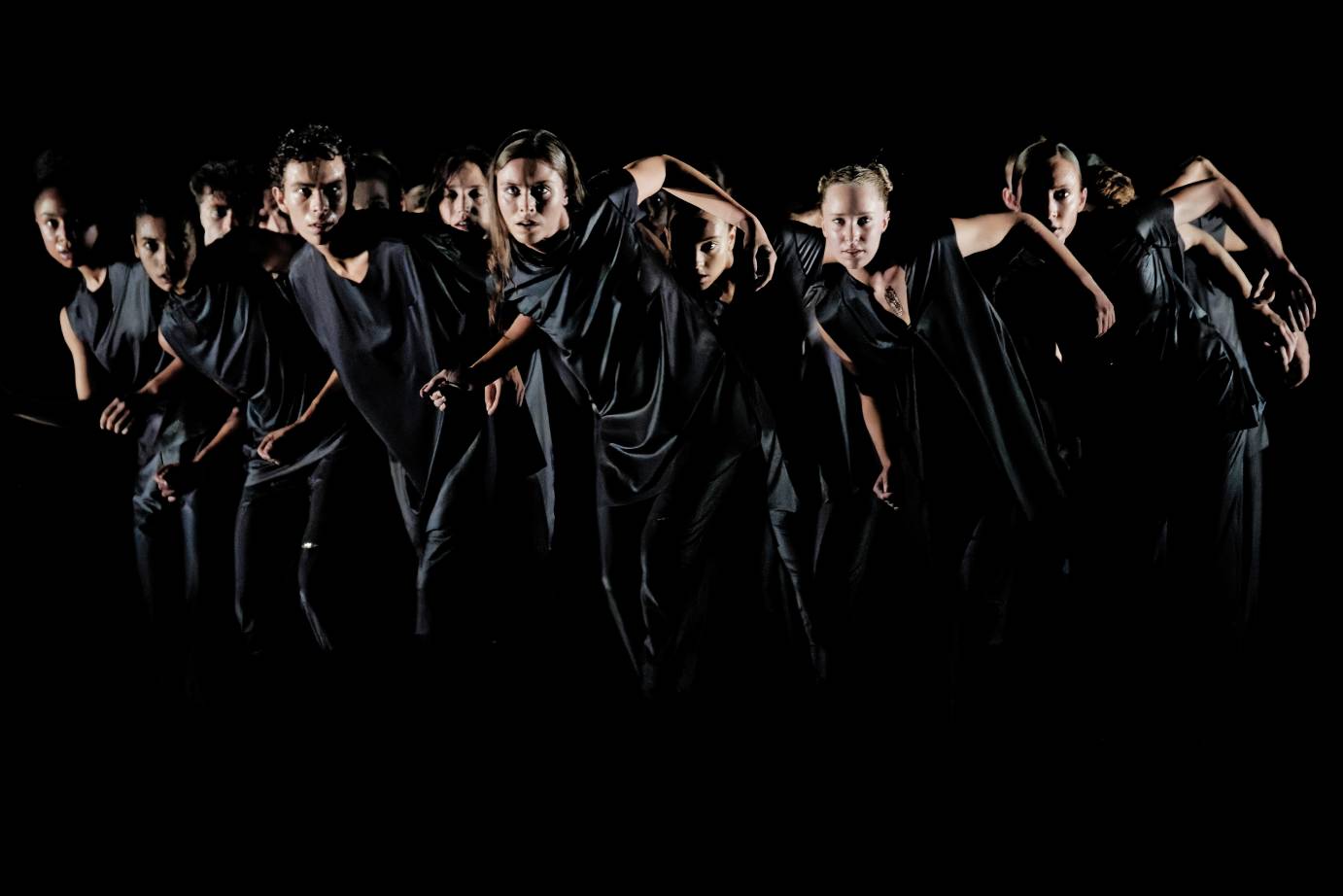
Lyon Opera Ballet in Christos Papadopoulos’ Mycelium. Photo: Agathe Poupeney
With a minimalist movement aesthetic and a penchant for black (of which this New Yorker does not disapprove), Papadopoulos’ mycelial world emerges from slow accumulation, repetition, and iteration — an emergence that demands no small measure of patience. Single bodies glide laterally through the darkness, their arms trailing from impassively frontal torsos that float over constantly shuffling feet. As they collide and cluster into a looming horde or surging flock, their movements are less muscular than cellular: meticulous and minute, requiring a deep collective knowledge of energetic origin and intent. The cast of twenty manages such coalescence as the work builds in complexity and breadth, though some struggle with the movement at its subtlest — those passages that most require that they each know precisely where the tiniest movement is coming from, how it travels, and why.
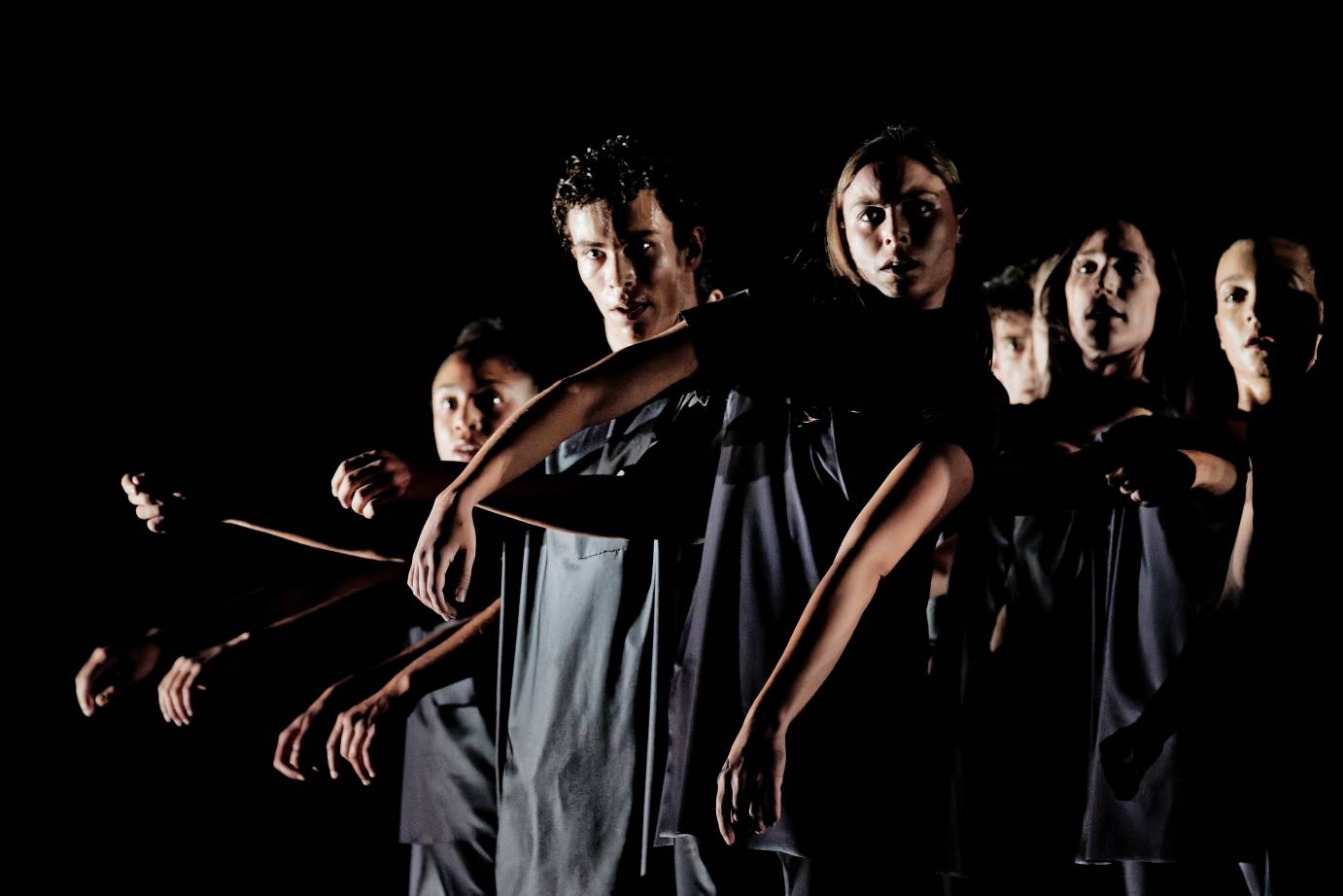
Mycelium’s arc becomes abundantly clear in the layered build of its movement language and sonic landscape, though less so in its visual components — shadows gather and disperse, dramatic side light estranges the planes of faces, a dark fabric backdrop billows wanly — but Papadopoulos and the dancers clearly carry a dramatic sensibility through the work. Together they become an organic machine: a system capable of complexity and collectivity, prone to slippage and disruption in its morphing patterns. While not a single foot leaves the floor and no hand rises above the shoulder, Papadopoulos is anything but limited in his invention at an uncommon level of detail that accrues with purpose into a larger vision. As the dancers rustle back into the elemental darkness from which they sprang, their spines undulate with persistent life: they are human, one and all — precious technologies unto themselves.