



Related Features
IMPRESSIONS: GRAHAM 100 at New York City Center (Part 2)
IMPRESSIONS: GRAHAM 100 at New York City Center (Part 1)

IMPRESSIONS: Martha@BAM—The 1963 Interview

By Robert Johnson
View Profile |
More From This Author
Published on November 19, 2025
Photo: Steven Pisano
Conceived, directed, and staged by Richard Move
Choreography by Richard Move in collaboration with the original cast members, Catherine Cabeen, Katherine Crockett, and rehearsal director Linda Hodes (1931-2025)
Company, Richard Move and MoveOpolis!
Performed by:
Richard Move as Martha Graham
Lisa Kron as Walter Terry
Catherine Cabeen and PeiJu Chien-Pott as Martha’s Company
Production Manager and Stage Management by Donalee Katz
Lighting Design by Donalee Katz
Scenic Video Design by Gabriel Barcia-Colombo and Robert Montenegro
Costumes by Pilar Limosner and Karen Young
Dramaturgy by Joshua Lubin-Levy
Properties by Christopher Boyd and Pilar Limosner
Hair and Makeup by Connie Fleming and Pia Guccione
Production Electrician: Colin Brown
Videographer and Assistant Editor: Ryan McLendon
Though she was ever so human, the late choreographer Martha Graham (1894-1991) was also a phenomenon. Her creations were milestones, her mind far-seeking, and she projected such striking originality that looking back on her achievements today, we feel overawed. In our smallness, perhaps the only way we can take Graham’s measure is through parody. Yet the Martha impersonation that drag artist Richard Move revived, October 28, 2025 in BAM's intimate Fisher Space, is much more than that.

Martha@BAM—the 1963 Interview, the latest iteration of an act Move has been tinkering with since the 1990s, recreates a conversation between the celebrated choreographer and dance critic Walter Terry, recorded at the 92nd Street Y’s Kaufmann Concert Hall, on March 31, 1963.
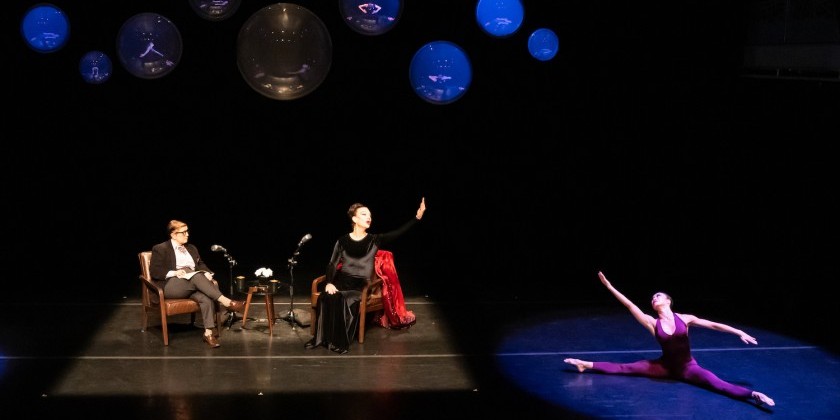
In Move’s redaction, Graham and her interlocutor are cartoon versions of themselves. Swathed in black, Move perches his husky frame on the edge of a chair and, lowering heavily shaded eyes, speaks in a purring baritone. Lisa Kron, as the excitable journalist in jacket and tie, sprawls in her seat and aims questions like darts. Yet paradoxically this cross-dressing duo draw us into Graham’s world, with its heroically scaled men and women entangled in psychic struggles. For Graham, the world was an epic battleground. For Move and Kron, it is meta-theater.

During their chat, Terry playfully coaxes Graham to reveal herself, while she tries to explain the inexplicable source of her genius. As they run down a list of famous Graham heroines from the Greek sorceress Medea to the foolish Empress of Every Soul Is a Circus, Graham tells us how she understands these women, but not exactly how she becomes them. She allows that each transformation represents “an infinite amount of suffering,” and “a terrific ordeal.” When one of the dark ladies of myth approaches her, at first, she turns away in fear.
Graham speaks of being seized or possessed, and of vibrating in sync with her characters. She achieves this vibration by probing her conscience until she achieves self-knowledge. “I know what it is to be jealous, very,” she admits, apropos of the spurned and vengeful Medea. “Everyone in life has tragic happenings. Everyone has been a Medea at some time.” Yet everyone does not murder her children in a paroxysm of bloodshed. In Graham’s view, Medea is not simply a jealous woman, and a practitioner of dark arts, but someone who will commit any crime to obtain power. “She was eaten by a terrible disease,” Graham says.

Revenge also motivates queen Clytemnestra, who feels justified in murdering her husband, and must review the events of her life to reconcile herself to dishonor. The incestuous Jocasta, in contrast, is an innocent victim of fate; and St. Joan is a mystic who in the dark interior of a medieval church looks up into a shaft of colored light and hears voices. Though caught in webs of tragic circumstance, all of these women, Graham emphasizes, have agency. They all make choices. “That’s… what life is about. It’s about the inner world of choice,” she says. Even the naïve heroine of Appalachian Spring chooses to commit herself, setting aside her fears and accepting the pioneer’s life of hardship out of hope for the future.
Passing from the sources of her characterizations to their embodiment in dance, Graham explains the use of her technique. Beginning in a place of meditative calm, and centering the body, the dancer prepares herself for flight. Her contractions may then express hatred or laughter. A leg may twist with rage, but the movement emerges from the dancer’s core and involves her whole physical being. The position of a movement within a phrase affects its meaning. Imagination is always present. When exercises threaten to become routine, Graham advises, “just think of yourself as dancing toward your own death.”
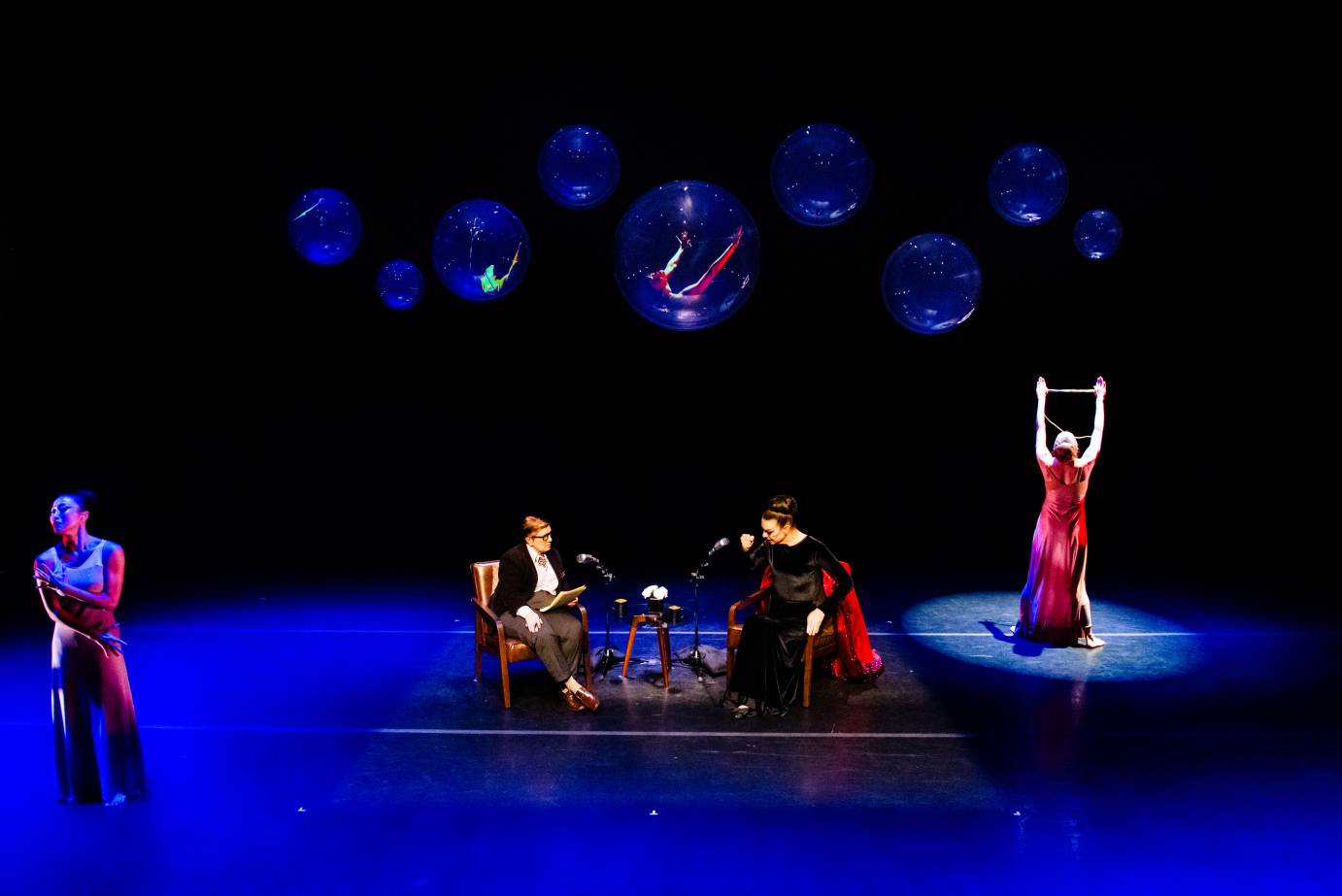
Drama infuses every aspect of Graham’s art. Yet, even so, this conversation would appear static if Move had not recruited two authentic Graham dancers to enliven the scene with their visceral performances. Catherine Cabeen and PeiJu Chien-Pott first appear as acolytes crowning Move’s outsize figure with their hands (and affirming Graham’s artistic stature). Then the two women take turns portraying the characters under discussion. Chien-Pott scrabbles on her knees and draws a wriggling serpent from deep within herself as Medea. As Clytemnestra, she wields a primitive axe, seeming to kick down doors as she advances. Cabeen assumes elongated poses that seem to connect heaven and earth, radiant in her stillness as St. Joan. Emerging from darkness to swirl around the interview taking place centerstage, these dancers seem to have issued from Graham’s thoughts.
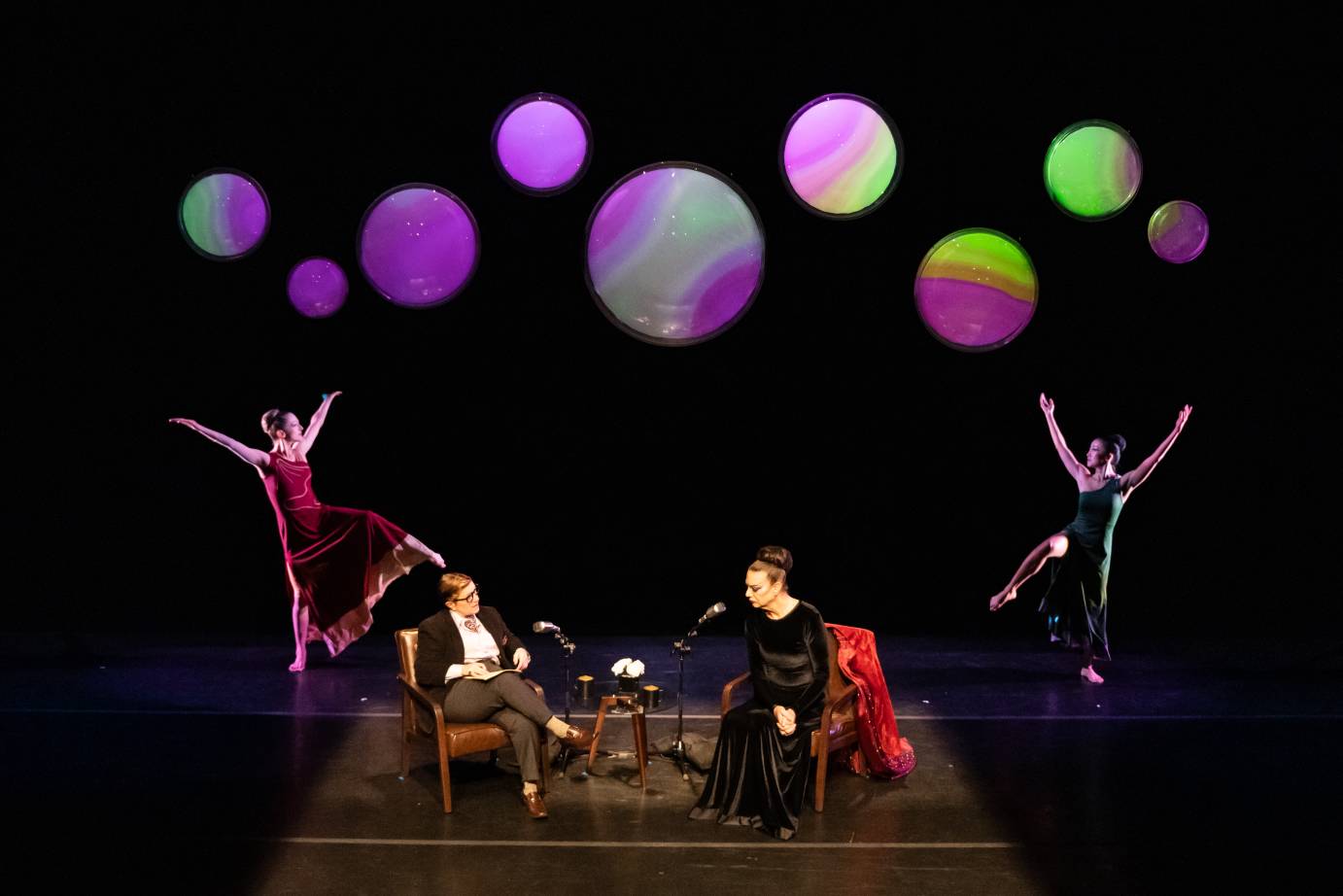
Indeed, the whole mise-en-scène of Martha@BAM points to the mind’s interior, where myths and memories loom large, and where desires express themselves freely. Above the set hang bubble-like screens in which more thoughts appear — stylized knives and coils of rope recalling Isamu Noguchi’s decors; and male body-parts illustrating Phaedra’s lustful obsessions. In this liberated mental space, Move and Kron’s ambiguous figures provide a dubious link to reality.
The approaching centenary of the Martha Graham Dance Company will give audiences a chance to experience Graham’s masterpieces directly, satisfying our need for heroes with performances of Night Journey, Chronicle and Appalachian Spring planned for the company’s April 2026 season at New York City Center. Related exhibitions, and a coffee-table book may also lead a new generation to Graham’s shrine. Yet Move, who, in a legal disclaimer, disavows any connection with the “Martha Graham Entities,” has made his own, significant contribution to the centennial. Experiencing Martha@BAM, we hear Graham’s words and feel her inspiration. Perhaps more importantly, we witness her power to obsess her followers, and catch a glimpse of divine madness.