


More Audience Reviews
A first look at Ingrid Silva's new work for Accent Dance NYC
Vinnie Jones' "The Truth and the Light"

AUDIENCE REVIEW: Ichhā
Company:
Barkha Patel Co.
Performance Date:
September 25-26, 2026
Freeform Review:
Barka Dance Co.: Ichhā
BMCC Tribeca Performing Arts Center
New York City, NY
++++++++++++++++++++++++++++++
Ichhā is an interdisciplinary solo work weaving original music, film, set design, garba and Kathak presented by Barkha Patel at BMCC Tribeca Performing Arts Center on September 25-26, 2026.
She begins alone, caught mid-motion in a single spotlight, in silence and stillness, commanding our attention. Then comes a silent clap: the anahata nada, the unstruck sound, heavy with meaning. The potentiality of an unrealized desire.
The spotlight stretches out into a corridor of light. Dressed in a plain cotton chaniyo and blouse, Patel garbas to nothing but the sound and rhythm of her own breath, building in speed and frenzy. From these opening moments, she makes it clear that Ichhā is not about the "prettiness" of dance or the "party" of garba but about unrealized desires. She turns both garba and Kathak toward personal, ancestral, and at times, difficult histories.
Upstage hangs a column of white cotton, lit from within, with a red cloth at its center. As the soundscape expands into muffled recorded voices and, eventually, Kathak bols, Patel pulls the red cloth down, drapes it over her left shoulder, and draws it along the corridor of light, creating a striking image. Whether those voices belong to her family hardly matters - they could be anyone's. Set against the white cotton, the red could suggest life, pain, blood, umbilical history, or marriage. The white fabrics are undecorated, lacking the abhla bharat (mirror embroidery) common across Gujarat. This restraint lets viewers interpret the imagery for themselves, free of exoticized, brightly colored tropes of India, while subtly nodding to Gujarat’s ancient cotton history.
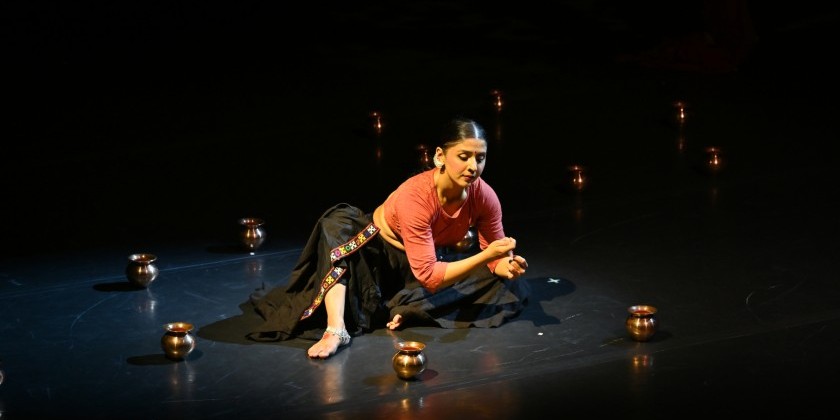
The white column lifts to reveal a scattering of garbhas (wombs). With similar undecorated, pedestrian movement, Patel aligns them along the corridor of light, then dances garba around and between them to "Tu Kali Ne Kalyani." Sung poignantly by Sushma Soma, the beloved song to Goddess Jogmaya had me garba-ing in my seat. Patel then settles center stage, amidst the garbhas, to enact the small rituals of daily life: oiling hair, rolling rotli, studying, and cleaning.
Then, a struck clap. The unstruck sound is finally realized, a desire given voice. A single, satisfying garba clap allows the signature sound of the form to finally ring out, commanding our attention once again. For a moment, nothing else exists. Kathak abhinaya follows - first reflecting that same satisfaction, then shifting into pain, a startled flinch, and an angry confusion.
The lighting widens into a large white circle as Patel gathers the garbhas into a pile downstage. Moving to the downstage-left corner, her Kathak footwork exhibits a visceral wrenching before returning to garba - this time with sounded claps, circling with a Kali-like energy. The garba clap has its own distinct life cycle - a beginning, middle, and end - and here, it lands with immense weight.
The piece closes as Patel lays the garbhas on the red fabric and ties them up into a potlo, carrying the desires of those who came before and our own. The lights fade to black as the slow strains of "Tu Kali…" hang in the dark.
Ichhā is rich with layers. Patel has clearly undertaken deep research into her ancestry and the concept of embodied, generational history. While the work speaks to the past, the garbhas also compel us to recognize that we are the ancestors of future generations and we, too, will leave desires unrealized. How will we be voiced? How will we be remembered or forgotten?
It is telling that garba was the form Patel instinctively chose to explore ancestral lineage - her ancestry is intrinsically linked with garba. Like all hybrid artists, she tests her parameters: Without the clap or the circle, is it garba? Without the chakars, is it Kathak? Which boundaries can bend or break while keeping the foundation intact? Seeing garba centered as the primary narrative vehicle after so many years was deeply satisfying, though the final circle could have run longer. Parijata Performance Projects presented a similar piece twenty years ago, in which I performed, and I have rarely seen garba carry a full concert work since.
Patel is a captivating mover and a highly trained Kathak dancer who also grew up dancing garba. She possesses clarity of line and lineage - a stillness, rigor, and a grounded technique. Hers is a Kathak body dancing garba and a garba body dancing Kathak - I could not tell where one ended and the other began, because both live in her body at once. Garba is her DNA and Kathak her bones; garba her soul, Kathak her heart.
Conversations about ancestral history can easily curdle into performative "trauma stories" or cloying celebrations of matriarchal wisdom. Ichhā was neither. It was an honest study of lineage through movement, rooted in both personal narrative and formal training. The result is a gratifying work that left me full, yet wanting more.
There is real potential in centering garba, a form seldom used as the primary narrative vehicle within a concert dance setting. In Patel's hands, this folk tradition becomes a powerful, sophisticated narrative medium. The delay of the struck clap is the right choice, and it pays off, but the final garba circle is over before it can fully bloom. The piece as a whole felt a bit long, and what it lacked was contrast: a longer sounded garba circle would have given the sustained gravity something to release into. Even if the brevity of the garba circle was deliberate, the length of the whole piece still needed that contrast. Garba's cyclical nature feels made for a piece about ancestry, which moves in a line from one generation to the next. Set against that linearity, the circle offers a rich dialogue: one form of time that travels forward and one that returns to where it began, each rooted in a distinct tradition and style.
Doing garba for longer would also give Patel a chance to use the space physically, to travel and claim the stage. And, personally, I simply wanted to watch her do garba as beautifully as she does and hear "Tu Kali Ne Kalyani" for longer.
The production grew out of Patel's CUNY Dance Initiative residency at BMCC Tribeca Performing Arts Center, with support from the Princess Grace Foundation Special Projects Grant and a NEFA National Dance Project grant. It was shaped by many hands: co-composers, musicians, filmmakers, vocalists, and lighting and set designers, who are credited in the program. This backing allowed her to realize a long-held vision with authenticity. In addition to financial support, dancers need artistic support and physical space, a literal bricks & mortar space, to ideate and build; grants like these are vital to New York's dance ecosystem, ensuring that work of this caliber finds its way to the stage.
Ichhā is a deeply felt work. In future iterations, a longer garba circle would complete it; or an ensemble might expand it, setting garba's communal circle against Patel's solo performance (though a piece this rooted in one woman's lineage may resist that). Either way, Patel has given us something necessary: a work that honors where we come from while stepping boldly toward where dance, and we, can go.
Author:
Aditi Dhruv
Photo Credit:
Sarabjeet Matharu