



More Audience Reviews

A first look at Ingrid Silva's new work for Accent Dance NYC
Vinnie Jones' "The Truth and the Light"
AUDIENCE REVIEW: LoCo Dance Company Generates Kinesthetic Empathy with "WAKE UP"
Company:
LoCo Dance Company
Performance Date:
5/31/26
Freeform Review:
Our flesh-and-bone existence defines the human condition. Beneath the skin, we are wired for animation. Rhythm beckons our senses, and our limbs intuitively respond. Our body’s burning desire to succumb to sensation is both our vulnerability and greatest strength because, after all, we are creatures driven by our insatiable urge to move.
Louise Coleman’s WAKE UP taps into this primal impulse by surrendering to the beat and allowing the body to embrace its most raw and unfiltered instincts. Through contrasting movement textures, theatricality, gestural storytelling, and rhythm-driven choreography, Coleman weaves a sensory experience that hopelessly intertwines the body and the beat; reframing dance as the purest expression of what it means to be human.
On Sunday, May 31st, choreographer Louise Coleman debuted her company, LoCo Dance Co., premiering WAKE UP at Gibney Agnes Varis Performing Arts Center. The evening-length work immediately pulls the audience to the edge of their seats, attempting to untangle the writhing mass of snaking silhouettes with their eyes. The rising and falling clump unravels into a circle on the red-lit stage, guided by the soft voices murmuring in Raja Kirik’s “Phantasmagoria of Jathilan”. Traveling through a movement gradient, the dancers emerge from the ground, evolving from faceless silhouettes into recognizable humans. This transition ruptures a kaleidoscope of textures, shapeshifting from liquid to sharp, hard-hitting dynamics, ignited and unapologetically tethered to the beat drop.
The dancers shamelessly embrace the rhythm with a satisfyingly raw, animalistic quality, indulging the audience with their intoxicating groove. At one point, breathing becomes the inciting action, accumulating energy and emphasis until the dancers' gasps course through them in a full-body chain reaction. This moment prompts the audience to consider the uncanny resemblance between our heartbeat and the drum break, suggesting the beat is inherently human: a universal rhythm pulsing inside each of us.
Simple, recognizable gestures, everyday interactions, and pedestrian activities serve as touchstones for progressive phrasework, rhythmical movement patterns, and storytelling development. The dancers portray mundane scenes– drinking tea, peering through binoculars, enduring audience laughter, and eating cereal– embodying a multi-dimensional view of the human experience. Alongside these gesturally-driven narratives, Coleman incorporates movement sequences from social and cultural dance traditions, further depicting dance’s role in fostering community, communication, social connection, identity, and cultural expression.
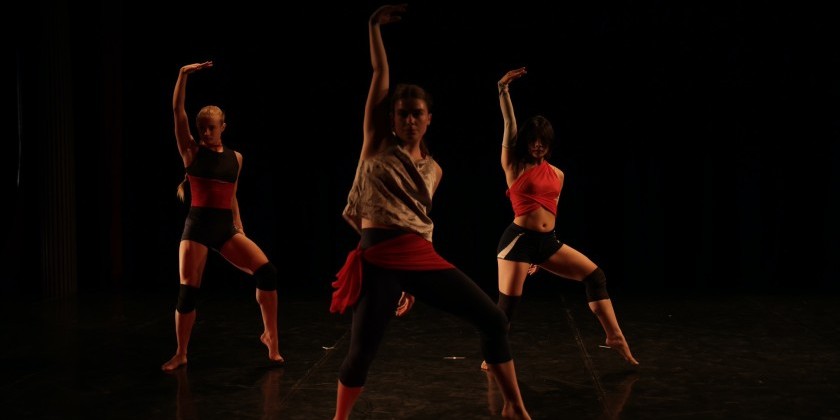
This exploration extends to the simplistic but effective costuming, styled by Coleman in collaboration with the company. Each dancer models a unique collage of earth tones across layered fabrics, fitted half-sleeves, and wrapped scarves, each featuring a distinct pop of red. Their costumes take on greater significance as they assemble downstage, striking poses at varying levels in a horizontal line. Cycling through this strike-and-pose routine, the dancers seem to travel through time. They slip between abstract reinterpretation of static figures from early cave paintings and Egyptian hieroglyphics to story panels etched onto ancient Greek urns, before arriving as modern-day models posing for billboards and at the end of a catwalk.
This moment strikes the audience with a realization of what the piece has been building all along. Through merged timelines layered with narrative fragments, we see how the body’s response to the beat through dance remains timeless, a token of the human experience. Through the rise and fall of civilizations– in each stage of captivity, rebellion, celebration, and rebirth– dance exists as the defiant voice of freedom, shaping history, culture, community, and connection in its path. Coleman matches the pounding in our chests to the beating bass to generate kinesthetic empathy. She encourages us to contemplate our human similarities by embracing the deepest part of our soul that longs to dance.
WAKE UP cultivates awareness and offers a sense of hope. It leaves us to wonder if dance is the anatomical voice we share; perhaps we have more in common than what divides us.
Author:
Lilliana Miller
Website:
https://lillianamiller.weebly.com/
Photo Credit:
(L-R) Lilly Lorber, Haley Mitchell and Marissa Chen. Photo: Audrey Skodis