


More Audience Reviews
Harry Styles’ Together, Together Tour at Madison Square Garden
200+ Dancers Audition for Scholarships & Awards in San Diego
AUDIENCE REVIEW: SHINDIG
Company:
Forza Dance
Performance Date:
November 14th, 2026 7pm
Freeform Review:
“SHINDIG” by Forza Dance
Photo Credit: Shoji Van Kuzumi
Venue: Ailey Citigroup Theater
Founder/Director/Choreographer: Michaella Barron
Performers: Gabrielle DiNizo, Araya Morris, Maddy Hall, Micah McKee, Gabriel Sharp, Margarette Bernal, Connor Tapp
Resident Composer: Quinton Nening
Original music: Quinton Nennig and Luisa Bressan
Live Music: Quinton Nennig (piano) Anton Kot (drums) Wangshu Xiang (cello) Grace Belsie (violin)
Lighting Design: Nicole Boldig
Costume Designer: Jenna DiPaolo
Stage Manager: Danielle De Vito
Reviewed by Richard Sayama
Forza Dance’s 2026 iteration of their annual “Shindig” was a true testament to the company’s strength and resilience. I have much gratitude to Forza Dance for its five years of service and contribution to New York City’s community. It was touching to see Founder, Artistic Director, and Choreographer Michaella Barron bring her work back to the Ailey Citigroup Theater, where she studied at the Ailey/Fordham BFA Program. Alongside Gabrielle Dinizo, who has collaborated with her since their undergraduate days, Barron’s continued commitment and passion to her craft has made Forza Dance a driving force in the contemporary field.
DiNizo, Araya Morris, and Maddy Hall have always been foundational pillars of Forza Dance through their extraordinary athleticism and storytelling. Margaretter Bernal, Connor Tapp, and Gabriel Sharp each bring their strengths and artistry to the company in their first season that greatly expanded the potential and imagination of Barron’s work.
The performance begins as Barron takes the stage to greet us. DiNizo lays face down center stage in a white unitard, bringing a sense of peculiarity and comedy in juxtaposition to the casualness of Barron’s remarks. Barron then traces a green line with a marker on DiNizo’s body and leaves the stage. This quirky scene sets the tone for the entire evening, offering a casualness. I also gather the feeling that Barron’s work will hint at unspoken, hidden messages which bring counter perspectives to what is presented on the surface.
DiNizo’s engaging solo reflects Forza Dance’s vibrance and celebration of live art: “Welcome” (2025) energizes the space with quirky, sporadic movements complemented by driving music. During the solo, DiNizo, with a box of markers, asks us to choose what color she should use to self inscribe onto her white unitard. This gesture encourages us to actively engage in dialogue with what is occurring on stage, enriching our spectatorship. Audiences chose blue, brown, and black markers which DiNizo then used to illustrate on her body within the choreography; a visual manifestation that is unique only to our performance and experience.
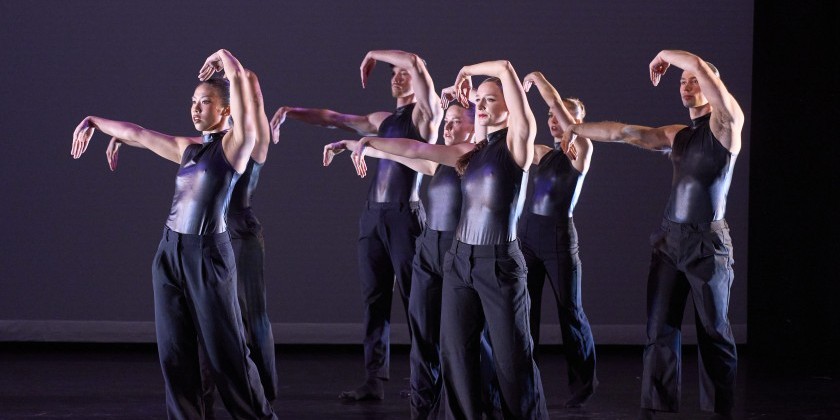
“Intuitiva” (2023), a full company piece, featured the seven dancers wearing black, fitted costumes alongside eerie techno music composed by Luisa Mei Bressan. The piece was rooted in structured choreography and spatial designs that felt methodical and mechanical. It brought me great relief to hear the dancers’ audible breaths towards the conclusion. A repeating, tender gesture of the hand reaching the heart and stomach also brought optimism within the work’s tension. I am curious to see an expansion on “Intuitiva” which further elaborates on the negotiation of intuition and imposed expectation. I yearned for the choreography to offer what inefficient movement can look like and how it exists in juxtaposition to the beginning.
The excerpt of “La Malmignatta" (2024) was one of my highlights of the night. Eerily and masterfully played by composer and pianist Quinton Nennig, I witnessed four dancers metamorph into spider-like creatures, often staying low to the floor and mobilizing in space on all limbs. The musical composition using the eight notes of the octanic scale is a satisfying enhancement of the recurring symbols of eight. I found myself yearning to witness the full evening length of “La Tarantella”.
Unlike the previous pieces, “What Should the Title Be” (2022) stands out because it is choreographed with few direct interactions between the five dancers. Each performer seems to be in their own world navigating their own distress. The baggy clothes on each dancer masks the defined topography of the body that has always been accentuated through tighter costumes before. The stretching and pulling of the shirts made me personify the costumes. Rather than seeing just five dancers, I began to see five dancers performing a duet with another part of themselves. Barron successfully and skillfully physicalizes the inner struggle that we carry beneath layers of fabric and thoughts.
“Someday my pain…” (2023) was a refreshing change, a duet negotiating space and support. Micah Mckee and Connor Tapp eloquently exchanged weight, even when the choreography itself is not romantic or tender with care. The music by Bon Iver carries a sorrow and subtle anguish that further defines the dancers’ narrative. I’m curious what would happen choreographically if the music was less narratively driven through melody and lyrics. The words felt a little too prescriptive that distracted from the choreography’s capacity to transmit enough information of Tapp and McKee’s relationship. I believe opportunity exists for the music to inhabit another element without overlapping with the choreography.
The last piece before intermission “The Truth, Apparently” (work-in-process) was another highlight of the night. This soon to be evening length work questions the power of truth. Beautifully accompanied by Nennig (Piano), Wangshu Xiang (Cello), Anton Kot (drums), and Grace Belsie (Violin), the piece begins with a series of seemingly random events that chaotically swirl in and out of space. Like a movie revealing hints of what happens, the piece settles to what seems like the chronological beginning.
Tapp, who embodies a character of leadership and authority, stands at a podium and addresses his six followers. The followers are infatuated by his mini tap performance and seem to accept whatever he says as the absolute truth. However, I was surprised to see the dancers showing signs of disdain and disrespect after Tapp leaves the stage. Their costumes of red and black hint towards a secret behind the facade that is performed for each other. At one point, DiNizo is given a large pencil, a symbol of power and truth. The ability to document something reflects the power to transmit knowledge.
“The Truth, Apparently” questions and illuminates constructivist theory where truth is determined by human practice and power structures. This fight for power is theatricized with the fight for the pencil. Later, each dancer comes on with their own envelopes with a letter written on it. Reluctant to reveal their envelope to others, the dancers dynamically dance Barron’s choreography that consists of captivating spatial and kinesthetic architecture. The secrecy of the envelopes also brings into questions like, “What happens when you withhold information?” or “How do you behave differently when possessing the pencil?” Overall, the excerpt of this evening length creates a strong foundation for further inquiry on the subject of truth and information.
The night ends joyfully and playfully with Forza Dance’s infamous “Pump up the Jam” (2023). I first witnessed this piece in 2023 and thought it represented the company’s core beautifully. The fun, energizing choreography and absurdity of some jokes all using the motifs of jams makes the piece that much more memorable. The dancers at one point bring out bread and jam for the audiences to activate their smell and taste sensories making the piece an immersive and uplifting party; a perfect example of what a shindig is.
Forza Dance is composed of creative, generous artists that are all aligned in the company’s mission of bringing people together through empathy and joy. Their mission radiates through their three core programs: 5 for $5 class series, BLOOM: Emerging Artist Festival, and Shindig. I’m curious if this generosity can sometimes be too instructive in the way an audience engages and witnesses their work. In the consideration of making dance accessible to a wider range of audiences, I fear that the choreography gives too much context that doesn’t allow audiences to generate meaning for themselves. It’s not the meaning itself that is important, but the process of inquiry and dialogue that an audience experiences when watching a dance. It’s ironic how the last piece, “The Truth, Apparently” has the intention of audiences creating their own narrative to interpret the scene. However the choreography and theatrics direct the audience to view the piece through selective lenses. I encourage Barron to trust both the choreography and the transmission of its data to audience members. There’s beauty in lost communication because it allows for new interpretations to emerge.
I highly encourage any prospective collaborators and supporters of Forza Dance to consider donating their thoughts, time, energy, money to further sustain the longevity of this company. Barron shared with me that she wishes that her company can have more access to resources that would allow her to dive deeper into choreography and process. I’m confident that these resources will propel Barron as an innovative emerging choreographer that can have a profound impact on communities that have the privilege of encountering Forza Dance.
Author:
Richard Sayama
Website:
richardsayama.com
Photo Credit:
Shoji Van Kuzumi