


AUDIENCE REVIEW: “Rabbit God: A Queer Chinese Fantasy”
Company:
Jiemin Yang
Performance Date:
November 19, 2026
Freeform Review:
“Rabbit God: A Queer Chinese Fantasy” by Jiemin Yang
Choreography: Jiemin Yang in collaboration with dancers
Venue: Culture Lab LIC
Concept & Story: Jiemin Yang
Dancers: Carl Ponce Cubero, Chieh Hsiung, Gabriel Sharp, Jacob Kurihara, Maya Lam, Tsubasa Nishioka, TJ Warren, Haitao Yang
Dramaturg: Truth Future Bachman
Composer & Orchestrator: Yen-Nien Hsu
Original Songs: Truth Future Bachman
Vocalist: Cheeyang
Costume Designer: Emily Hsieh, Zhang Yu
Projection design & technologist: Wenjun Chen
Art direction: Jiemin Yang
Martial Arts & Staff Movement Coach: Chieh Hsiung
Mask designer: Qingan Zhang
Ritual space & installation design: Qixin Zhang
---
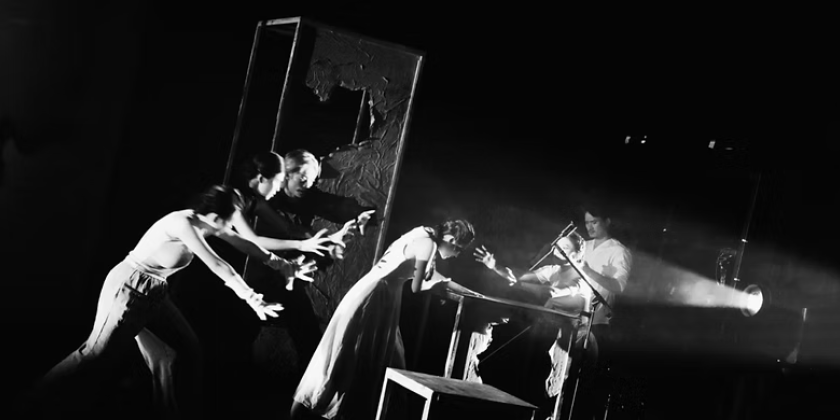
Jiemin Yang’s evening-length performance “Rabbit God: A Queer Chinese Fantasy” masterfully melds contemporary dance, martial arts staff work, live music, vocals, and projection to portray desire, comradery, and love. Occurring in Culture Lab LIC’s intimate theater, we almost feel inside of the spectacle as we witness a tale of transformation originating in Fujian, China. Jiemin reimagines the story of the Chinese deity the Rabbit God (portrayed with fierce beauty by Carl Ponce Cubero). The Rabbit God watches over same-sex love; the performance also highlights the family, friends, mentors, enemies, and spirits encountered along the Rabbit God’s journey, danced powerfully by Chieh Hsiung, Gabriel Sharp, Jacob Kurihara, Maya Lam, Tsubasa Nishioka, TJ Warren, and Haitao Yang.
Yang sets the evocative, yet playful, tone of the evening as we explore Culture Lab LIC’s gallery space that precedes the theater (where the dance work later takes place). In the gallery, we are welcome to purchase beverages and lounge in soft chairs and sofas. On display in one corner is an elaborate shrine honoring the Rabbit God, with candles, wine, beads, and a rabbit mask. Candles glow throughout the gallery, and the lighting is dark and sultry, yet inviting.
As we take our seats, a projection beams the title of the work in the upstage space. Projections are utilized throughout, setting the scenes for each location, such as houses, temples, dream-like clouds, and even the underworld.
Unfolding over ninety minutes, observers familiar and unfamiliar with the Rabbit God’s story are equally able to follow Yang's powerful narrative, with room available for us to create our own interpretations. Opening with an emotional, yearning ballad sung live by Cheeyang, Truth Future Bachman’s original lyrics describe an encounter of love seen in a dream, asking if the love will remain or be cast away. These words echo a moment when Cheeyang rolls artifacts like dice when taking centerstage. From this opening scene, I feel we are in a spiritual house.
The story unfolds through Jiemin’s dynamic, swift choreography, depicting a human named Tianbao Hu (danced generously by Carl Ponce Cubero) living a harmonious life alongside a sister-like figure (Maya Lam). Dressed in lightweight, loose pants and flowing, solid-colored shirts, Cubero and Lam train together in martial arts. Each wielding lightweight, flexible staffs, Cubero and Lam whirl their staffs above their heads like propellers with smooth control, trying to keep one another on their toes with their unpredictable, yet decisive, strikes. Even when one “takes the other” down to the floor, their love and care for each other radiates.
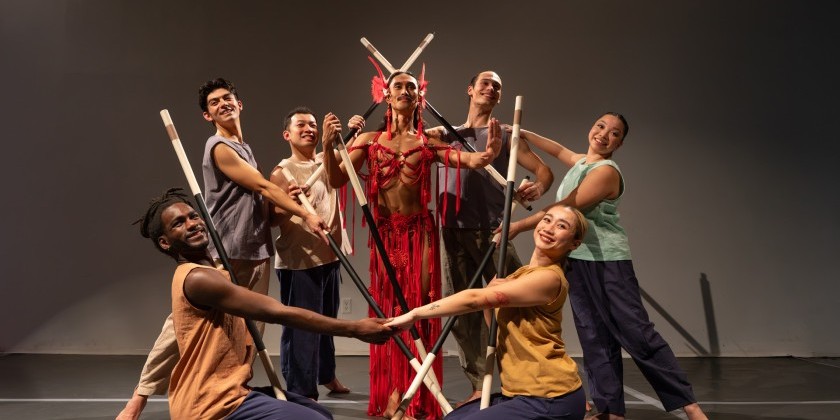
Three spiritual figures emerge in the early scenes, unbeknownst to Lam. First is a masked figure clad in all-black clothing (Haitao Yang) who will come to recur throughout the story as a clashing figure to Cubero. Soon after, two new characters emerge, breaking the spell of seriousness: TJ Warren and Jacob Kurihara bounce, skip, and stride through the space, wearing stunning, sparkling red and silver costumes designed by Zhang Yu. The pair also adorns red rabbit masks and ears, and their torsos and pelvises are draped in a rope-like top with fitted, silver shorts. Cubero appears curious, enticed, and adopts their spritely movement quality.
As the narrative progresses, Cubero and Lam’s characters attend an audition at a temple to become an imperial guard alongside fellow villagers (Kurihara and Warren) under the direction of three leaders (Nishioka, Hsiung, and Sharp). Lam ultimately achieves this position. Sharp plays the highest leadership figure in this scene, and Cubero develops an ongoing fascination with him, mimicking his arcing, carving gestures, ultimately breaking away from the group.
The dancers’ extremely coordinated and calculated staff martial arts plays an integral part of the work. Staffs emphasize a tradition, a practice, a craft, and a way of life. At first, they appear rigid and unwavering, symbolizing strength: yet at closer look, I could see that they were also flexible. Agents of change. Agents to both support and extend oneself. And at times, they became partners within moments of partnering.
A turning point in the work occurs as Cubero approaches Sharp in the middle of the night, as if to caress the leader’s cheek. Discovered by Lam and the others, Cubero’s character is beaten to death with the staffs. As their character’s soul was sent to the underworld, surrounded by demons, the atmosphere becomes wrought and sinister.
Hsiung takes on a new character in the underworld: a figure of royalty, clad in elegant robes of black and red. Cubero explains through movement that they had no wrongdoings on Earth - that their only crime was loving someone. In this moment, they are revisited by Kurihara and Warren (again as rabbit figures), and Cubero becomes the Rabbit God, to rule onwards as a deity of queer love. While Cubero's and Lam's characters are not reunited on Earth in the flesh, Lam’s character senses the Rabbit God’s presence; she, and the world, have a new, caring deity of love watching over them.
Jiemin Yang’s theatrical “Rabbit God: A Queer Chinese Fantasy” brings us together in a luminous tale of love. I left the performance wanting to learn more about the folktale, and appreciating the power of each element to tell such a thrilling story.
Author:
Kristen Hedberg
Website:
kristenhedberg.org
Photo Credit:
Grant Hao-Wei Lin | IG: @boombnust