


More Reviews
FRACTURED by SOULSKIN Dance and MAFFEI Dance Company

Community, Care and Support: Mark DeGarmo Dance's Virtual Salon Performance Series
AUDIENCE REVIEW: Romeo & Juliet Suite: I Am A Camera
Performance Date:
3/20/26
Freeform Review:
Benjamin Millepied's one act, Romeo & Juliet Suite, is a Neo modern influenced piece that can't decide if it wants to be an abstract or a narrativve ballet. Given it's New York premiere by the Park Avenue Armory, Millipied didn't concentrate first on telling the story. It was less depicted as much as picked up what was going on duing the seemingly-random proceedings. Your context relied on how familiar you were with the play. The length has been cut and some of the music had been placed in a different order. Only four characters from the Shakespearean story are credited in the program: Romeo, Juliet, Tybalt and Mercutio. We don't see just see them on stage, but projected on an enormous screen.
There was a revolving cast of three pairs of lovers: male/female, female/female and male/male. The audience were not privy to casting, so you won't know who filled those roles on any given night.
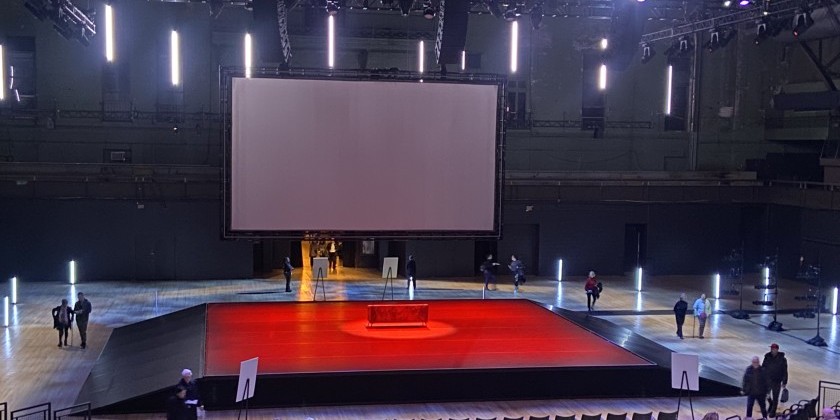
To begin, two dancers relaxed on a blood red love seat as they watched a huge screen upstage center, as if they were in a movie theater or more likely, their living room with a massive home video setup. That segues into an appearance by the handheld Camera Operator, former New York City Ballet Principal dancer Sebastien Marcovici, as he filmed the cast. He followed the dancers as they moved under the screen into the foyer of the vast Wade Thompson Drill Hall, where they joined the company backstage. Onscreen you saw the dancers milling about hanging costumes. Then suddenly, without motivation, two glared at one another with distrust and hatrad, Mercutio and Tybalt. Romeo and Juliet were then introduced, and so we began.
The masked ball happened in a small downtown club suggested by mirrors and a swirling mirror ball. The camera does most of the work, part of it's job was to disorientate the viewer. The lovers first met in what could be the hallway to the bathroom or in front of coat check. They are fast familiar, no shyness or trepidation. In what would traditionally be the balcony pas de deux, they started by running through the building, stopping at a brightly lit white screen where their hands lightly touched in close up. It's a rare moment of simple beauty. They finished on a ledge back inside the drill hall. The sight of them on the scren and simultaneously in person, kissing for the first time before running off into the existential darkness, best captured the spirit of doomed young love.
Later on, the death of Tybalt was dramatically captured under the stadium seating of the audience, a virtual infinite maze bathed in red light designed by Francios-Pierre Couture. The cinematic moments such as those after the lover's duet, are the most effective of the evening, bringing the audience closer to the action in a way that would be otherwise impossible. The videography was a collaboration between Olivier Simiola and Millipied. There were no sets, the costumes designed by Camille Assaf, were contemporary dark colored glittery tank tops, dress shirts, pants and skirts for some of the women. Only the female Juliets wore lighter shades.
Daphne Fernberger and Rachel Hutsell were the most fully realized as a couple. Their dancing brought shading to the movements as they leaped, spun and embraced each other. The love story they told was organic and generous. Renan Cerdeiro performed with a lithe and subtle lyricism as the brooding Tybalt. Kyle Halford's Mercutio and Arcadian Broad, who seemed to be Benvolio, danced every performance with unflagging energy and enthusiasm. Even without billing in the program, Broad received a deserved solo bow.
Classical choreography tends to phrase finishes on the upbeat. Millepied, who comes from the classical ballet tradition, commiteed to pushing the steps through the music, keeping the dancers mostly grounded in busy gestural motifs. The dancers had the movement in their bodies bringing a naturalism to the often tiresome work. Skating, hip hop and vogueing were borrowed to mixed results.
The history of how Sergei Prokofiev brought his ballet score of Shakespeare's Romeo and Juliet from page to the stage is as complicated , and tragic as the story itself. Composing it in 1935 was the easy part. Originally conceived as a one act ballet, it was expanded against his wishes to three.
Though blasted at an unnecessary volume, the glorious music is the heart of this and all productions. It never fails to touch the human soul with the evocative, sad melodies, at times eerie and horrific, are a tribute to the late master's genious. With it's cut and paste approach, this is not a version all will embrace, but nonetheless, the audience at the Armory sat in rapt silence for the duration of the performance.
Author:
John Summers
Photo Credit:
John Summers