


Related Features

DANCE NEWS: These Are Works & Process’ 2026-2027 Curated and Open Call Residency Artists
THE DANCE ENTHUSIAST ASKS: Daniel Gwirtzman Celebrates Pride & Creativity at New York City Center Studios
IMPRESSIONS: New York Flamenco Festival (Part II)

By Robert Johnson
View Profile |
More From This Author
Published on April 9, 2026
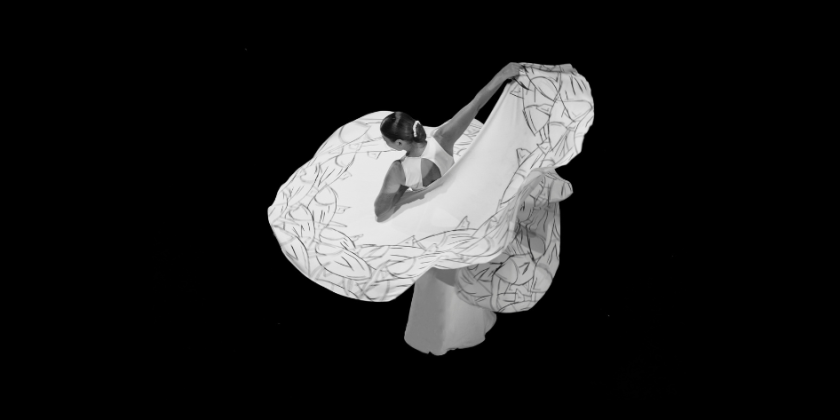
Sara Baras at New York Flamenco Festival. Photo: Sofia Wittert
At the New York Public Library for the Performing Arts, Joe's Pub at the Public Theater, New York City Center, Guggenheim New York, and The Metropolitan Museum of Art
New York Flamenco Festival (Part II)
New York Public Library for the Performing Arts
La Argentinita in New York: New York in La Argentinita
Performers: Speaker: José Javier León, Vocalist: Rocío Márquez, Dancer: Irene Morales
Saturday, February 28, 2026
Bruno Walter Auditorium, NYPL for the Performing Arts
Irene Morales
RAW
Live Producer: Anthonius
Cante: Al-Blanco, Guitar: José Fermín Fernández, Baile: Irene Morales
Joe’s Pub at The Public Theater - Saturday, February 28, 2026
Sara Baras
Vuela
Direction, Choreography & Staging: Sara Baras
Script: Sara Baras
Music Direction & Musical Adaptation of Paco de Lucía: Keko Baldomero
Scenic Design: Ras Artesanos
Costume Design: Luís F. Dos Santos
Lighting Design: Óscar Gómez de los Reyes & David Reyes
Sound Engineer: Sergio Sarmiento
Painting: Fernando Quirós
Texts: Santana de Yepes
Stage Manager: David Reyes
Dancers: Sara Baras, Daniel Saltares, Chula García, Cristina Aldón, Carmen Bejarano, Miriam Pérez, Elena Barba, María Guerrero
Musicians: Keko Baldomero, Guitar; Andrés Martínez, Guitar; May Fernández, Singer; Matías López “El Mati,” Singer; Rafael Moreno, Percussion; Alexis Lefevre, Violin; Ivo Cortés, Cellist (recorded)
New York City Center - Thursday, March 5, 2026
Juan Tomás de la Molía
Singer: Juan de la María, Guitarist: José Fermín Fernández, Dancer: Juan Tomás de la Molía
Joe’s Pub at The Public Theater - Friday, March 6, 2026
Works & Process Presents
Uptown Rhythm Dance Festival
Kukai Dantza: Yarin
Dantzari - traditional Basque dancer: Jon Maya, Flamenco dancer: Andrés Marín, Drums: Julen Achiary
Peter B. Lewis Theater, Guggenheim New York - Sunday, March 8, 2026
Sonia Olla & Ismael Fernández
Los Ricos
Vínculo
Dancers and Singers: Sonia Olla and Ismael Fernández, Pianist: Camila Cortina, Guitarist: Gabriel González, Bass Guitarist and Percussionist: Juan Diego Villalobos, Drums: Yilmar Vivas
Joe’s Pub at The Public Theater - Friday, March 13, 2026
Olga Pericet
From Carmencita to Pericet
Guitarists: Gerardo Núñez and Álvaro Martinete, Dancer: Olga Pericet
Film: La Carmencita (1894)
Producer and director: William K.L. Dickson
The Metropolitan Museum of Art - Sunday, March 15, 2026
Someday, Irene Morales will have the luxury of dancing on an opera-house stage. At this year’s New York Flamenco Festival, however, the emerging artist from Spain had smaller venues assigned to her. On February 28, 2026, Morales appeared on the shallow platform of the New York Public Library's Bruno Walter Auditorium, and on the modest corner stage at Joe’s Pub, where, as part of its 25th-anniversary season, the Flamenco Festival programmed a series of events. Undaunted, Morales cut loose, proving her mettle in imaginative performances that riffed on the old saying, “There are no small (stages), only small actors.”
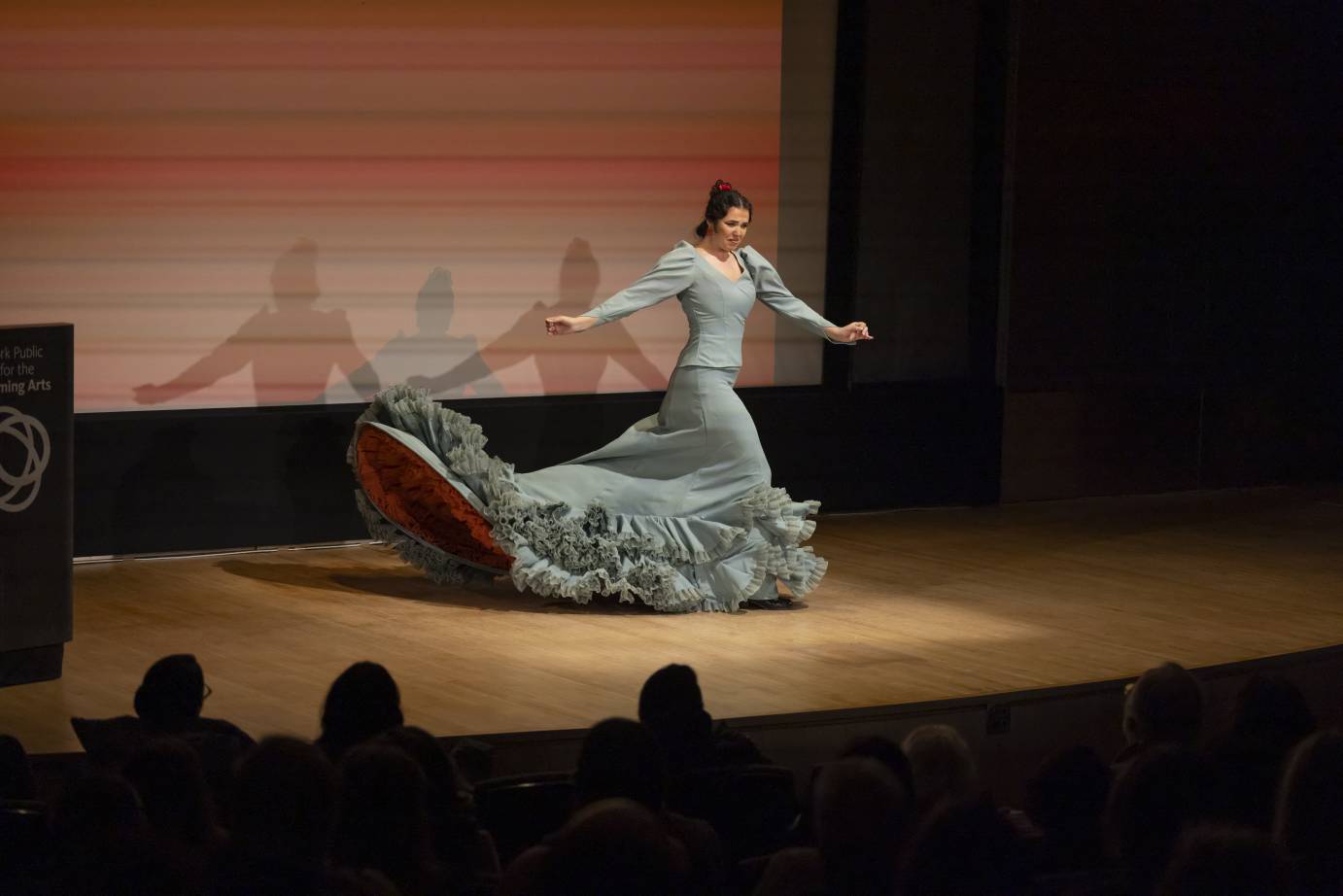
At the library, the dancer took part in a lecture exploring the career of the late, flamenco phenomenon Encarnación López Júlvez, better known by her stage name, La Argentinita [1898-1945]. Professor José Javier León gave a scholarly account of La Argentinita’s turbulent life, with its artistic triumphs and personal tragedies. She was part of a “Silver Age” triangle of friends that included her lover, the doomed bullfighter Ignacio Sánchez Mejías, and the poet Federico García Lorca, murdered during the Spanish Civil War. La Argentinita’s legacy includes the preservation of Spanish ballads such as En el Café de Chinitas, and the style of dancing she passed to later generations through the teaching of her sister, Pilar López.
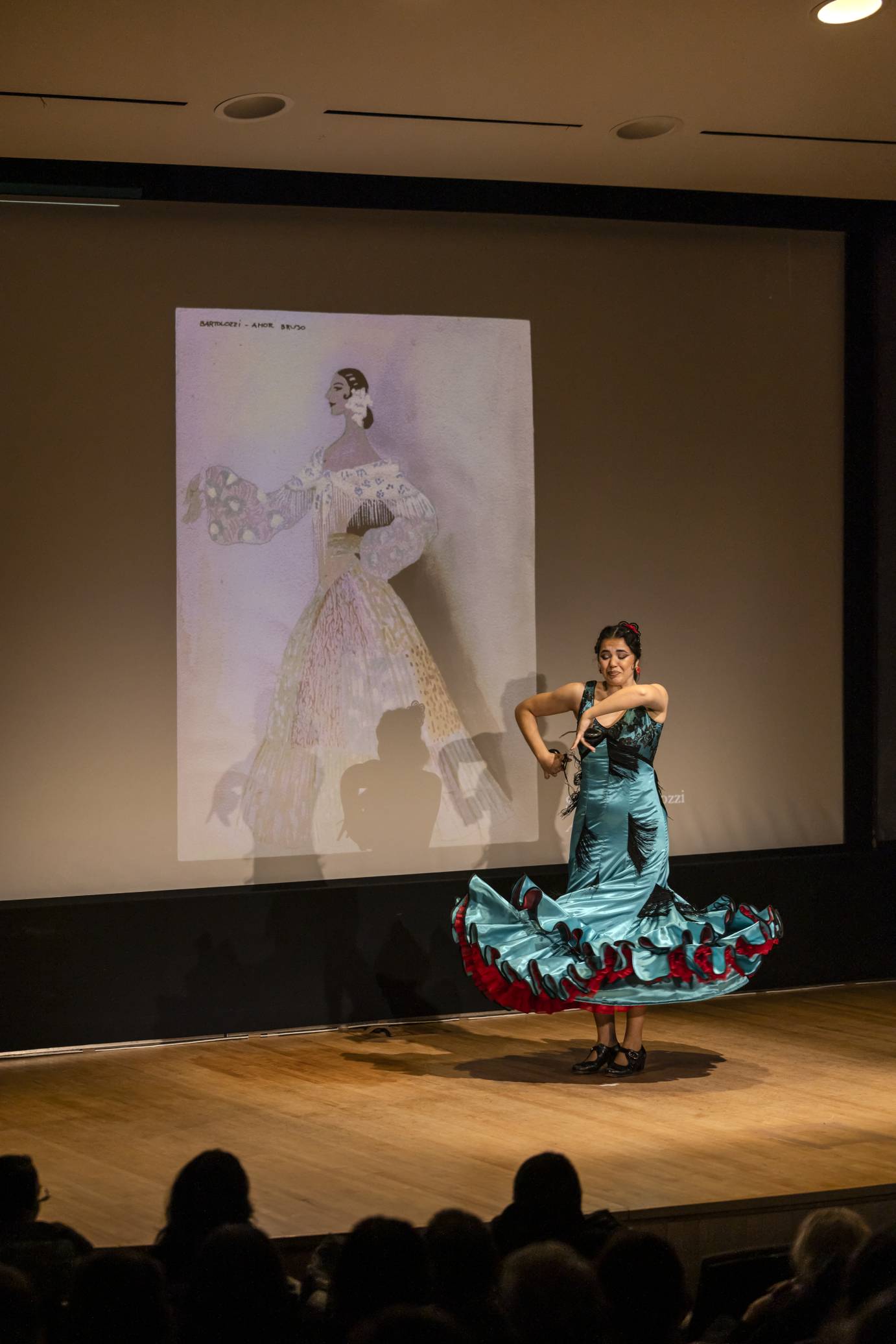
In her first dance, Morales seemed to bring the past to life. Entering like a sleepwalker, she turned her back to us and averted her gaze. When this ghost came alive, however, she was fully present, all coquetry and charm as she stamped and turned beneath curling arms, played castanets, and flashed ruffled petticoats. During the second interlude, she managed the bata de cola daintily, tiptoeing and spinning her train before striking a triumphant attitude.
Later that day, Morales passed from the antique to the contemporary, presenting an imaginative piece called RAW at Joe’s Pub. Making a dance out of the ritual of dressing, she transformed the ruffled bata into a series of costumes. The skirt concealed her like a chrysalis, wrapping her in an enigma as she sat astride a chair. Once risen, Morales showed herself fully in command of the space and of the skirt, promenading, swishing, and abruptly changing directions. She played coyly with a fan; and spinning her train expertly, Morales scoffed at risks, never spilling over the edge of the diminutive stage, where viewers lining the edge doubtless expected a mouthful of ruffles.
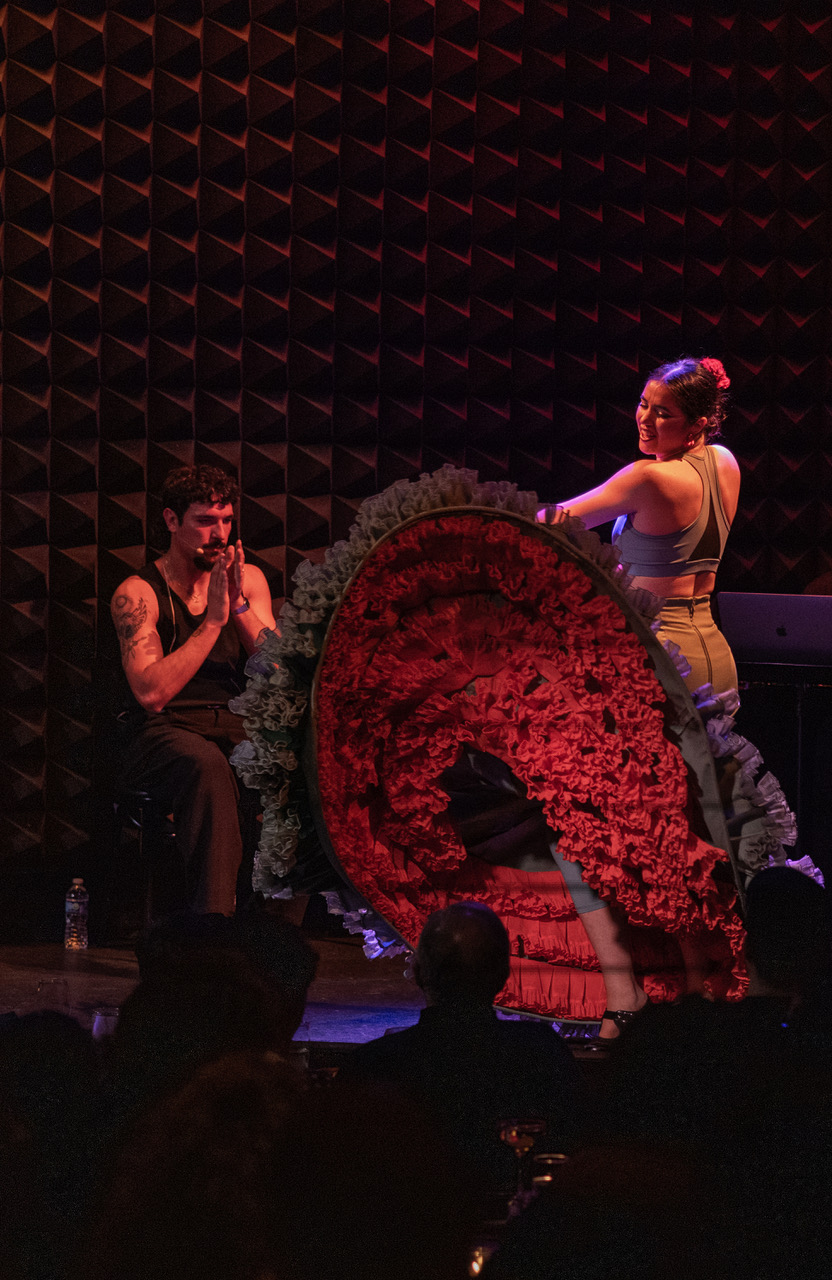
Taking turns with her musical partners, Morales also performed in a leotard, and in a simple frock. Her relationship with Al-Blanco, the honey-voiced singer, alternated between tenderness and defiance. She placed her head on his shoulder, allowing him to serenade her with a heart-broken lyric: “Seated on the sand, I die of grief/All that remains are memories of you.” Then she broke free. Coiling and gathering energy, Morales hitched up her dress and fanned herself, dancing madly and rearing back with pride.
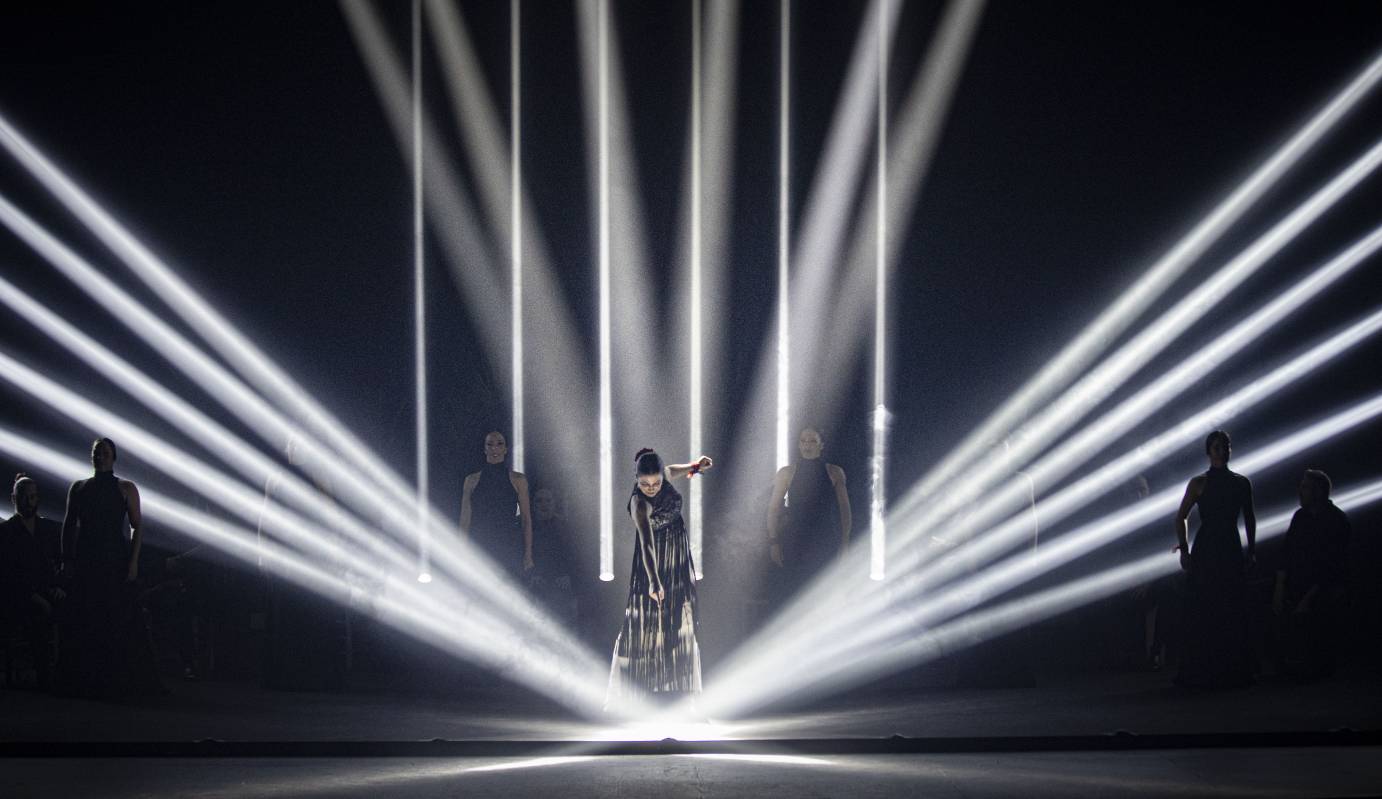
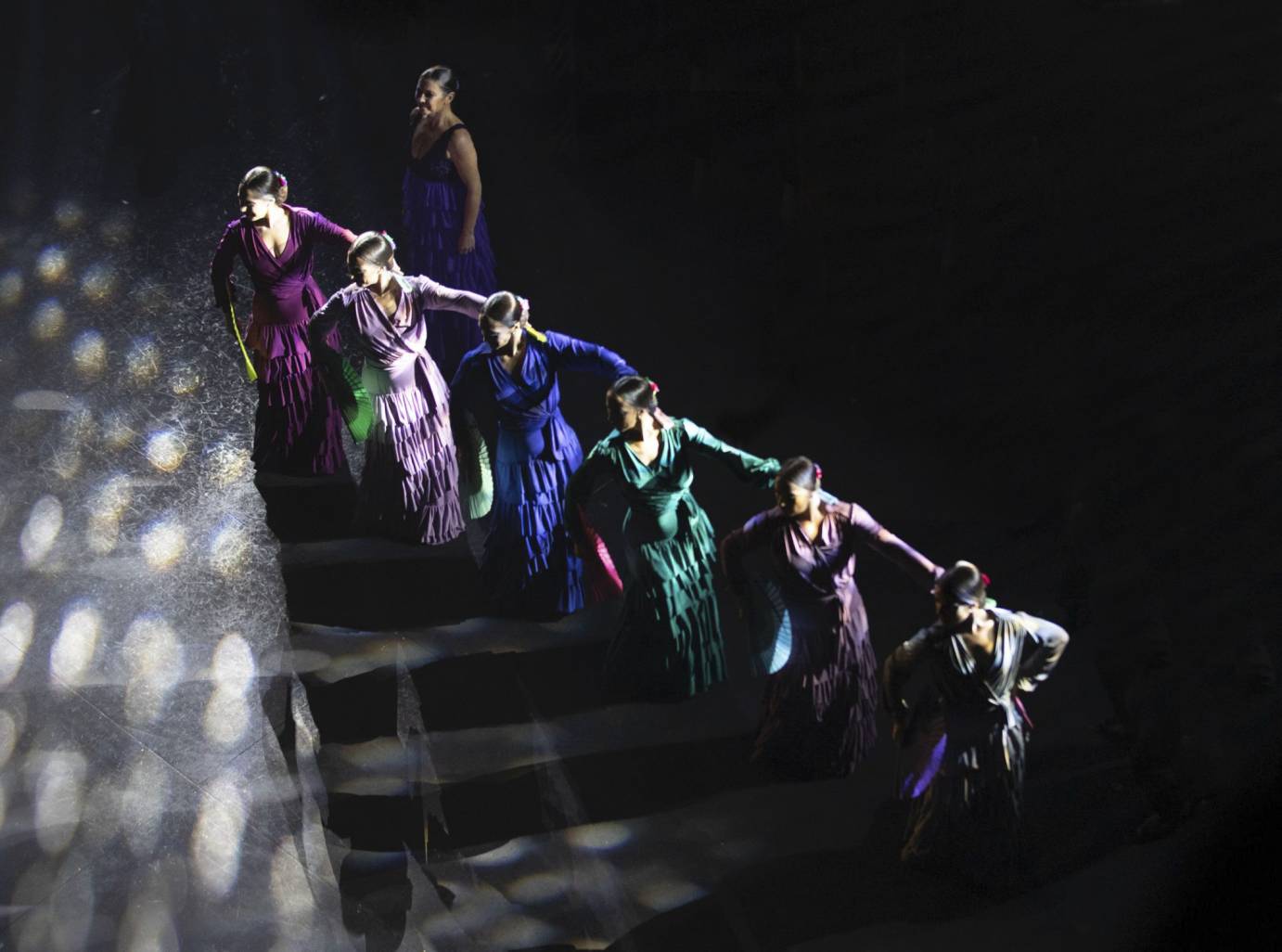
The second week of this ambitious flamenco season also featured a mainstage event: Vuela was Sara Baras’ theatrical tribute to the late guitar virtuoso Paco de Lucía, on March 5, at New York City Center. Smoky bars of light criss-crossed the stage; and projections helped define the space. Yet Baras controlled the scene with the force of her personality. From the very first, this star demonstrated a magnetic ability to manipulate the weather, summoning a thunderstorm with an abrupt gesture or echoing the patter of raindrops with a gentle diminuendo in her heels. A well-rehearsed corps of dancers reinforced or relieved her deploying canes and fans as props. Yet the ensemble numbers lacked imagination, amounting merely to precision drill, or a parade of colorful costumes. The women flounced in aquamarine dresses like sea-foam. Blazoned with purple wisteria, they assembled human bouquets, while an empty chair signaled Paco de Lucía’s absence, and Baras placed flowers on the maestro’s grave.
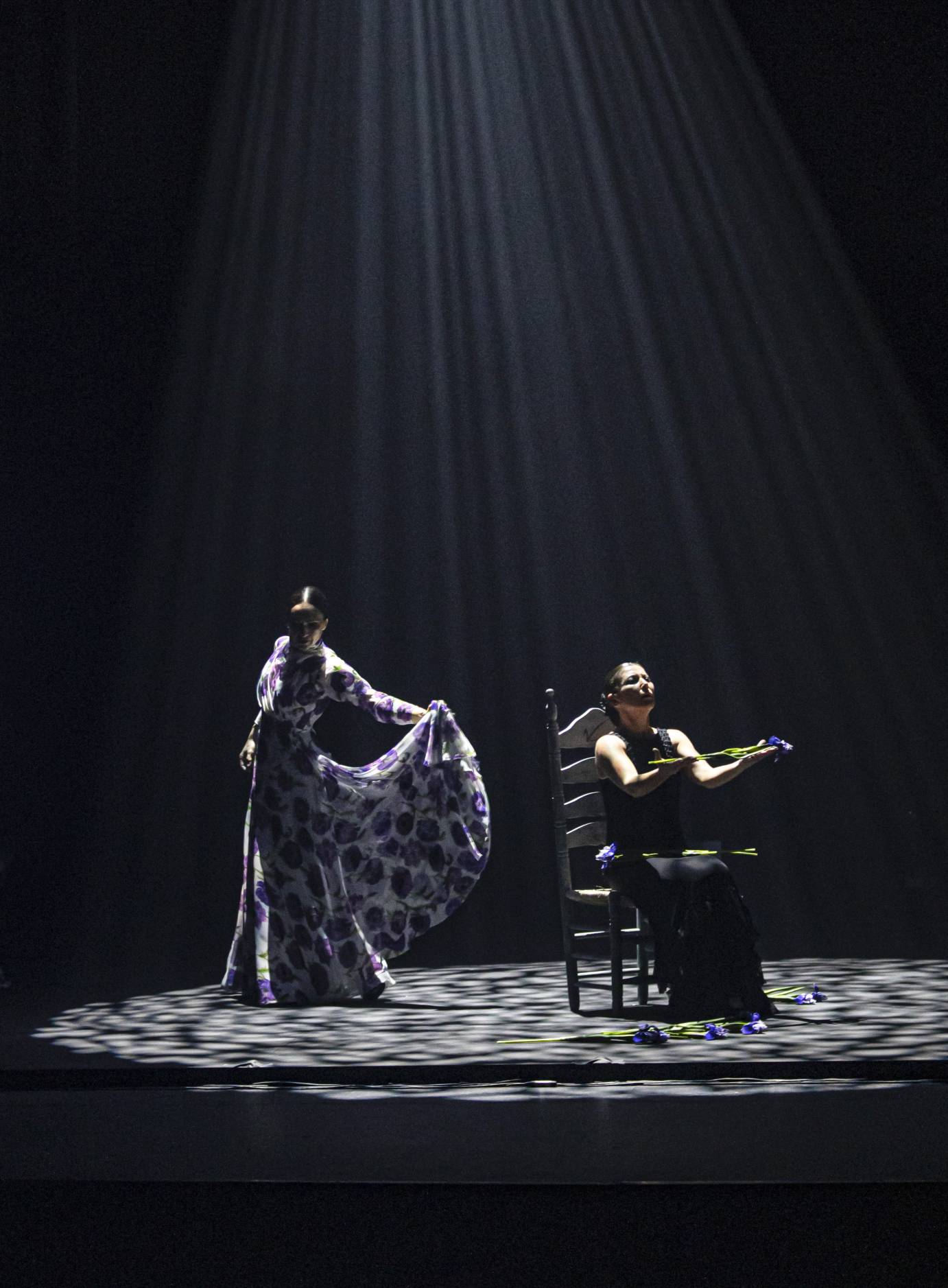
Ironically, with all the resources of a large production at her disposal, Baras’ triumph came in an episode without embellishments. During the stripped-down duet titled Mourning, she danced opposite Daniel Saltares unleashing primal energies. Concentrated bursts of stamping alternated with dramatic gestures, as Baras stretched her hand in mute appeal or clenched it to her heart. Clasping hands, the partners rocked from side to side, or raised their arms to form symmetrical figures. Baras curled in Saltares’ embrace, and reeled away. Despite their vitality and the tenderness of their relationship, this dance exuded anguish and the clammy air of death. At last, we heard those mysterious “black sounds” that Lorca wrote about; and Baras brought forth the spirit of the duende from what the poet called “the deepest chambers of the blood.”
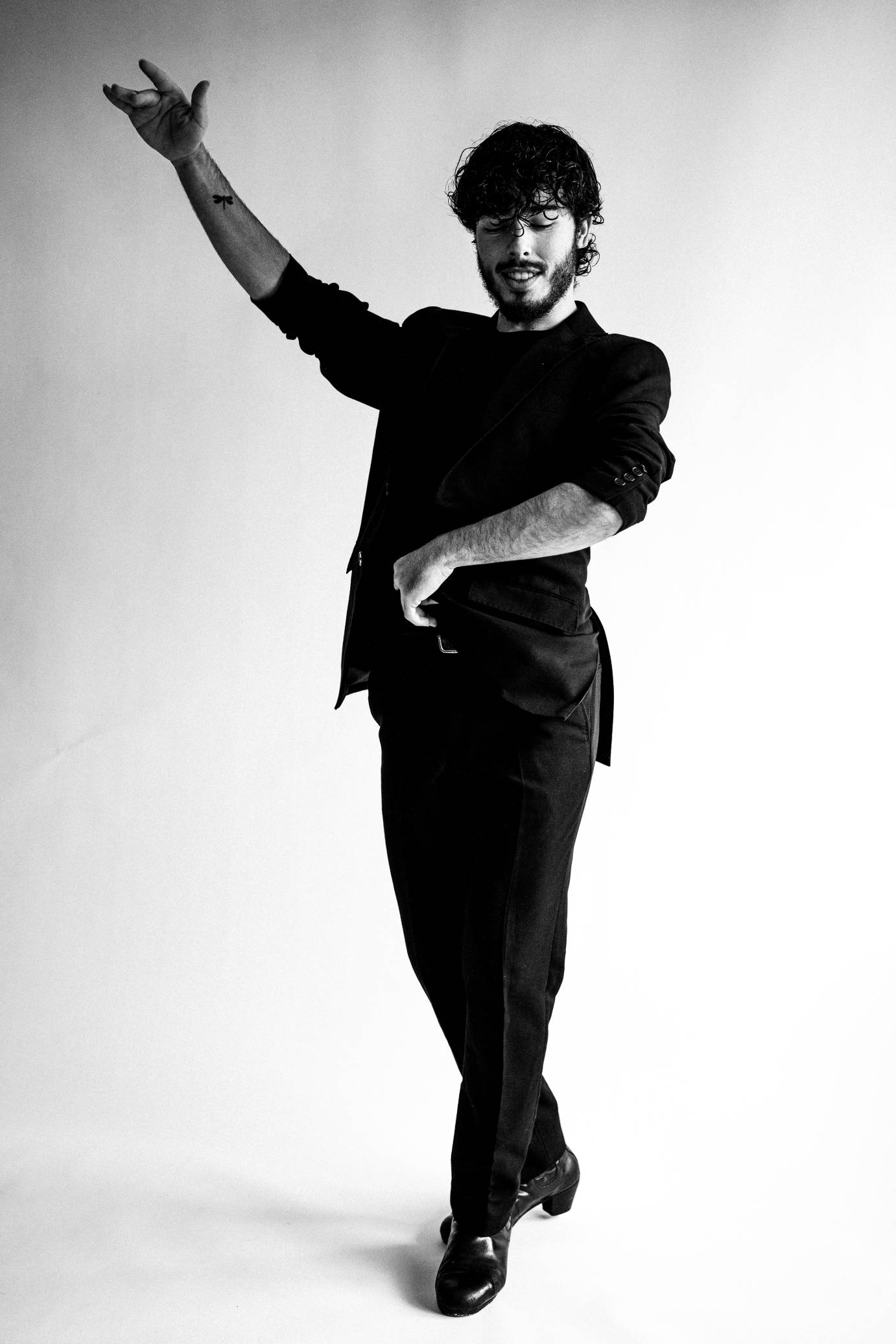
The series at Joe’s Pub continued, turning the spotlight on young hotshot Juan Tomás de la Molía, on March 6. Flinging sweat from his brown ringlets as he arched his taut body, and lowering thick eyelashes, Molía won the title of Flamenco’s newest sex symbol. A dancer’s looks are never ultimately what counts, however — only the dancing matters, and the artist borrows whatever beauty he has from alchemical combinations of form, movement, and style. Molía cannily employed dynamic and emotional changes to compensate for the lack of space. He blistered the floor, pitched invisible flowers to his adoring public, and collected himself in a solemn in-gathering that maintained the flow of energy through moments of profound silence. In cheerful segments, he twinkled and playfully slapped his rump. He spun at daring angles, and commanded our attention with a single raised finger. While Molía changed costume off-stage, guitarist José Fermín Fernández kept us occupied expressing delicate melancholy or gaiety; but we waited with impatience for the dancer to return.
Joe’s Pub also gave a platform to Sonia Olla (dancer) and Ismael Fernández (vocalist), in a show that celebrated the release of their latest music album, Vínculo, on March 13. Crowding the stage with a piano, a drum set, and a keyboard, and headed by the versatile flamenco cantaor, the group known as Los Ricos jammed its way through Latin music genres from rumba to bolero, with Olla’s heelwork integrated into the sonic mix. After a passionate opening, Olla’s figure softened and grew playful, and, though she did not dominate the ensemble, her stamping feet had the final word. The message of this feel-good program — that love is more powerful than war — seemed confirmed near the end, when audience members joined the cast in a raucous, on-stage dance-party. Miraculously, there was room for all.
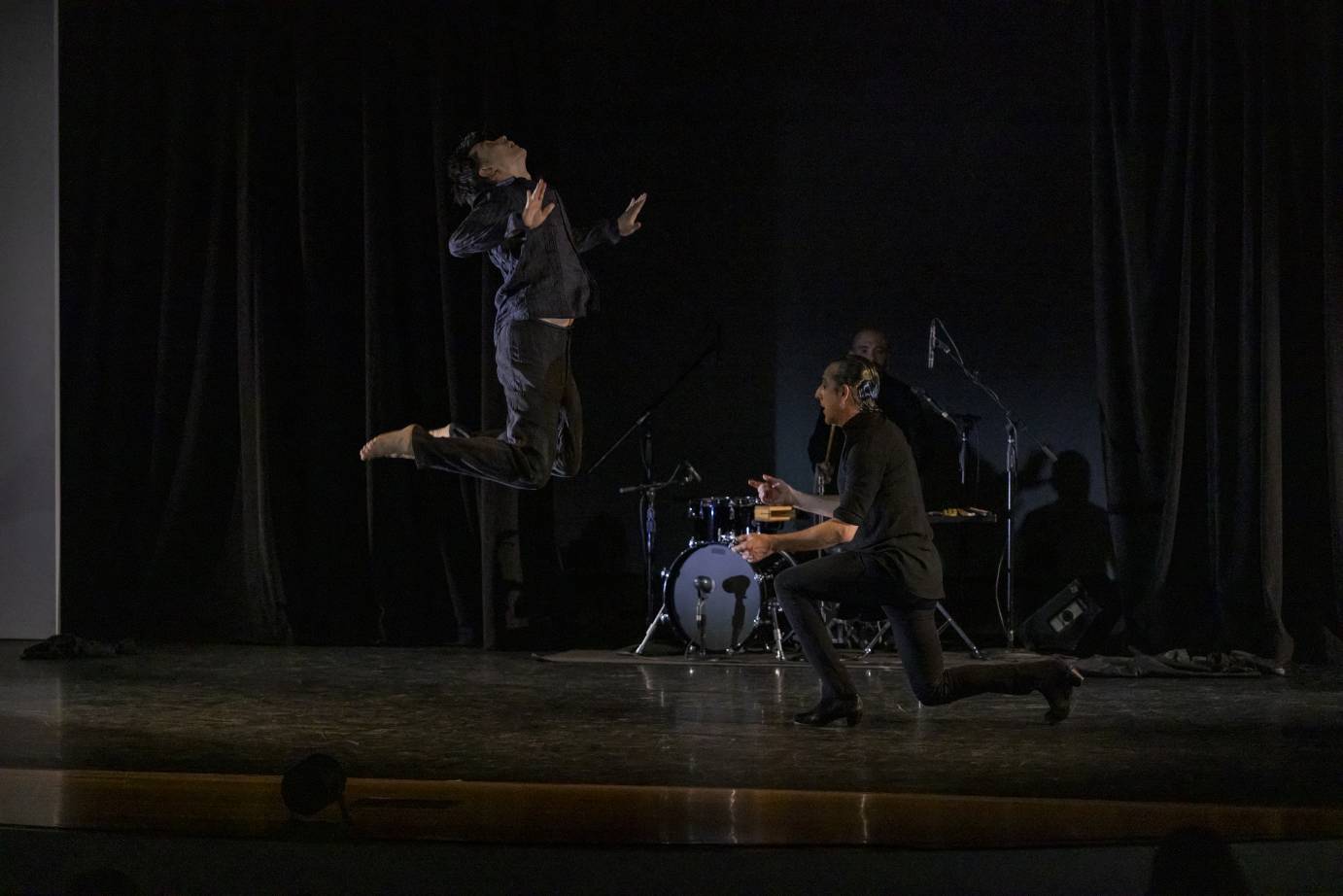
Marching onward, the Flamenco Festival invaded the Solomon R. Guggenheim Museum, on March 8. Here, as part of the museum’s Works & Process Uptown Rhythm Dance Festival, in the Peter B. Lewis Theater, dancers Jon Maya and Andrés Marín presented an experimental dialog between Basque folkdance and Spanish flamenco.
Maya, the Basque dancer, introduced this austere and shadowy number called Yarin bouncing and twirling with one leg crooked before him. He rocked on his feet, cut capers, and traced airy circles (ronds de jambe). Maya never seemed to tire, though Basque dancing is relentlessly aerobic. Emerging from the audience, Marín presented a characteristically Andalusian figure in a bolero jacket and hat, which he shed as he approached the stage. His dancing was taut and planted, where Maya’s was loose and rollicking, one stamping and the other springing. How can these dance styles, and these nations, ever be reconciled? Julen Achiary, the upstage percussionist, attempted to create a neutral environment with sounds that transported us from the Iberian Peninsula into outer space. The dancers laid hands on each other’s shoulders in a gesture of solidarity, but, try as they might, their bodies would not fit together neatly.
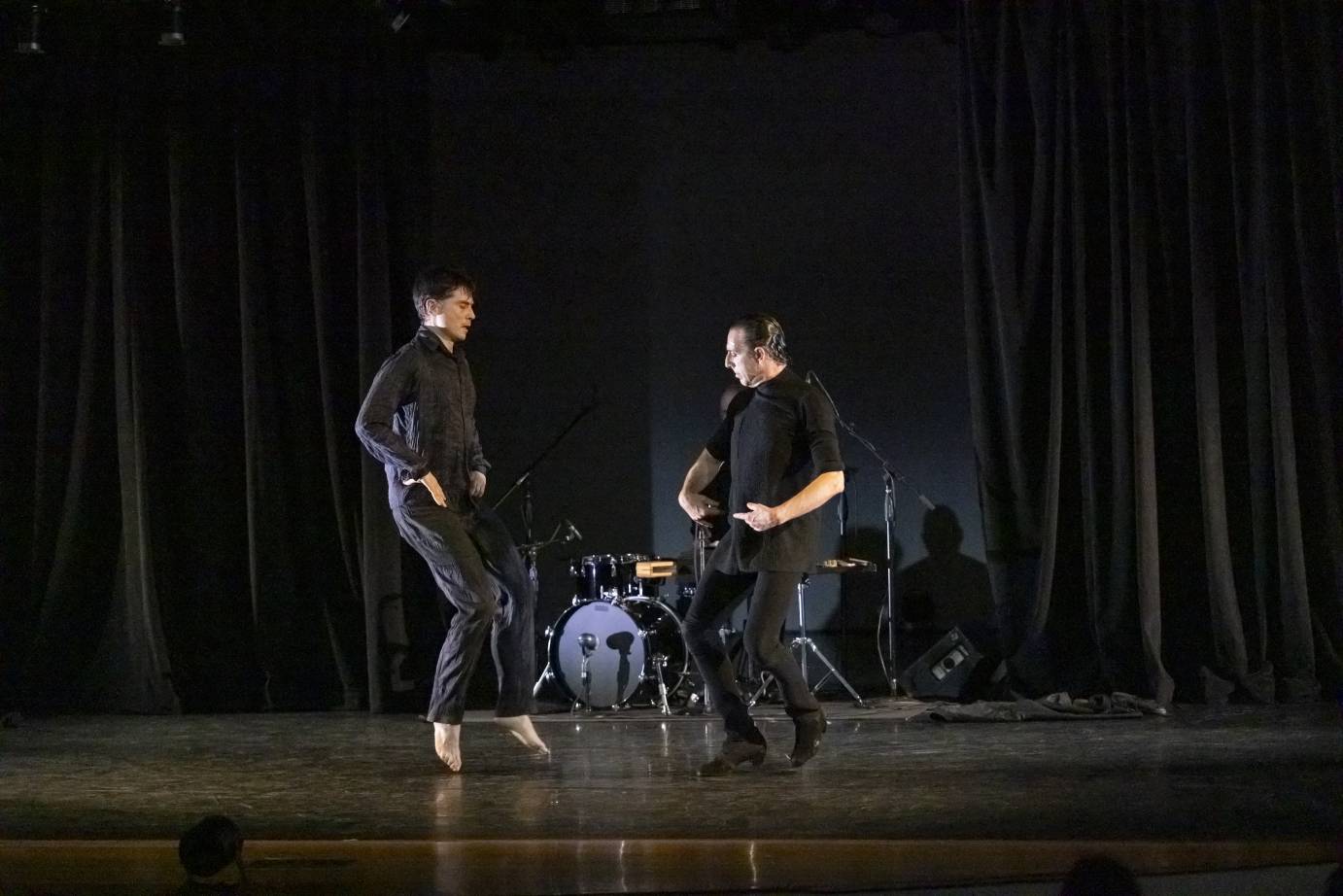
The history of Spanish dancing in New York is a long one. Flamencologist Ninotchka Bennahum has documented tours by 19th-century performers including Lola Montez, Pepita Soto, Isabel Cubas, and Trinidad Huertas (“La Cuenca”), the latter performing in drag. (Sixty-one years before Hollywood siren Rita Hayworth turned the tables on Tyrone Power in the movie Blood and Sand; and 122 years before Pedro Almodóvar depicted a female bullfighter in Talk to Her, La Cuenca donned a matador suit to become a gender-bending sensation.)
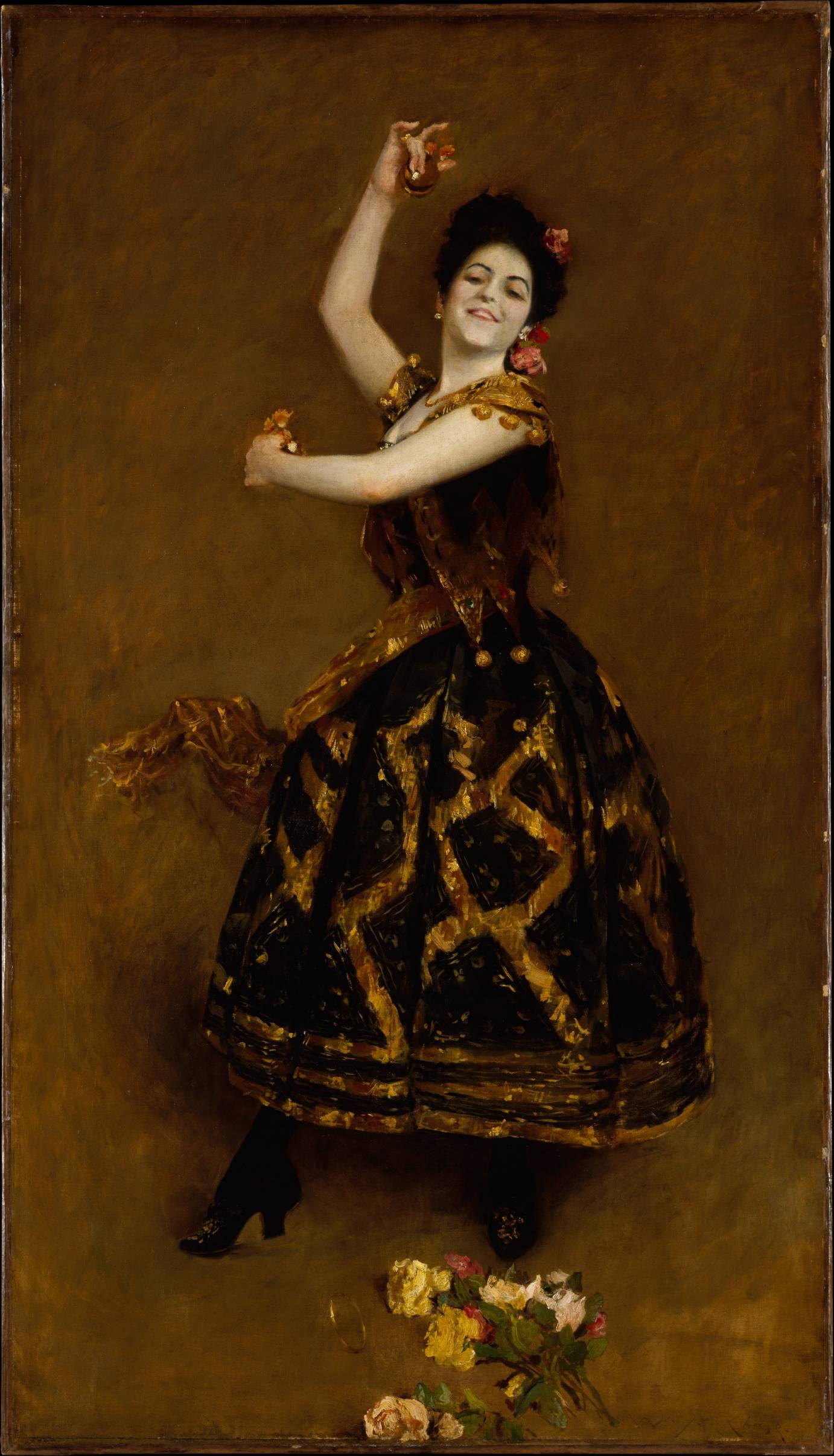
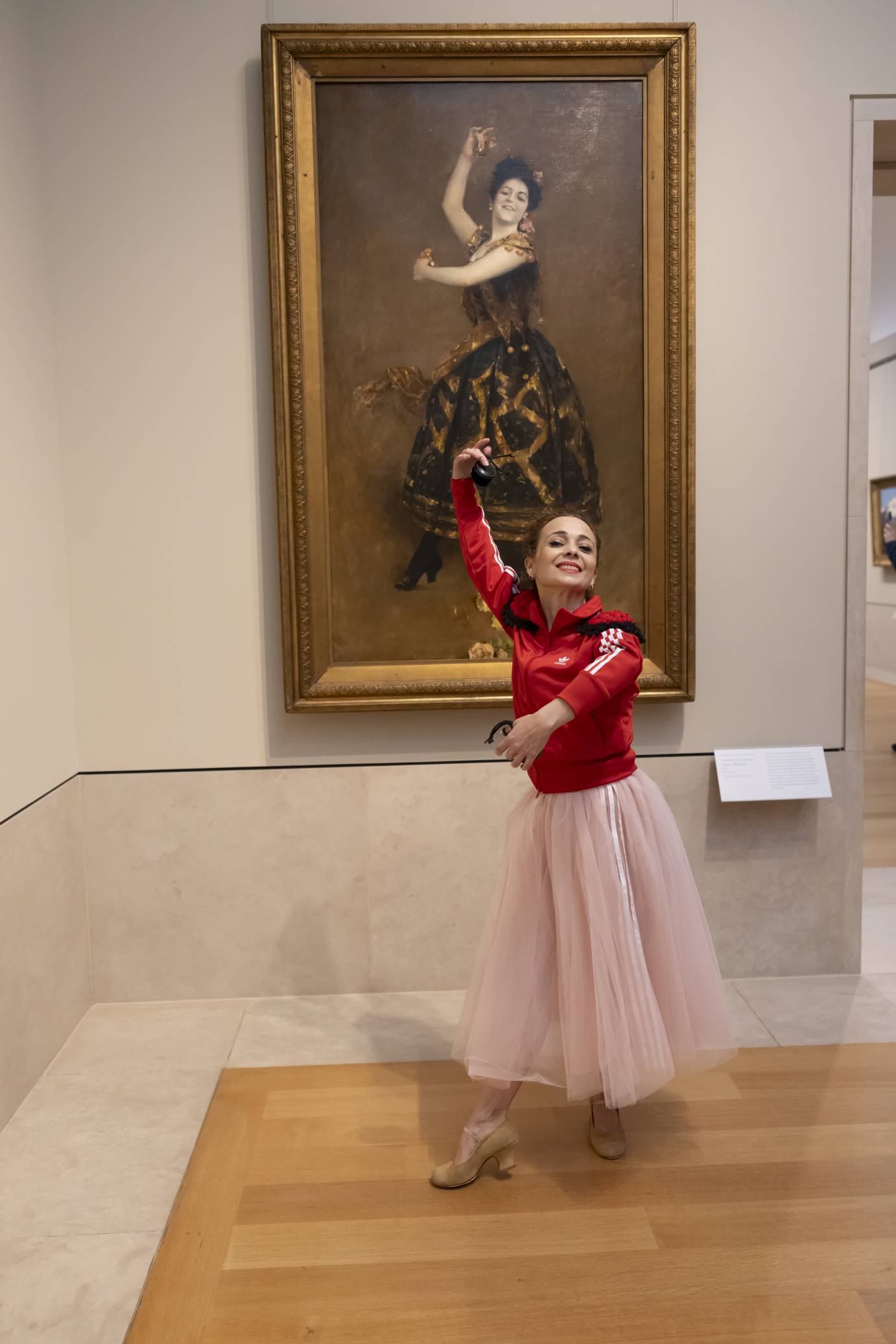
Yet, the organizers of this year’s New York Flamenco Festival wished to draw our attention to another memorable Spanish star, Carmen Dauset Moreno (“La Carmencita”), who conquered this city in 1891, and whose charms were so devastating that disappointed lovers threw themselves from balconies. She was also the first woman to be filmed in the studios of Thomas Edison; and today La Carmencita’s full-length portrait hangs in the Metropolitan Museum of Art. The portraitist, William Merritt Chase, painted her with gifts from her admirers, and seems to have caught the dancer in a very good mood.
Matt_Karas%20_%40karasmattik-3%20Small.jpg)
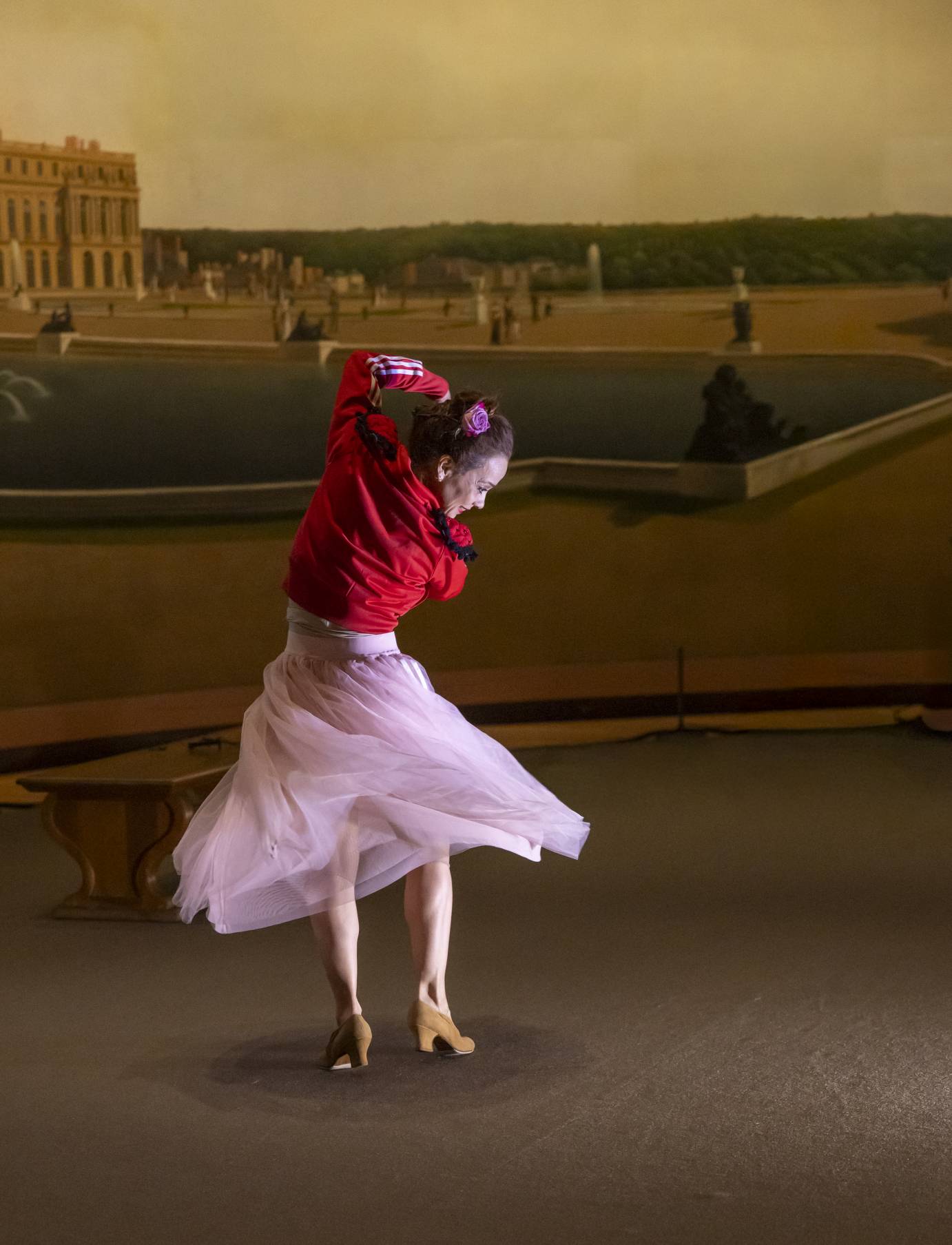
Dedicating its closing act to La Carmencita, the Flamenco Festival presented a lecture-demonstration by a glamorous contemporary star, Olga Pericet, at the Metropolitan Museum of Art, on March 15. Enjoying the intimacy of a salon performance, this event took place in a gallery surrounded by John Vanderlyn’s panoramic views of the palace of Versailles. Other works of art, including Édouard Manet’s The Spanish Singer, appeared on a screen, and, in another nod to oil on canvas, Pericet wore the white gown and black shawl of the dancer in John Singer Sargent’s famous picture El Jaleo. Yet it was Pericet’s living art that held our rapt attention.
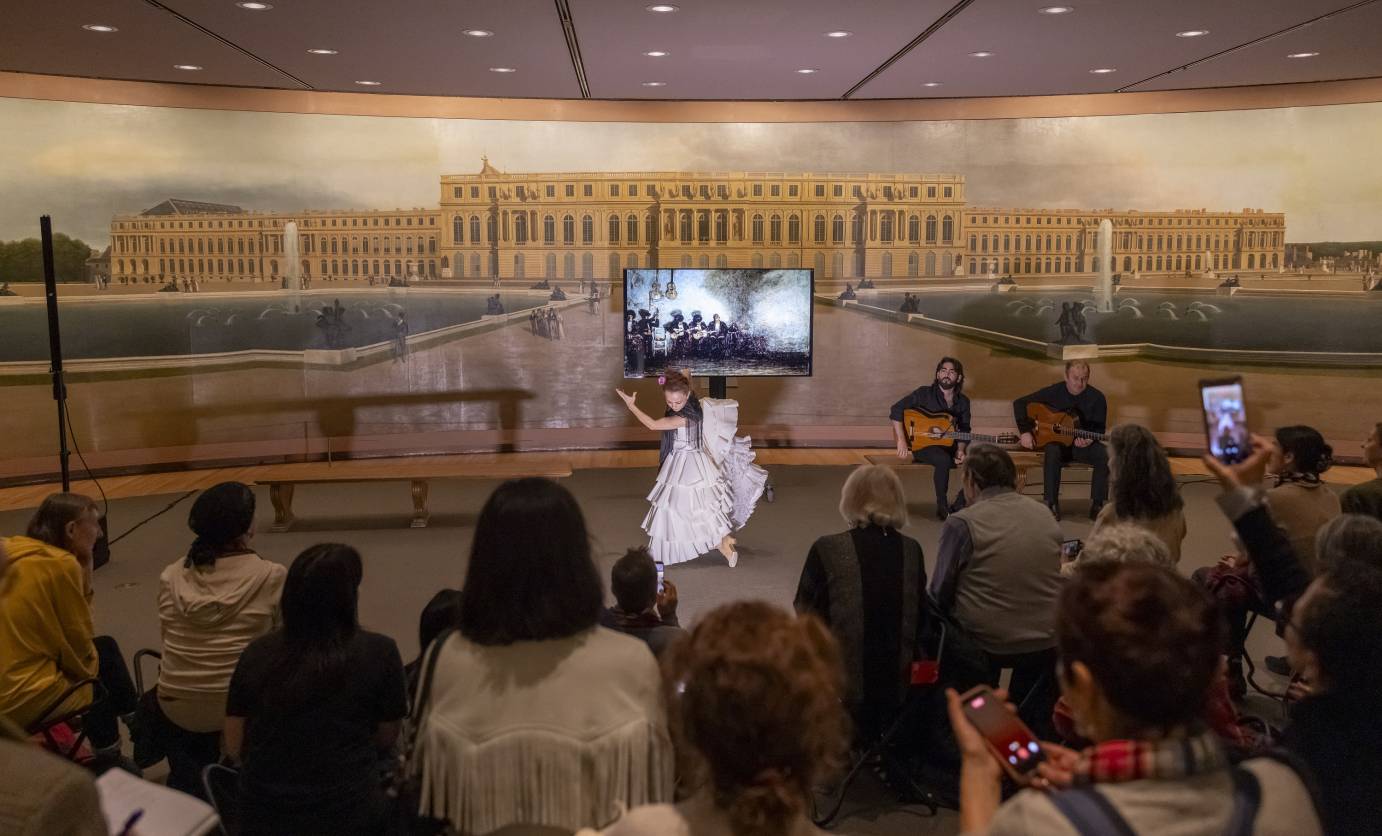
Pericet is one of those rare individuals whose inner light cannot be concealed, and who moves with a luxurious fullness at any speed. She began posing languidly, her skirts spread over a bench, attentive to the guitarists playing on the other side of the space. Raising one hand with a graceful gesture, she drew attention to the curve of her neck, and grazed the rosebud in her hair. Though feigning indolence, her energy at rest could have brought water to a boil. Then, rising to the challenge of the music, Pericet performed a volatile solo, small-scale twists and flourishes growing into powerful kicks and swirls. In a delirium of movement, she swept the space with her whole body, and surrendered in ecstatic backbends. Pericet marched and threw down her hands angrily, eliciting an “olé” from the standing crowd. Then, turning again to seduction, she darted sinuously among the viewers.
In the lecture portion of her program, Pericet described La Carmencita as “the Muse of upper-class society,” but also as the heir to a historical tradition, who contained “many women within herself.” According to Pericet, La Carmencita left a lasting impression on the Russian school of ballet. The Russians, she said, were amazed by her ability to play castañets while performing the destaques (extensions) and quebradas (body-bends) of the Escuela Bolera. A screening of the silent film made in Edison’s studio (in 1894!) confirmed not only La Carmencita’s effervescent personality, but also her redoubtable technique; and one could indeed trace a direct line of influence between the horizontal position of La Carmencita’s body in a vuelta quebrada, and the extreme plasticity that Russian choreographer Léonide Massine demanded of his dancers in the 1930s. Twenty-first-century scholars have identified the dance in this remarkable film as a petenera; and for her finale, Pericet changed costume and improvised her own dance to a second screening of the film with music added. Bounding and prancing, and accompanying herself with castañets, Pericet ravished us again - another avatar embodying the spirit of a great people.