



Related Features
A Postcard from MOMIX Artistic Director Moses Pendleton About the Company's Upcoming Season at The Joyce
IMPRESSIONS: MOMIX in OPUS CACTUS at The Joyce

THE DANCE ENTHUSIAST ASKS: Moses Pendleton of MOMIX on Moving with Nature

By Theo Boguszewski
View Profile |
More From This Author
Published on December 2, 2025
Photo by Alberto Rorodrigalvarez
Don't Miss MOMIX in "Alice" at The Joyce Theater This December
Long before founding the pioneering dance company MOMIX, Moses Pendleton was performing for an audience of cows on his family’s Vermont dairy farm — a “cowographer,” as he fondly recalls. That playful blend of nature, movement, athleticism, and imagination has defined his career ever since.
Recently honored with the 2025 Richard Brettell Award in the Arts from the University of Texas at Dallas, Pendleton celebrated the occasion with performances, lectures, and a photography exhibit exploring the beauty of the natural world.
As MOMIX readies its production Alice at The Joyce Theater this December, Pendleton reflects on a career of turning the everyday into the extraordinary.
Theo Boguszewski for The Dance Enthusiast: You grew up on a dairy farm in Vermont. How did that upbringing shape your perception of how movement, discipline, and nature interact?
Moses Pendleton: Well, up in that Northeast Kingdom of Vermont, people needed to create their own entertainment. My father was a breeder of Holstein Friesian cows, and I was part of that dream to create the perfect Holstein. And so I was very involved with farming and veterinarian medicine and forestry, all those kinds of things. The nature did nurture me in the beginning. My father passed away at an early age and my mother sent me to further my abilities as a downhill skier in Mount Hood, Oregon, at a ski-racing camp. I got an early decision acceptance at Dartmouth, and the second day of classes, I broke my leg in a training accident. So my ski career was quite shattered right away.
I ended up taking a dance class to get myself back in shape for the ski team. The dance instructor, Alison Chase, was faced with a lot of us very athletic students without dance training. I was a skier, another person was a pole vaulter, another a bicyclist. I've often said that my world was “putting the aesthetic on the athletic.” We had to find out ways that we could express and explore that without doing something that we couldn't do, namely classical ballet. So we ended up creating these body sculptures. And that was the beginning of Pilobolus.
We also did a lot of posing for an art class. We were very interested in the visual and the physical. Visual theater is the way I describe MOMIX to this day. Dance is certainly a part of it, and we take a very broad definition of dance. Anything that's visual and musical I suppose could be called dance.
Going way back, my first experience performing, when I was very young, was showing off Holstein Friesian calves at local fairs. I won a blue ribbon at the Eastern States exhibition – one of the finest fairs in the country and highly competitive. And then I graduated to organizing movements of cows for the Vermont Council on the Arts and other audiences. I was known as a “cowographer” in the early days. That was a very big hit. Cows are very curious animals. I put a white sheet over my head on an adjacent hillside, and set an audience about a quarter mile away, so they would watch my zigzagging pattern and the cows would follow wherever I went.
Those were the formative years. The Vietnam War caused the students to want to escape into the woods and play drums on hollow spruce logs. Dance and music and the arts was really the escape for us. I think that was because of the sociological and political unrest at the time.
Many of us start off in dance with this very narrow definition of what dance is. And you started with an extremely broad definition.
Yeah. We didn't worry about whether it's dance or not. We were putting on a show. I've always been interested in entertaining. With MOMIX, it's really a mix of a lot of those elements. It's not dance, but there's a lot of dance in it. It's not Cirque, but there are elements of acrobatics. And also the whole visual aspect with lighting, costumes, and movement to create something otherworldly or bring people into the MOMIX land. We go to work like a painter or sculptor trying to create an image. And then see if that image can move in time and space.
Was there a moment when you realized that presenting work was going to be your career path?
The first piece we choreographed formally as Pilobolus was a male acrobatic gymnastic trio. And by some freak accident, we were asked by this local producer if we would perform that piece at a Frank Zappa concert in Smith College. After taking dance for two months, we're opening a Frank Zappa concert to 3,000 screaming Smith girls. Afterwards Zappa asked us if we'd go to Iowa City the next day, and we said, thanks, “Mr. Zappa, but we have math exams, we have to get back to school.” But when we got back, we realized, you know, there's something to what we're doing. The audience seemed to like it. Maybe we should continue working on that.
So you co-founded Pilobolus and then later went on to found MOMIX. How did the creative philosophies of those two companies eventually diverge?
Pilobolus was a collaborative of six people. And after 10 years, like in any relationship, that began to not be as productive, and I decided to branch out on my own, to go have a solo career, so to speak. I wanted more artistic control of the product.
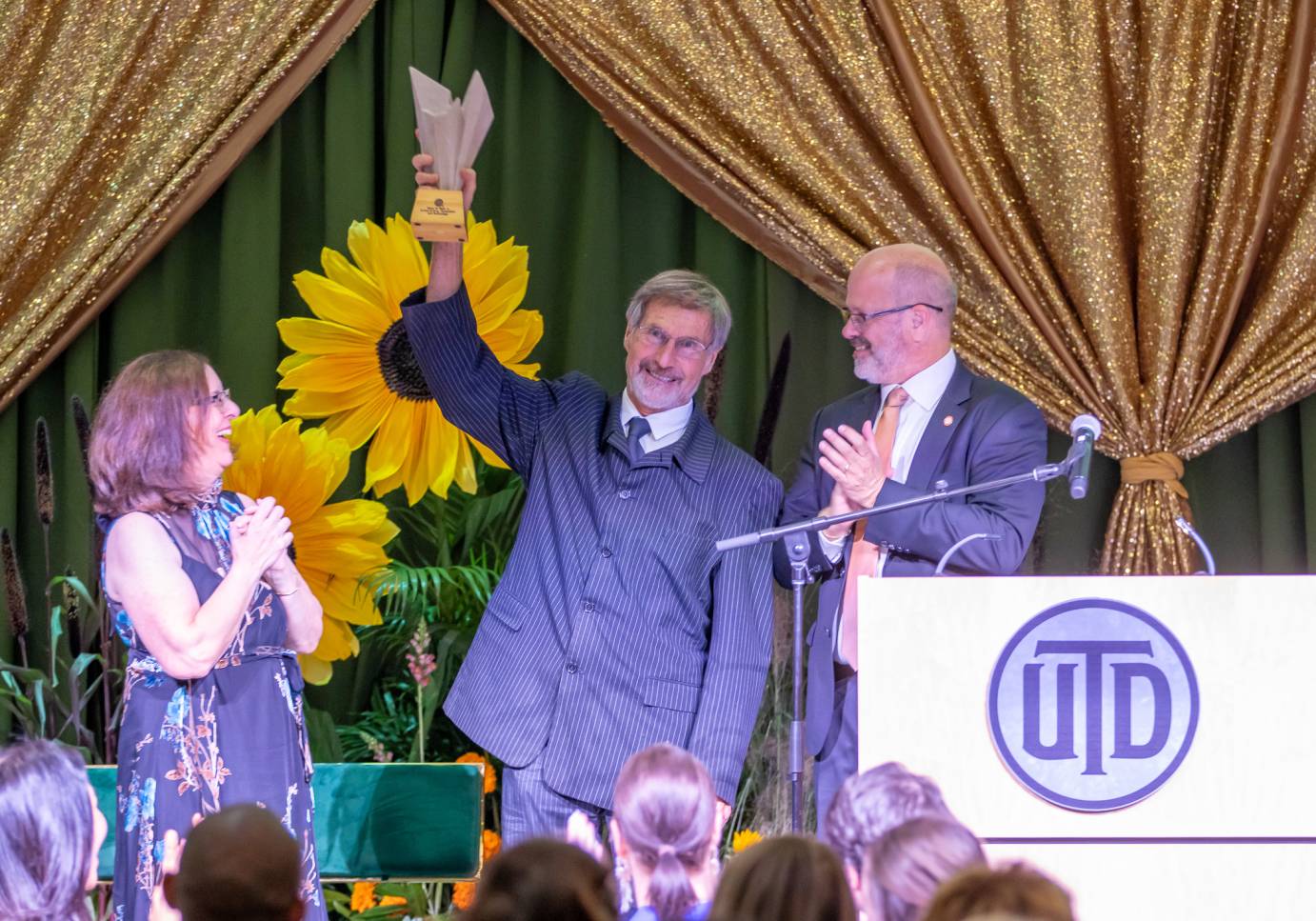
You were just awarded the 2025 Richard Brettell Award from the University of Texas at Dallas. Did you have a relationship to the University prior to the award?
No prior relationship, though we go to Dallas on a regular basis and perform at the Winspear Opera House. As part of the award, I came down to Dallas with my family and the MOMIX company and we did a residency. We brought down the company to do a show in their auditorium, and I was very happy to be able to show some of my photography, which is my real passion of the moment. So I had a photographic exhibit, we had a MOMIX performance, and then I made a gala speech at the dinner.
And then we were invited to tour the campus and to sit in on classes and talk to honor students, and also do a master class in dance. We met a lot of interesting and dynamic people and it was a very positive experience. They're doing some interesting things in terms of cross fertilization of science, technology and the arts and humanities.
Your lecture last weekend was titled “Imagination in Motion: The Art of Revealing the Unseen.” Can you speak to the meaning behind this title?
I apply that to my interest in nature photography. I find lots of magic in my own backyard, in the frozen mud puddle and the aging cabbage. I've been collecting 30 or 40 cabbage heads from the local cabbage farm, and I'm drying, curating, and marinating them in dry heat so they curl and shape and begin to look like something other than what they were at first. There's a word for it — “pareidolia.” That’s the phenomenon when you see faces in the clouds or in the tree bark, that kind of thing.
Does your work in photography feed your choreography and vice versa?
I said in my gala speech that we need to “train the eye, trust the accident and let nature finish the sentence.” I really believe in “trust the accident” — you make things because you don't know what you're making. It's a process of discovery and then it applies to choreography and life in general.
And “let nature finish the sentence” — we're all collaborators with life force and movements and energies. I think the basic aesthetic that I've always believed in was the human making contact with the non-human, the plant and the animal and mineral, the energies all around us. And that has been exciting for me. And my photography allows me to be quite alone too. I don't have to collaborate with other people. I like the privacy of going out and meeting a lot of different ideas and forms in nature.
And I see the movement too. The dried cabbage. I can catch it in such a way that it looks like a soloist in La Bayadere.
You mentioned this time during the Vietnam War, when there was a feeling of people wanting to retreat into the wilderness. Do you feel like that's happening again now?
I think the country’s in a real state of unrest — the tectonic plates are shifting again, much like they did back in the late ’60s and early ’70s. But America’s always been a place of pressure between two sides; as Ken Burns said, it began on division. I like what Robert Frost wrote — “good fences make good neighbors” — because I believe in having your own identity and culture without everything melting into sameness. Personally, my instinct is to go deep into the forest, to get away from the noise. I tell people: put down the screens, step into the sunlight, take a walk among real trees. The key to life is energy — that big “E” Einstein talked about — and the best way to keep it alive is through contact with nature and beauty. I grow tens of thousands of sunflowers here in Litchfield County; they’re my daily inspiration. They remind me to stay curious, stay alive, take a cold plunge in the lake, and let the world’s natural rhythm do its work.
What's next in your creative journey? What's new and exciting on the horizon?
I'm in the process of organizing a photographic show in Italy. I'm working with the company to bring back a show that premiered 18 years ago called “Botanica”, which is coming to Dallas. This is kind of “Botanica Season Two.” I’m working on some new technical ideas because that has changed a bit over the years. Lighting, sound, systems…
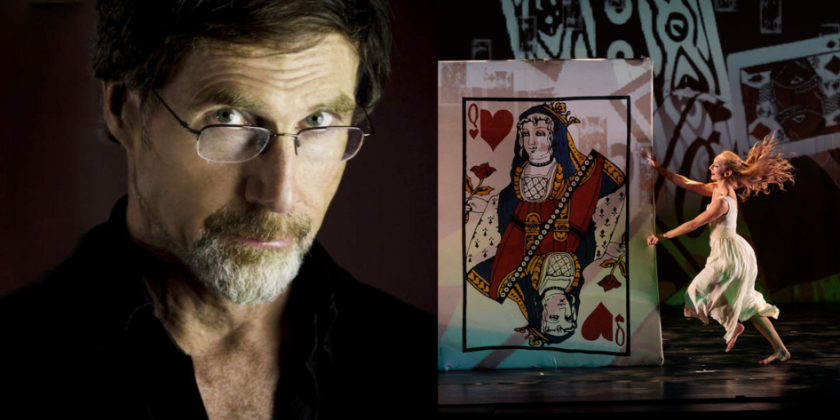
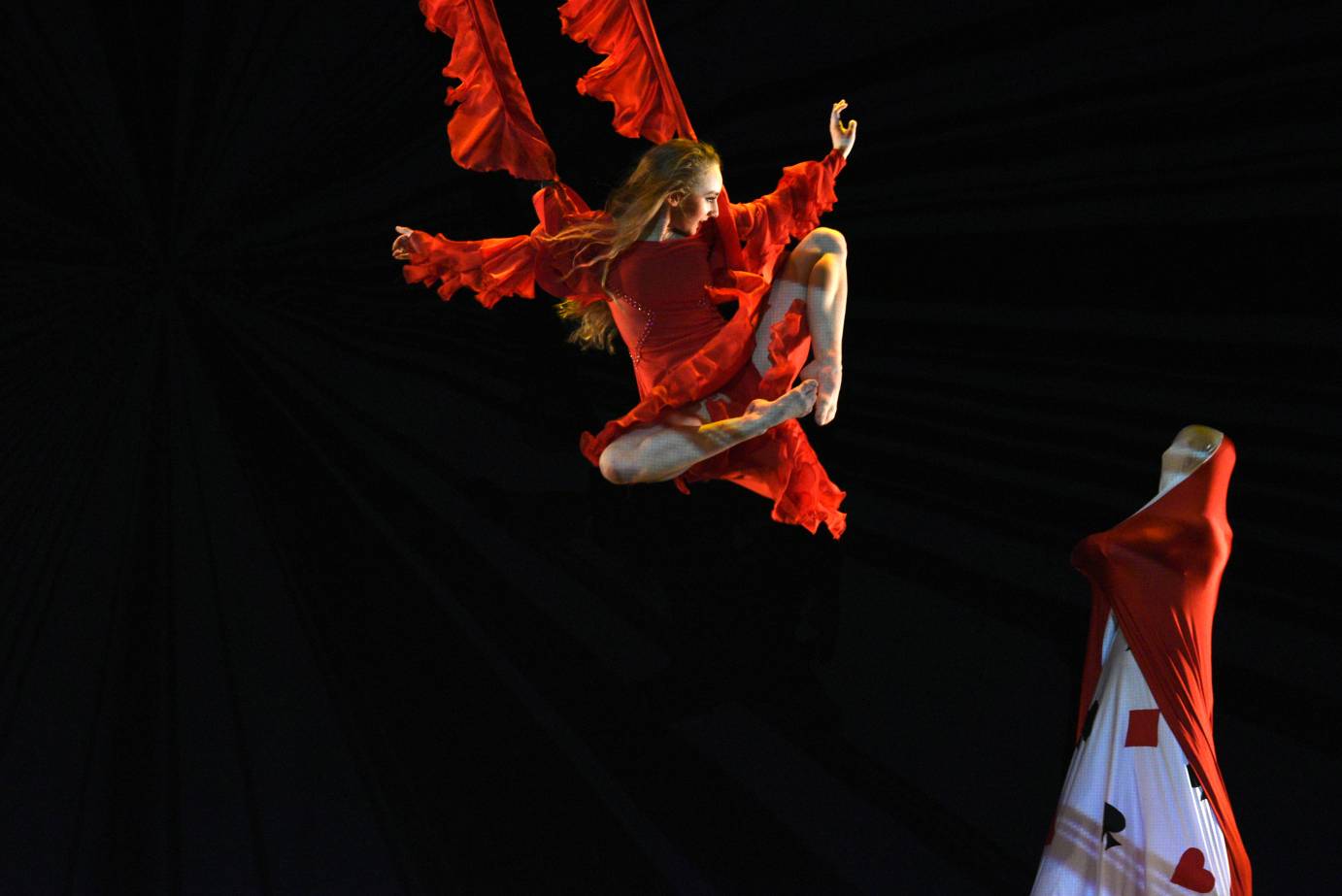
And then we have “Alice”, the new production that is touring around the US. The idea was to use Alice as a springboard for an invention that would entice people down the rabbit hole, MOMIX style. Much of Lewis Carroll's intention of Alice wasn't just the book; you never would have known about the book if you hadn't seen it through the wonderful illustrations by a man named John Tenniel. And so in a way, MOMIX is further illustrating the story in our own way. If Carroll were alive today, he might have added a chapter because of what he saw in the MOMIX show.