

Related Features
DAY IN THE LIFE OF DANCE: A Peek into the Final Preparations for the Performance Mix Festival
![IMPRESSIONS: [Spring in Brief] Sugar Vendil, Alexa Grae & Symara Sarai, marion spencer, and Tyler Ashley](/images/features_small/Spring_in_Brief_2.png)
IMPRESSIONS: [Spring in Brief] Sugar Vendil, Alexa Grae & Symara Sarai, marion spencer, and Tyler Ashley
IMPRESSIONS: Spring in Brief | Jonathan González's "Swerve Fatigue" and Symara Sarai's "Angelic Architectures"

By Sarah Cecilia Bukowski
View Profile |
More From This Author
Published on May 7, 2026
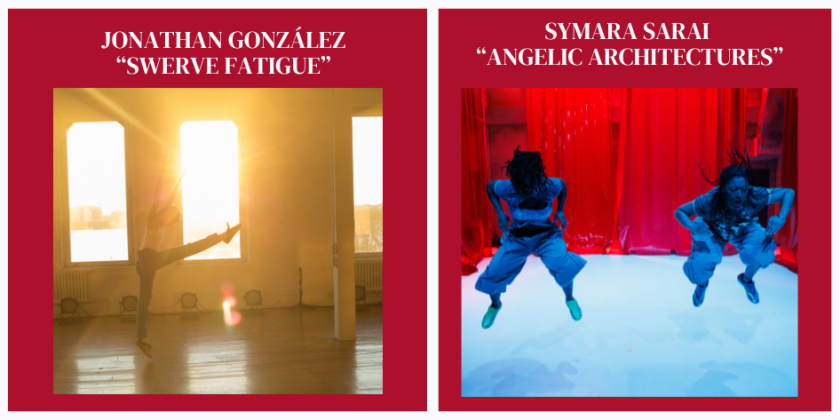
Photo: Jonathan González and Symara Sarai
Performances at The Kitchen and Abrons Art Center
Jonathan González's Swerve Fatigue at The Kitchen
Choreographer: Jonathan González
Performers: Wayne Arthur, Ananda Naima González, India Lena González, Marguerite Hemmings, Kingsley Ibeneche, AJ Wilmore
Sound: Alexis de la Rosa, GENG PTP
Lighting Design: Jonathan González
Costume: Jonathan González
April 10, 2026
Symara Sarai's Angelic Architectures at Abrons Arts Center
Choreographer, Director, Costume Designer, Performer: Symara Sarai
Sound Design, Original Music, Live Vocals: CHIMI
Performers and Choreographic & Text Collaborators: Kentoria Earle and Kashia Kancey
Production Designer: Caz Slattery
Lighting Designer: Ava Elizabeth Novak
Production Stage Manager: Gia Ramos
April 17, 2026
Lately I find myself thinking about effort and ease. Not as opposites, but as two sides of the same coin. I think about the ways effort and ease are portrayed in the world: in the superhuman efforts of Olympic athletes, in the indulgent ease of luxury ad campaigns. And I think about how they show up in my own life: the everyday effort of climbing the 110 stairs that cut through the hill to my street, the ease of my first glide through the cool water of the pool where I swim laps most days of the week.
But it’s in witnessing performance that I am most drawn to the nuanced textures and simultaneities of effort and ease, where I find myself catching my breath as I behold sweat and surrender in the supreme athletic virtuosity and soul-deep commitment that artists bring in the breadth and particularity of their unique and myriad voices.
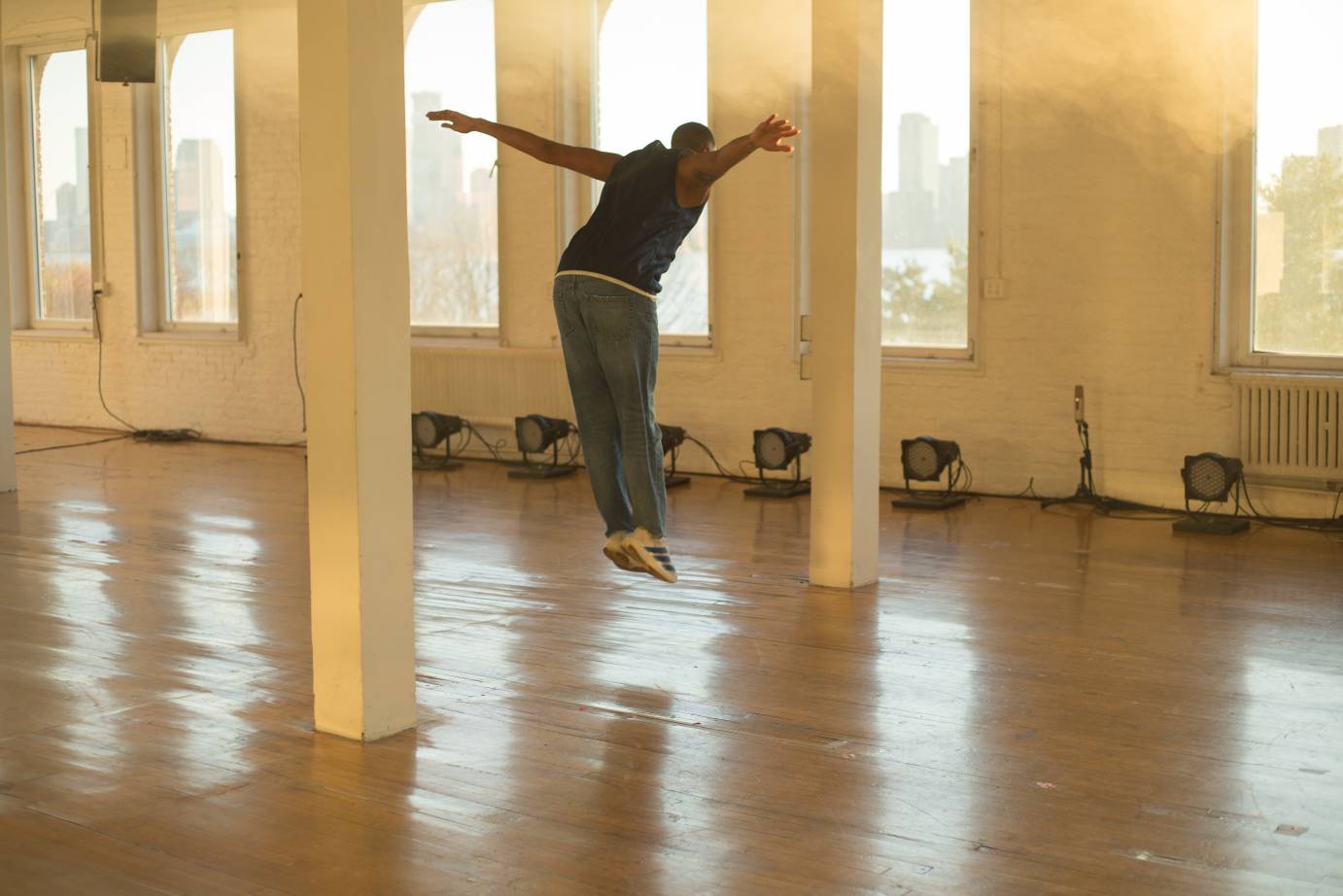
Beyond the illusions of effortless ease inherent in some modes of performance — the steely strength and pliant grace of the ballerina—I marvel at the organic simplicities of easeful coordinations, at the fine-tuned calibrations required to find ease in effort, at the transcendence of pushing effort to its limits in the fullness of a moment. Lately my own dance practice has been more about finding ease — it’s been a while since I last pushed my body’s physical limits — and while a part of me misses intensely the feeling of losing myself in the visceral catharsis of effort, I find I can (and perhaps should) sometimes lose myself in the limbic flow of ease. Experiencing performance, gratefully, offers something of both through the harmonies of physical empathy that radiate from the bodies of performers to my own, seated in my humble chair.
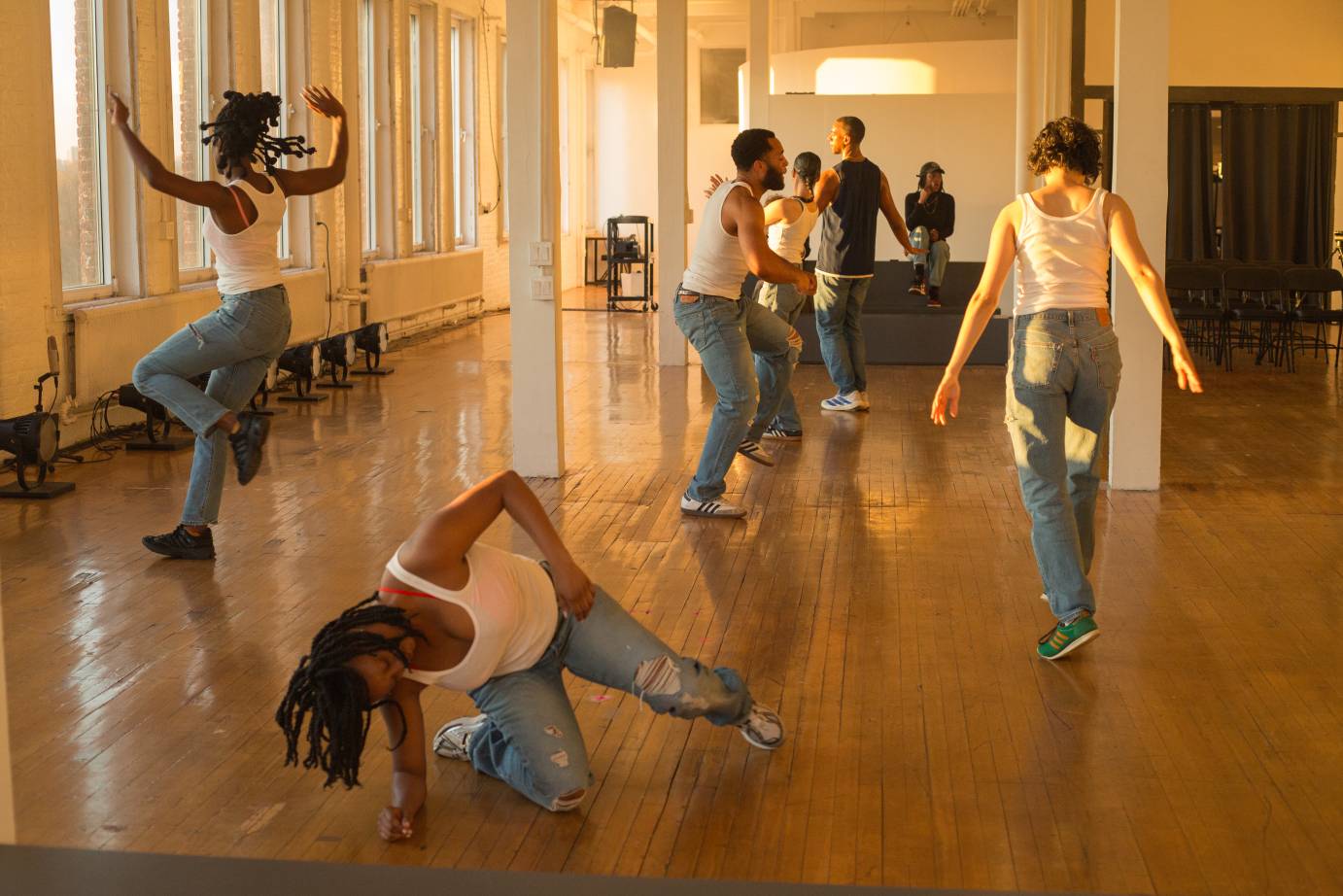
Two such performances this April catalyzed these reflections on effort and ease: Jonathan González’s multimedia group work, Swerve Fatigue, presented by The Kitchen in their loft at Westbeth, and Symara Sarai’s dance-play, Angelic Architectures, at Abrons Arts Center’s Experimental Theater. Both artists work in experimental forms that merge movement, sound, and design into polyvocal renderings of intimate interior narratives and expressions of collectivity. Physical proximity, direct address, and contact with their audiences press further into troubling these intimacies through moments of friction, confrontation, and sensory destabilization.
Each in their own way, González, Sarai, and their collaborators center questions of Blackness in their self-portrayals, drawing on physical, musical, linguistic, and cultural vernaculars to explore how these embodied lineages continually rub up against the stuff of their worlds. These questions play out through their deft and purposeful articulations of effort and ease, and while the tone and resonance of their works differ markedly, these two artists show how strategies of Black resistance and survival reverberate from their bodies into the world.
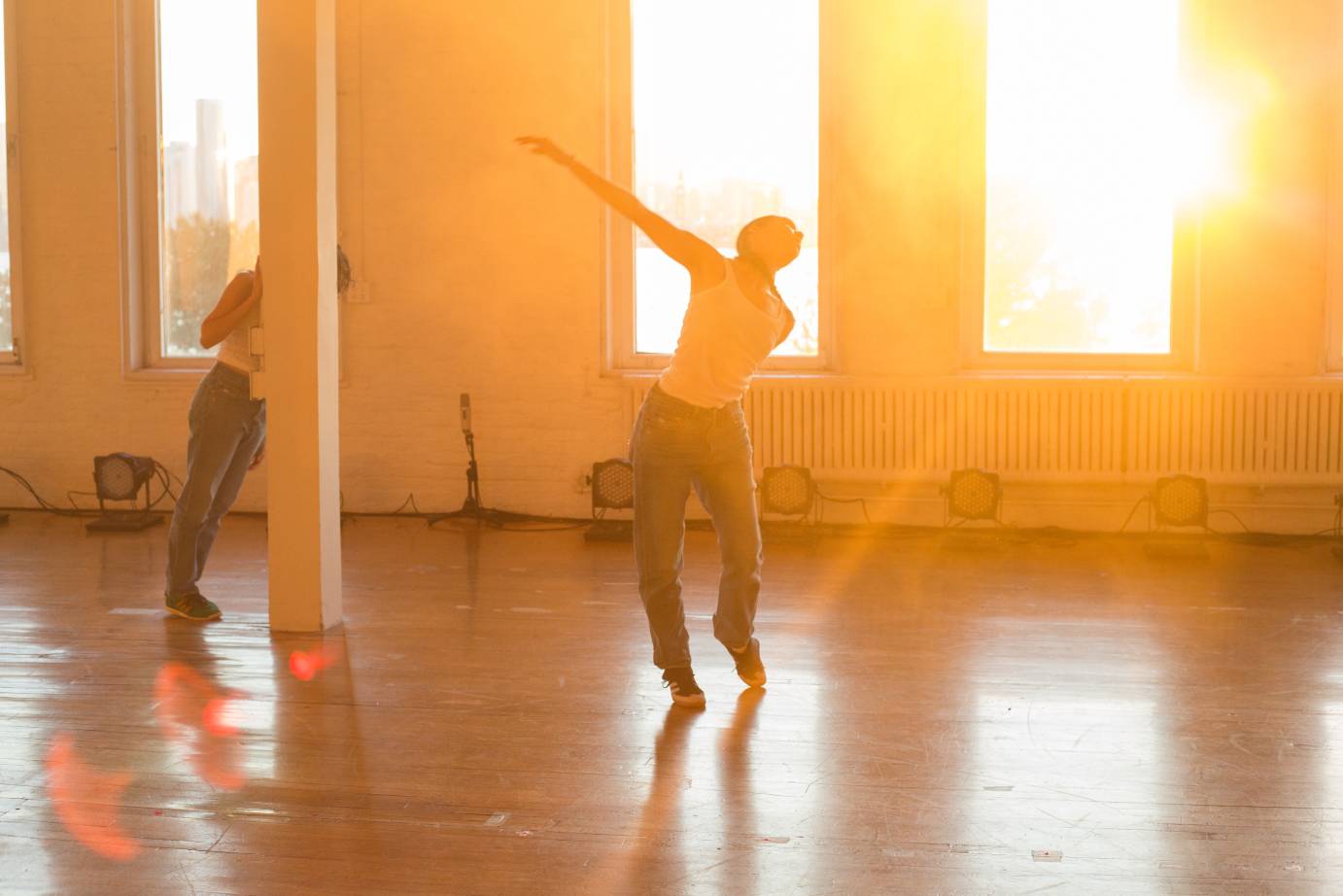
The title of González’s work stems from individual and collective practices of “swerving” — sudden changes of direction to find clear paths—and group tactics for navigating the exhaustion that builds through these accumulations of calculated and improvised avoidance (bearing in mind that a swerve can be psychological, semantic, or emotional as well as physical).
The work opens with a solo for González that draws attention to architectural and spatial parameters through intricate acts of tracing while establishing touchstones in Black dance architectures — Alvin Ailey, James Brown, and Haitian Yanvalou among them — that the other five dancers absorb, revocalize, and multiply in shifting juxtapositions — tap, breaking, ballet, hip-hop, jazz, and more — as they join from the perimeter. With these languages they claim their histories and extend their imaginaries through the legacies and lineages that mix and remix in their bodies.
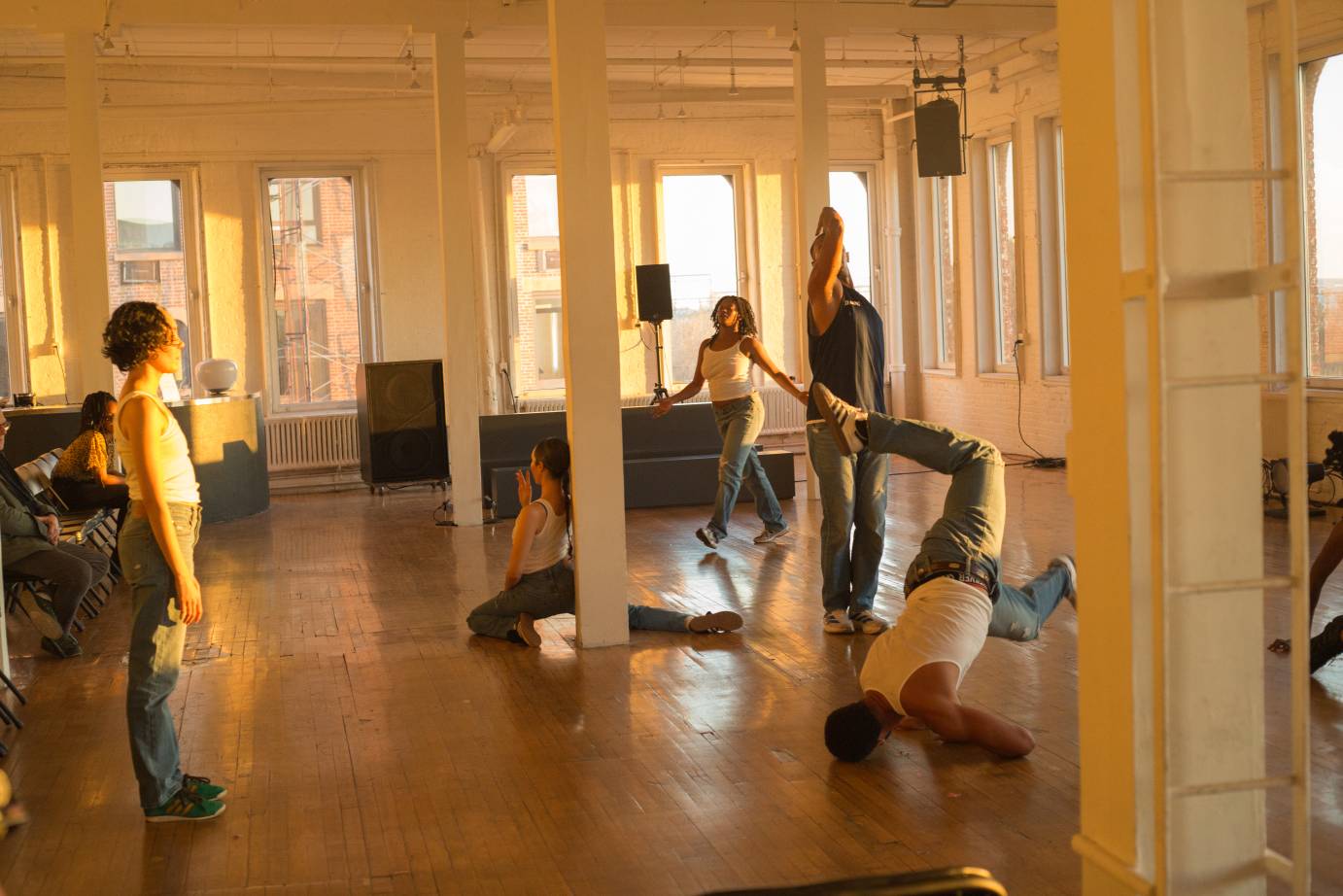
Birdsong rises to meet the sounds of their bodies as the waning sunset over the Hudson casts colors and shadows through the wall of windows behind them. They move iteratively into passages of group swerving that build in density and speed to breathtaking sprints as their voices rise, counting in unison only to shatter into jagged arrhythmias. Peeling back to the perimeter, they become as stoic as the loft’s square white pillars to clear the space for the monumentally lyric baritone Wayne Arthur, who fills the air with fragments of grave and tender arias.
The dancers sculpt landscapes, obstacles, and writhing support structures around him to shape his journey, ultimately engulfing him as a many-limbed creature that squeezes itself into a corner to clamber up and over the audience. As their effort accrues, so too do sound and atmosphere: a slowly-encroaching rumble and moody haze become an all-encompassing sonic throb and dense fog that scramble the senses. These sensory overloads bind everything and everyone in the space as we become witnesses to inextinguishable collectivities enacted through encounter, interruption, and continuity, and finally, through the sheer pleasure and ease they find together in the syncopated slip and swirl of a shared groove.
As the lights fade to reveal the twinkle of city lights through the windows in the just-fallen dark, I sense a journey that has come to rest, yet remains ready for anything.
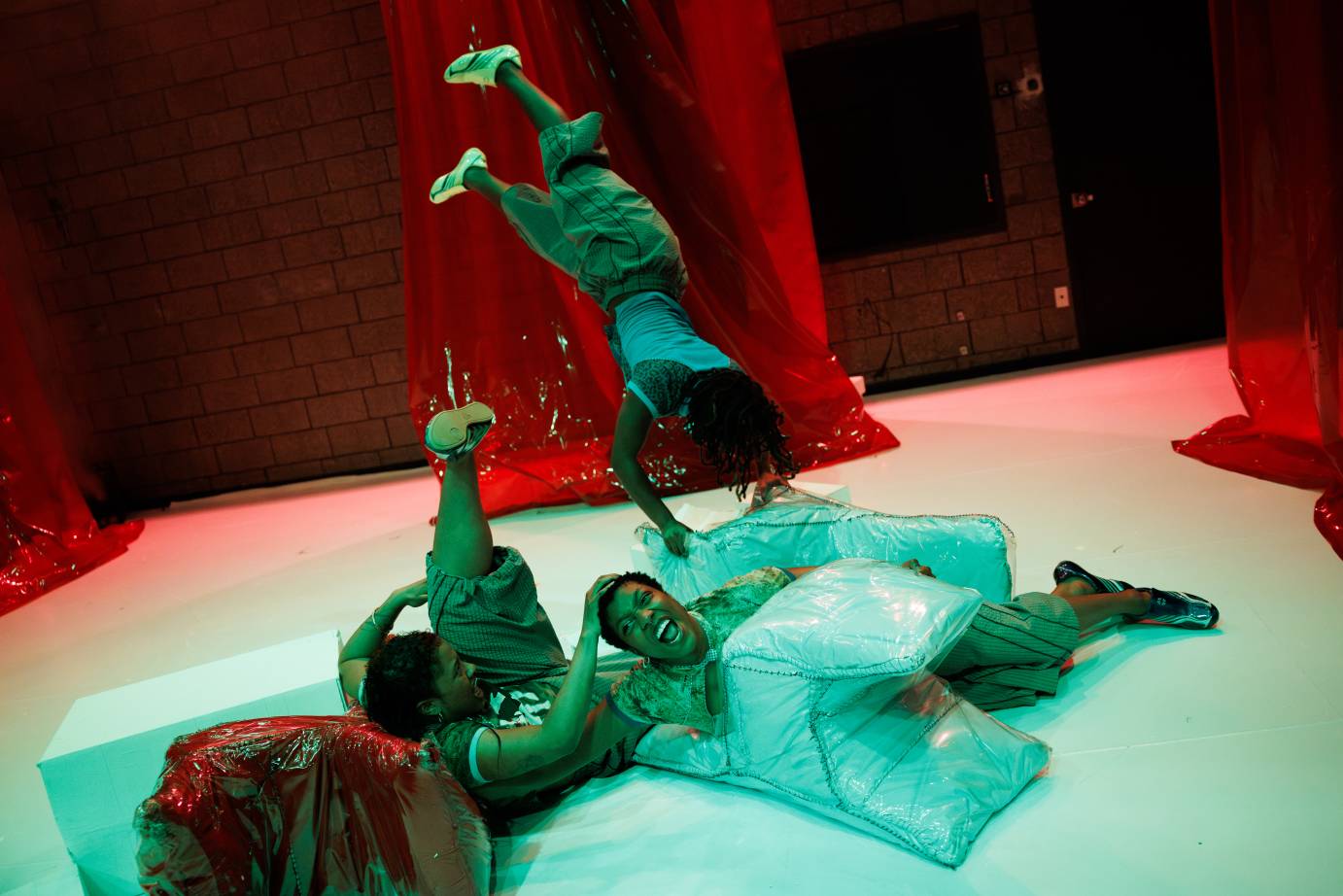
Symara Sarai's Angelic Architectures. Photo: Maria Baranova, courtesy of Abrons Art Center
“Ready for anything” suits the indomitable Symara Sarai to a tee, with a body of work that is as wide-ranging in its thematics as it is unpredictable in its expressive registers. Her Angelic Architectures, ignites the close confines of Abrons’s cinderblock-walled Experimental Theater, which are hung with translucent red plastic panels that are at once clinical, sinister, and strikingly chic. The trio for Sarai, Kentoria Earle, and Kashia Kancey excavates the contours and frictions of Black femme interiorities through scenes of isolation, desire, defense, care, and solidarity. Their collaboratively-authored movement monologues draw on deeply-felt, almost diaristic words and gestures that are echoed and amplified by sound designer and vocalist CHIMI, who acts in tandem with the performers to shape rhythmic and melodic soundscapes that become playful, ominous, and frenzied in turn.
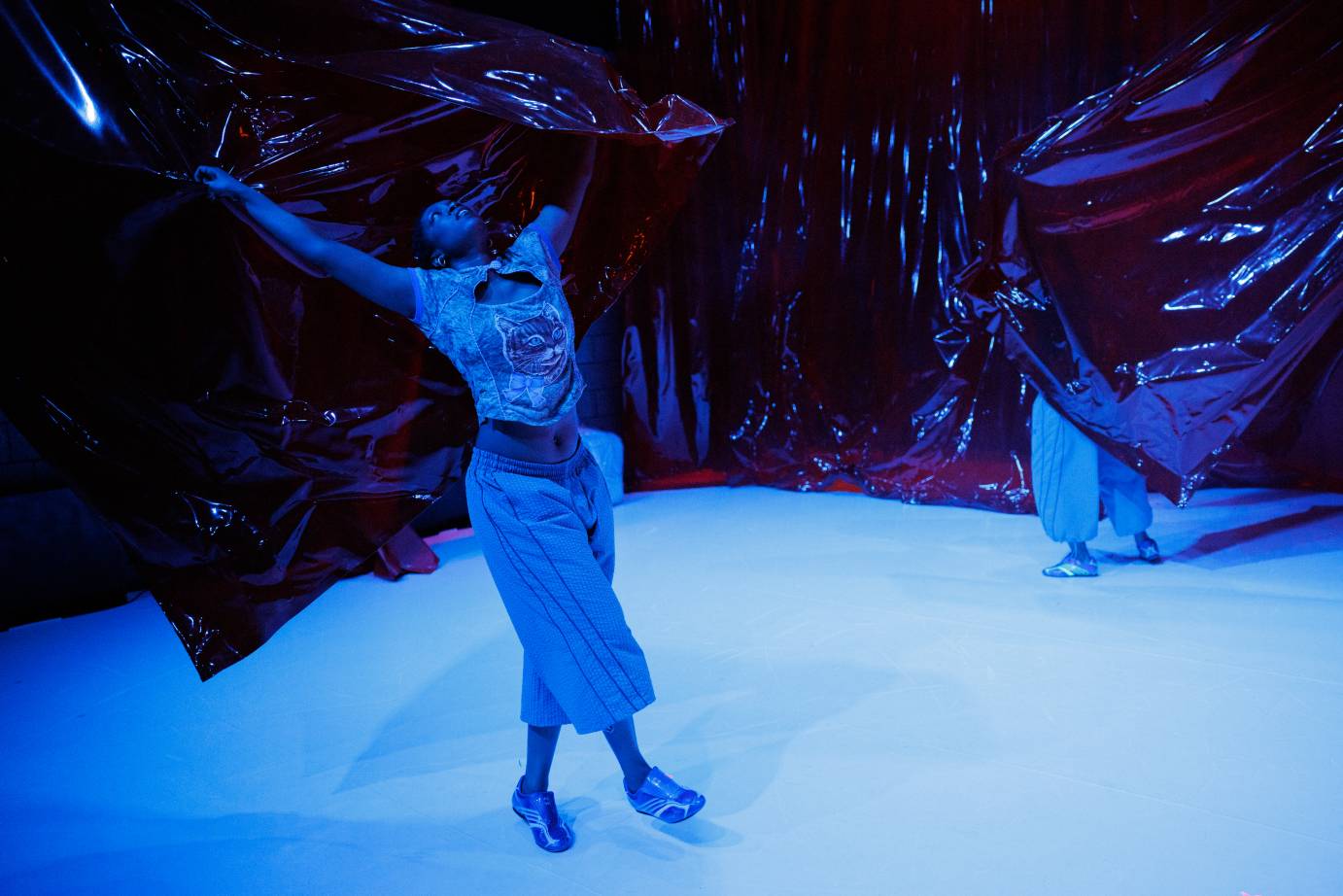
Symara Sarai's Angelic Architectures. Photo: Maria Baranova, courtesy of Abrons Art Center
Sarai and her collaborators embody Black feminist critique in their incisive externalizations of interior narratives and sensations that rise sharply to plateaus of sustained effort. Grounded in the subtleties and extremes of their physical capacities, they shake and tussle and tangle through escalating frustrations and gasping surrenders; for a moment, they fold into one another and gently clasp hands. They manipulate spoken passages of text to show the power of words through persistent repetition, sly wordplay, and modulations of tone, speed, volume, and rhythm, unafraid to tackle the sharpest precarities and complexities of love, including self-love, and what it means to be worthy, what it might feel like to be free. Through the excesses of their explosive and elastic feats, they find their most ecstatic release in the collectivity of a church revival, in the effort and ease of a stomp and clap, of voices raised together in song. Once again, the performers’ journey opens, ever and always, into possibility.
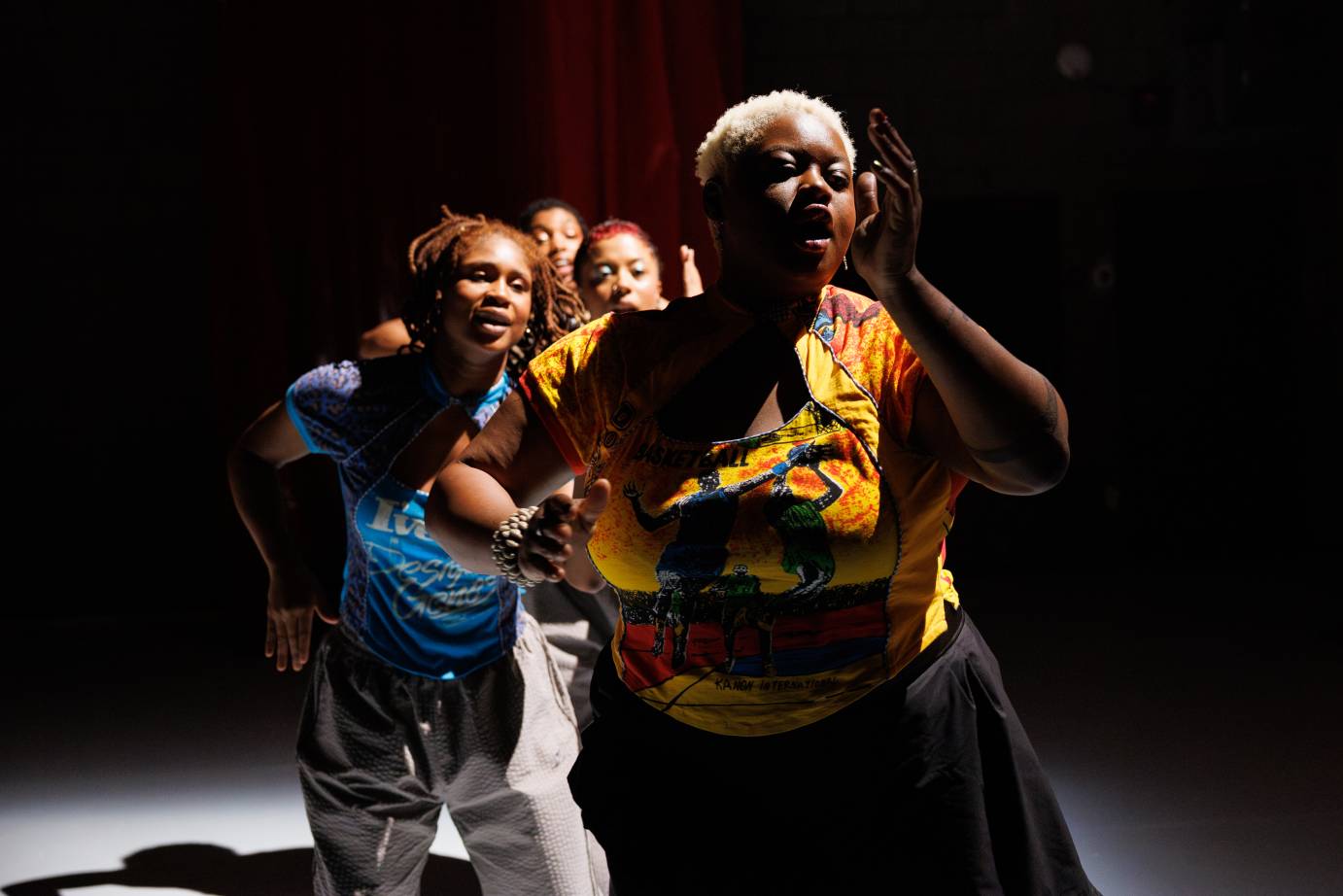
Symara Sarai's Angelic Architectures. Photo: Maria Baranova, courtesy of Abrons Art Center