



Related Features
IMPRESSIONS: Lydia Johnson Dance Leaves Us with a Sense of Caring at New York Live Arts

IMPRESSIONS: Fresh Tracks 2026 at New York Live Arts
IMPRESSIONS: Ogemdi Ude’s "MAJOR" at New York Live Arts

By Lisa Jo Sagolla
View Profile |
More From This Author
Published on January 21, 2026
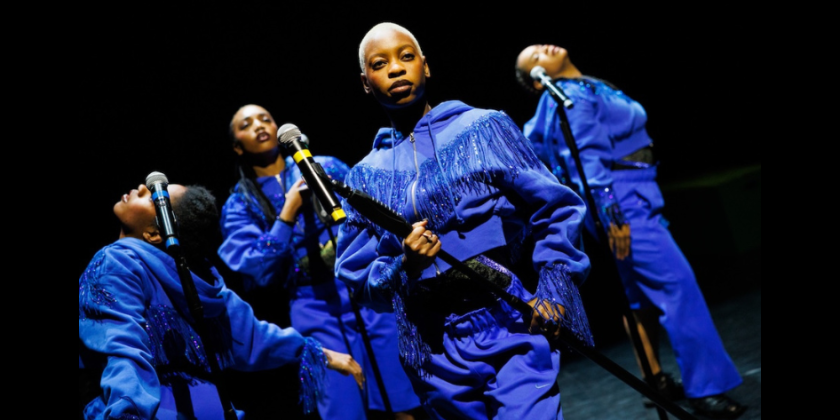
Ogemdi Ude's "MAJOR". Photo: Maria Baranova
New York Live Arts, Live Artery, presents
MAJOR
Choreography/Direction: Ogemdi Ude in collaboration with the performers
Music: Lambkin
Lighting and Set Design: Simean “Sim” Carpenter
Costume Design: Celeste Jennings
Dance Captain: Selah Hampton
Brooklyn United Choreographer: Whitney Wiggins
Brooklyn United Drum Director: Rodney Smith Jr.
Performers: Kayla Farrish, Selah Hampton, Jailyn Phillips-Wiley, Junyla Silmon, Chanel Stone, song aziza tucker, and the Dancers and Musicians of Brooklyn United
Jan. 7-10, 2026
Because of how exciting I find Stepping -- that other team dance form spawned on the campuses of Historically Black Colleges and Universities, about 100 years ago – I jumped at the opportunity to see the first North American showings of MAJOR, a dance-theatre exploration of majorette dance. Not as regimented as the spoken-word-and-body-percussion-driven Stepping, created by Greek-letter fraternities, majorette dance is an ensemble form birthed at HBCU’s in the 1960s when marching-band majorettes put down their batons to perform full-out precision dance routines combining Black-rooted vernacular and theatrical dance styles.
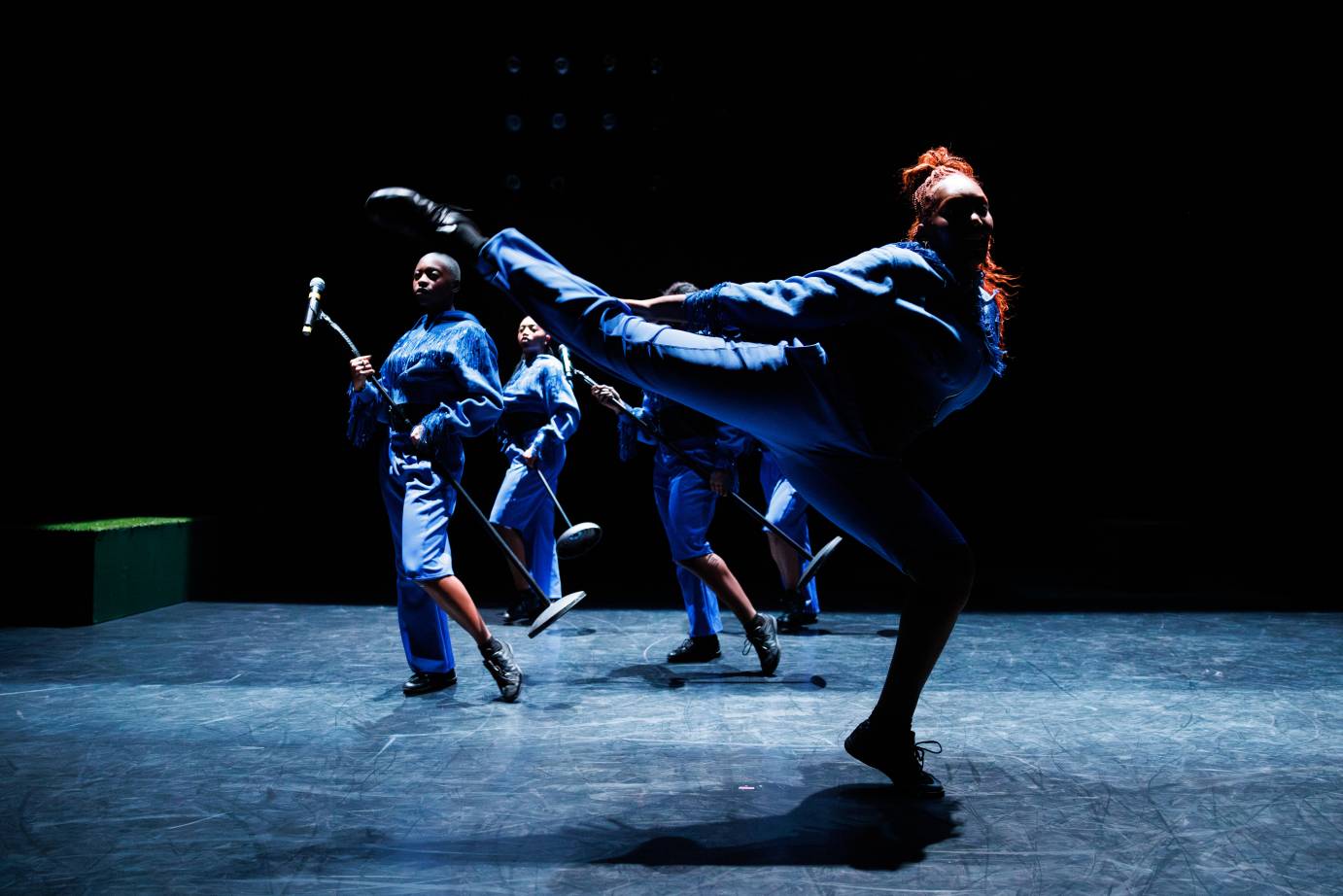
Premiered in Germany last August, MAJOR was presented in early January at New York Live Arts, as part of the venue’s annual Live Artery festival. Choreographed and directed by Brooklyn-based dance artist Ogemdi Ude (in collaboration with the performers), the provoking 55-minute piece unpacks Ude’s corporeal, self-identity journey from a young majorette dancer to a grown-up choreographic artist committed to uplifting her “community” of Black femmes, which includes all LGBTQ+ folks who present in a feminine fashion.
The keenly-structured work opens with a telling solo in which a young woman flounders about, starting and stopping as she “tries out” different steps and styles in a struggle to find the “right” way to move her body. From the physical vocabulary she samples, we realize this is going to be a work about the relationship between the choreographer’s early experiences as a majorette dancer and her current interest in revisiting those movement sensations, and their social implications, as an adult, contemporary dance-trained mover. The soloist is soon joined by the five other members of her “team.” Enticingly costumed by Celeste Jennings in bright-blue pantsuits with glittering fringe across their bosoms, they begin to practice a majorette dance routine, describing each movement as they do it – “one-eighty turn with slide, swirl waist in a circle and pop hip.” The dancing is highly sensual, a combination of undulations and percussive accents. There’s vogue-like strutting and posing, with hands placed decoratively around the face.
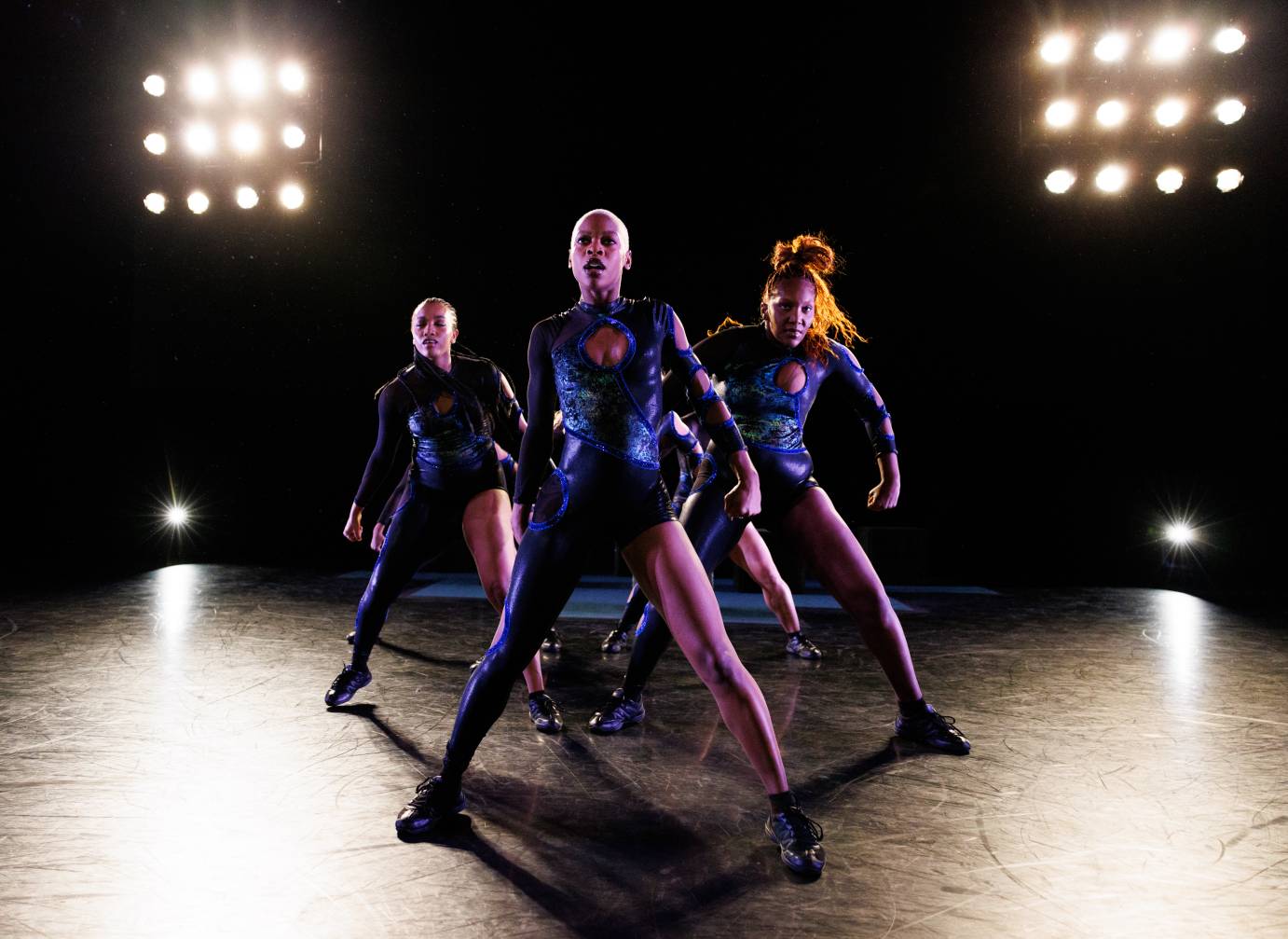
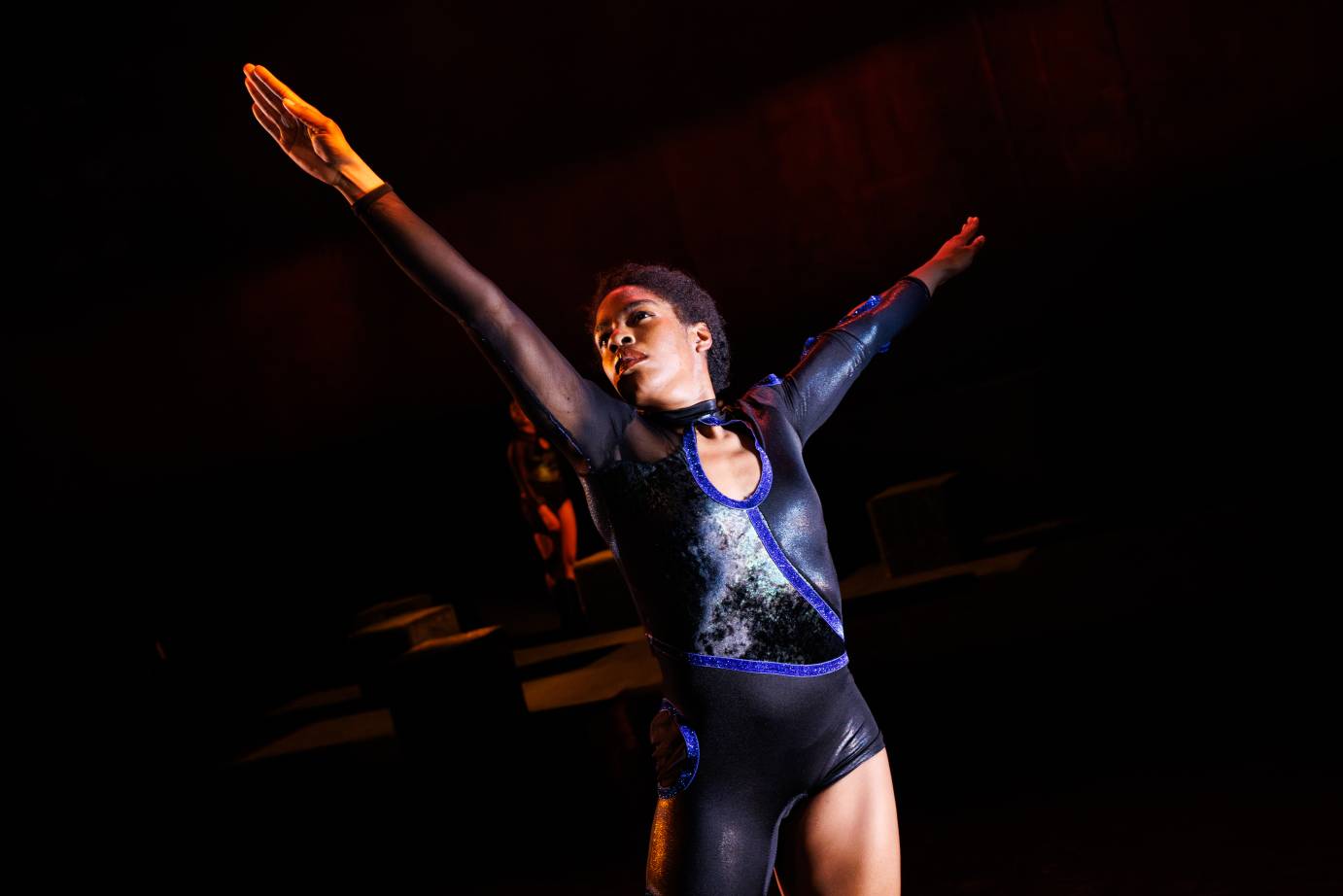
Ultimately, they strip off their blue outfits and, now clad in tight-fitting black leather, launch into energetic execution of high kicks, straddle jumps, twerking, and sharp crotch-framing gestures. Majorette dancing, it seems, is not as “clean-cut” as Stepping, and certainly not for the prudish. By the end of the scene, these dancers emerge as a fierce tribe of Black femmes, an identity that grows bolder as the piece progresses. In an interview with Bill T. Jones, recorded in December, Ude stated that she employs only Black femme dancers, and the six forming the cast of MAJOR are all extremely engaging performers. The stand-out dancer is Kayla Farrish, who breaks from the group in the next scene to perform a stunning solo, gliding cat-like through lower levels of the space with the speed of a cheetah and the strong, surprising attack of a stalking lioness.
Unfortunately, what follows is a raunchy ensemble passage kicked-off by every imaginable variation of derriere shimmies – accelerating the vibrations to supersonic speed, performed bent over in back-to-the-audience crotch-displaying stances, done standing buttocks to buttocks with a partner, or with one hand grabbing each cheek, shaking them hard and finishing off with a slap. As the sequence evolves, it becomes virtually unwatchable. Not only does the lighting (designed by Simean “Sim” Carpenter) blanket much of the stage in darkness, while spotlights aim blinding streams of harsh white light directly out at the audience, but we hear dancer song aziza tucker proclaim “This is it. This is grown-girl shit.” She goes on to scream ferociously into a microphone, telling us “I’m not being watched, I’m making you watch.” The accompanying electronic music (composed by Lambkin) grows louder and louder, but tucker yells above it, assaulting us with her words, and becoming increasingly more enraged, as she and the others emit unrestrained fury in their lewd miming of sexual movements, desperate to convince us (or themselves?) of the truths they are proclaiming.
I was reminded of the, albeit much tamer, decades-old argument among feminists who disagree on whether strippers are sex objects or liberated women empowered by their capacity to “manipulate” men. Ude, I think, is wrestling with how a former majorette dancer can revisit the sexy moves she once performed in order to own the feelings they evoke within the context of her own evolved sexuality.

As the dust settles, the tone of the piece shifts dramatically. Suddenly, we’re witnessing a tender duet that, at first, feels confusing, as it’s not clear how we got here from the preceding provocations. But when the duo’s movements become playful, and we see two girls returning to their youth – practicing majorette steps and sensing, perhaps, the blossoming of a sexual attraction -- the piece feels back on track. Though the duet goes on too long and is not always interesting, I advise viewers to hang in there!
SPOILER ALERT! Just as we start to grow disappointed that Ude’s piece is not as much about majorette dancing as one may have hoped, a seven-member drumline of teen-age boys charges in and saves the day! Banging away on snares, bass drums, and cymbals, they prance and bop about with terrific flair, moving through their patterned formations not with militaristic marching but with wonderfully bouncy steps and spins. I found myself grinning from ear to ear and, judging from how happy the drummers looked, one suspects they were enjoying performing for us as much as we relished watching them.
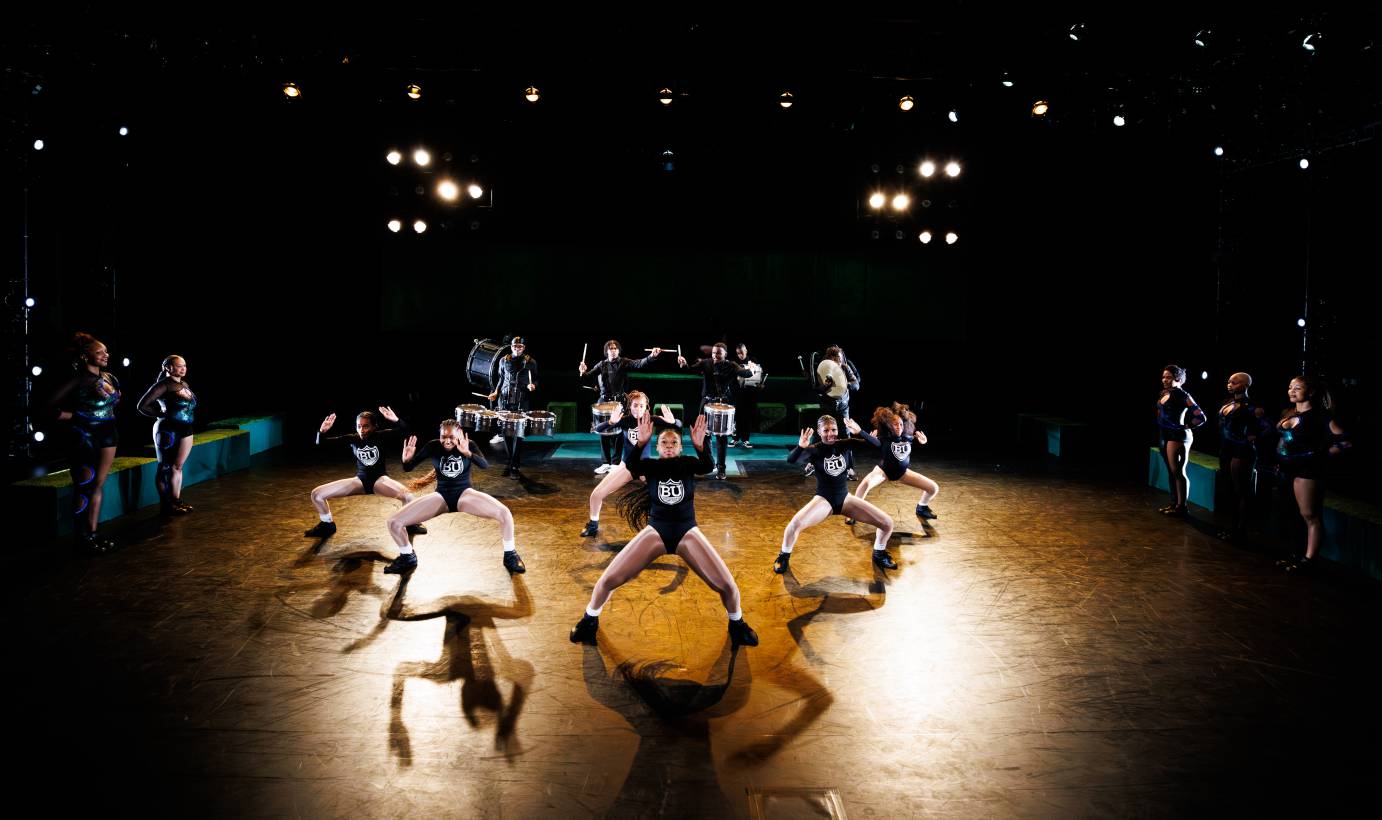
And then, when I thought it couldn’t get any better, the talented percussionists were joined by -- yes, you guessed it – a team of young majorette dancers! They wore leotards sporting the letters “BU,” as the youngsters all hail from the Brooklyn United Music and Arts Program, a New York City youth organization that provides instruction in marching band as an art form combining musicianship and pageantry. As Ude’s piece built to its spectacularly entertaining finale, the adult performers joined in the fun, dancing alongside their younger “selves” while the crowd roared in appreciation.