


More Audience Reviews
The Queens Outdoor Dance Festival in October 2026
Barkha Patel Presents "Ichhā"
AUDIENCE REVIEW: Elizabeth Buchheister’s Sold-Out Debut of "Eight Dances" at Arts On Site
Company:
Elizabeth Buchheister and Company
Performance Date:
11/14/2025
Freeform Review:
In a world where resilience feels necessary for survival and unity is increasingly elusive, dance remains a medium to explore the potential for both. Surrounded by disconnection, distractions, division, and performative displays of togetherness, the question of how we genuinely relate to one another is becoming increasingly urgent. Eight Dances enters this landscape with vulnerability, using the body as a site where fracture, endurance, and connection coexist and unity is not assumed, but actively worked towards.
On Friday, November 14, I attended Elizabeth Buchheister’s sold-out debut of Eight Dances at Arts On Site. The program embodied her first five years as a professional choreographer with modern-contemporary works highlighting her multimedia, theatrical, faith, dance, and community influences. Complete with live music, costuming, lighting, and set design (self-produced by Buchheister), her choreography posed as a love letter to the world crafted with structure and attention to detail. She delved into diverse subject matter: emotional battles, a desire to impact, a cross-genre love of music, and humorous social commentary on digital media.
Yet despite the program’s versatility, her movement style remained consistent throughout, allowing the evening to flow effortlessly. This consistency was the glue holding the program together through Buchheister's musically driven style, which balanced relationships, structure, theatricality, surprise, and humanness.
Her choreography was fueled by relationships and building community—reflected not only in the dancers’ connections with each other, the space, music, and other production elements—but also in the audience. During the pre-performance and intermission periods, I engaged with other audience members and remained actively tuned in to the conversations around me. Filling each seat in the black box theater were lighting designers, musicians, dancers, family, thespians, and individuals from her faith community.
I was especially captivated by how the audience mirrored her choreographic approach. As a professionally trained modern dancer, I recognized the rich blend of influences revealed through her Horton-heavy movement vocabulary, fusing linearity with waves and a strong relationship to the music.
In His Love–set to Jon Foreman’s “In Love”–analogized a faith relationship. The music opened first, taking on the “guiding source” role in a “I go, you follow” relationship. The dancers mimicked the beat with rhythmical footwork, direction changes, and swinging arms.
Four Dialogues for Piano, Violin, and Movement expanded this relationship to include Buchheister, her full cast, and onstage musicians. The live music was a brand new piece created in collaboration with the musicians Karl Kilb IV and Jonhum Palado. The choreography contrasted “division” versus “unity” dynamics, delivering energy shifts from chaos to everyone moving as one. It reflected the “fragmenting” and “restabilizing” processes in artistic relationships, with movement echoing and opposing musical phrases.
It ended as the dancers sank to the ground, clustering and lounging against the piano and musicians behind them in a final angelic image: community birthed from struggle. “Struggle” persists throughout Buchheister’s choreography, not as a plot line, but as a core indicator of the human qualities her movement style embraces.
Her movement is infused with a grippingly human approach. Each piece was organic, allowing the audience to resonate and find a piece of their experience reflected in the struggle. In His Love unveiled raw, human textures on the body. By highlighting the physical work and challenge in performing the movements, the piece embodied the emotional, mental, and spiritual toil of the human condition. With purposeful stillness, heaving chests, aching pains, and burning muscles, the dancers illustrated resilience in climbing life’s mountains.
In contrast, Impact texturized humaneness on a different scale. Set to upbeat jazz, the dancers energetically turned, arched, and absorbed the beat in their hips with ever-present smiles and theatricality. Their bodies showed a physical buoyancy definitive of passion, joy, and a burning desire to uplift, impact, and serve a higher purpose. Buchheister’s structural implementation allowed for patterns to traverse naturally across the stage in a collage of shapes. The dancers took turns leading as they wove among themselves, switching between technical and groovy textures.
Although her movement is rooted in structure, Buchheister showed she also took pleasure in breaking it by skillfully incorporating theatrical qualities and surprise to pull the audience into her world. Just when you thought you understood the piece’s trajectory, she flipped it.
Several moments revealed this: the slew of masked dancers in Ego States prancing jovially from a slit in the back curtain; one dancer’s horrified look upon losing her mask; and a sneaky dagger reveal in The Dance of Death (from The Three Furies). However, no other piece grasped the audience with its theatricality and unpredictability like There is No Destination.
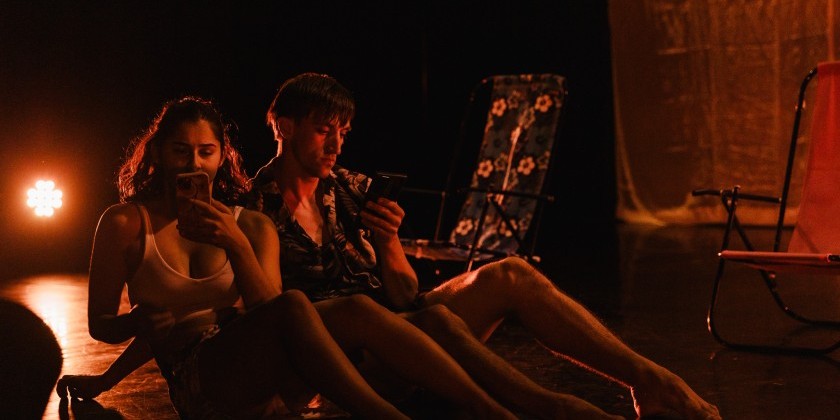
Props, lighting, an atmospheric soundtrack, and highly developed characters infused this theater-dance duet with humor, holding a mirror up to the audience. An eye-opening tweet on the digital age inspired its plot about a couple vacationing. While digital media gets them there, it also takes over their vacation and quality time.
It followed them throughout the lightbulb moment, overpacking, a frantic rush to the airport, and— reaching their destination —a slow-motion descent down digital rabbit holes. The story came to life with timely sound effects, emotive facial expressions, humorous back-and-forths, bold gestures, and playful partnering between the couple and their suitcases.
The final section showed them on beach chairs simultaneously doomscrolling on separate, often intertwined journeys. The music, lighting, and the dancer’s sloth-like movements created a time-warping illusion as they melted off their chairs into each other’s arms, faces melded with their screens. It highlighted the absurdity of our phone-driven relationships and their influence on how we interact with others and perceive the world. The piece ended with the dancers enmeshed on the floor with their devices before a blackout left only the eerie glow of their phone screens—sending a shiver down our spines.
This wasn’t the only moment evoking spine shivers. Each piece was seeped in a similar charge, layered with vulnerability and gradually stripping away thematic facades to reveal the sometimes uncomfortable truths beneath them. Piece by piece, Buchheister allowed her own vulnerability as an artist to show, inviting the audience to not just witness it, but to share it. Rather than offering solutions, Eight Dances gathered awareness, holding space for contradiction, struggle, and collective reckoning. Buchheister presented resilience not as individual endurance, but as something communal, multidimensional, and alive.
Author:
Lilliana Miller
Website:
https://lillianamiller.weebly.com/
Photo Credit:
Paiter Van Yperen and Santina Leone in "There is No Destination." Photo: Scott Hoffman