
More Audience Reviews
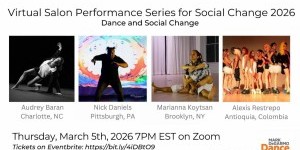
Community, Care, and Support: Mark DeGarmo Dance's Virtual Salon Performance Series
Thomas Hogan Presents: 'Goliath' a work-in-progress.

AUDIENCE REVIEW: FRACTURED From SOULSKIN Dance & MAFFEI Dance Company
Company:
SOULSKIN Dance & Maffei Dance Company
Performance Date:
2/27/2026
Freeform Review:
On Friday, Feb. 27, I attended FRACTURED, a collaborative performance between SOULSKIN Dance and MAFFEI Dance Company, premiering four works at The Ailey Citigroup Theater. Despite the companies’ distinct styles and multi-media approach, it was unexpectedly cohesive. As a professional dancer and graduate of the Fordham/Ailey BFA program, I'm familiar with JoLea Maffei’s style and hold a double degree in Creative Writing alongside a background researching methods for effective storytelling and nonverbal communication through choreography. This gives me a unique insight into the works presented, specifically in recognizing how storytelling threaded it all together.
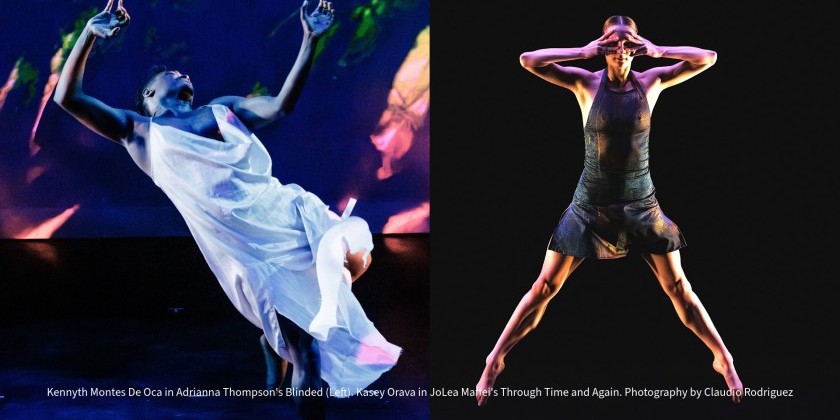
MAFFEI Dance Company opens the program with Through Time and Time Again. Baroque themes shape every angle, from Emil Marti and JoLea Maffei’s vibrant teal and orange costumes featuring delicate Fleur de Lis designs to the stylistic gestures. The soundtrack incorporates Viola da Gamba works from 18th century composer Carl Friedrich Abel, performed by Paolo Pandolfo, with Eran Fink providing an original companion Jazz suite inspired by Abel’s music.
Baroque concepts not only inspire the piece's overall aesthetic but also its choreographic structure. The work incorporates defining characteristics from traditional 16th-18th century Baroque dance compositions, influenced by Feuillet notation. This includes symmetrical floor patterns, a strong musical relationship, precise footwork, upright posture, and elegant movement within Maffei's contemporary interpretation. Inside this structure, the dancers hang on every note with breathy pauses, rippling torsos between sharp lines, and indulgently gyrating their hips and shoulders. Each duet connects playfully through the dancers' engagement and partner response. Constant eye contact, flirtatious grins, and animated faces share mixed pride and pleasure, matching the groove and sass infused with elements of the Horton technique.
Adrianna Thompson’s Blinded blurs the fine lines from the piece prior with an emotional minefield of shifting tensions, power plays, mind games, and heart-wrenching turmoil. True to form, SOULSKIN presents a raw, deeply intimate depiction of mankind’s two-faced tendencies screaming: “We are the ones inflicting the most pain, and yet we are also the ones healing it”.
Unpredictability and chaos underlie its multi-stranded storyline, reflected through the range of characters represented onstage. Each dancer wears unique, eclectic pedestrian-style outfits, such as black or white contemporary-styled dresses and baggy T-shirts, layering long skirts. Contrasting MAFFEI Dance Company, SOULSKIN embraces messiness over visually pleasing structures. Much like the human condition, the work emphasizes individuality through the dancers’ ownership of movement, space, timing, and evolving partnerships. Four contrasting couple relationships move in scattered formations, creating a sensory collage of images and twisting plots examining human relationships. The free-flowing, abstract movement favors unapologetic gestures and gripping portrayals. One partnership morphs from loving to backstabbing as a scarf unravels from a costume, transforming into a weapon. Reminiscent of Black Mirror, the tone turns sinister as the scarf slips into a chokehold before muzzling the dancer. In a sudden reversal, the power dynamic shifts, placing her in a dominant role as she cradles her partner with the scarf. Another dancer arches back into their partner’s arms, encountering an invisible bullet with a sharp chest contraction that reverberates down their hanging arm in an unsettling jiggle. Near the end, the dancers’ independent quality fades, replaced by the sense that an outside force is controlling the movement. The dancers shift from individuals to a machine, moving as one in stiff segmented motions against the echoes of grinding gears.
Roxy Roller’s tone-switching soundtrack adds to the fluctuating illusions, pulling us into a chaotic soundscape flipping from atmospheric, hard-hitting bass to techno and metal rock. The dancer seamlessly embodies these quick turnarounds, accompanied by an ongoing reel of projections behind them. Jaco Strydom’s textured visuals are dripping in symbolism– urban snapshots, forested planes, flickering flames, ocean waves, mountain landscapes – encasing the piece in a dystopian quality. Cycling through these elements, the digital backdrop emphasizes the world’s shifty state, our smallness, and the ripple effect of our actions on the planet.
MAFFEI Dance Company’s Rainwalker was a product of a three-way collaborative creative process between the company, writer Zeph Ellis Maffei, and composer Reuben Butchart, continuing to explore storytelling through a mixed media approach. Darkness opens the piece alongside Zeph Ellis Maffei’s text, voice-recorded by dancer Dominic Roberts. This intro successfully pulls the audience’s attention to the writing before movement joins the storytelling process. The read-aloud narrative intermixes with Butchart’s soundtrack, fusing ancient voices and drum beats into a mystical atmosphere. Exaggerated gestures, facial expressions, body positions, and walking patterns shape the movement’s communication-driven purpose. Hard stops, sharp textures, and pauses function as abstract periods, breaking up the steps into segmented, fractured sequences.
Three large blocks support this segmented structure, serving as core set elements in the storytelling process. They shift formation for each plot as the dancers slip effortlessly into new characters’ skins. Dominic Roberts serves not only as an audio narrator, but also as an onstage narrator through whom we join as outside observers, watching how the people around us move in rituals. Familiar scenes caress the stage: one man running his morning laps across the dock, an elderly married couple dancing, and three women communing for their habitual gab session. These seemingly mundane moments reveal patterns within each participant’s routine and their status as fragments within the observer’s own. Near the end, this theme expands as the observer becomes the central figure–manipulated and carried by the other characters–reflecting how their routines are woven into the rhythm he relies on. In a mystical turn of events, these characters transform from factual fragments into fragments of the imagination, evolving into a moving set that mirrors the authors' thoughts. It illustrates how everyday moments, stored within the storyteller’s mind, shapeshift through the creative process.
Four dancers from SOULSKIN ascend diagonally in Unexpected Encounters, using their flourishing wrists to carve out holes in the space for their movement to slip through. Catherine Cooper’s silk tunics feature beige and indigo color blocking, fractured designs, and a split construction. These loose, flowy garments enhance the dancers’ spirals and featherlike suspensions, pairing playful sliding, flicking, and swiveling textures with limb tossing, snaking, and hair flips. The tone portrays a ravishing lust for life and blissful meadow frolicking. An unfathomable pleasure permeates the never-ending wave and flow, despite the music’s cross-genre trajectory from car horns to harp, piano, and Jazz.
Heightened skin sensitivity characterizes the work as movement massages every nerve ending centralized on the body’s surface. The dancers luxuriate in the joy of movement with no action limited to a single limb or anatomical plane. Instead, motion travels continuously through the body’s pathways like a steady energy stream.
The stark contrast between both companies' styles, movement quality, costuming, musical preferences, and aesthetics fascinates. MAFFEI Dance Company explored composition through a structural lens, valuing linear shapes and groove. SOULSKIN Dance confidently broke this structure, melting sequences together. However, storytelling formed a continuum threading each piece together like a patchwork quilt. The companies’ contrast sent a clear message: "We might be different, but that doesn’t mean we can't come together to tell the same stories in different ways."
The program left a lasting impression, a reminder that we are all fragments of a greater narrative. Our diversity is power, and if we take the time to pick up the pieces together, only then is our combined voice loud enough to form a solution.
Author:
Lilliana Miller
Website:
https://lillianamiller.weebly.com/