
More Audience Reviews

Trinity Irish Dance Company at the Joyce Theater
Timely and timeless: 17 years of Andrea Miller's BLUSH
AUDIENCE REVIEW: The Beauty of the Abject: Mark Bankin and Scarecrow
Company:
Mark Bankin Ensemble
Performance Date:
February 28th, 2026
Freeform Review:
It is a beautiful Saturday in New York; the lingering winter light bathes the city streets. When I arrive in Midtown, one of the least tranquil parts of Manhattan, and enter The Tank; the theater where Scarecrow has been in residence from February 12 to March 1, it feels as though all the bustle and commotion dissipate.
Onstage, a dancer balances on a chair, her eyes closed. The piece of furniture strikes the floor with a reverberating sound; that is the only prelude to the work. There is no curtain, no proscenium suddenly revealed from behind drapes to the first-time spectator. The set design, in turn, recalls an old time—harvests carried out by women, a field of hay and aged wood, simplicity and endurance at once. When Scarecrow begins, the dancer recites a poem, addressing the audience with verses delivered so rapidly that their meaning nearly dissolves. Throughout the dance-theater piece, poems are the only words we hear; written by poet stone tsao, the program informs us, it is the language that intertwines with the bodies, with the coldness of solitude and the elegance of movement. In truth, the bodies themselves sketch poetics that ultimately yield to the spoken voice.
Scarecrow portrays what Julia Kristeva has termed the abject: that which exists neither within the subject’s interiority nor outside in the world, and which horrifies by disturbing identity, system, and order. It does so by moving the spectators between life and death, between beauty and wickedness, using movement as a vessel. Suddenly, a telephone rings. It does not stop ringing, even once the dancer onstage answers—something that continues to interpellate us, to interrogate us. Then, the dancer collapses into the chair; after swooning, she appears to be dead. Her silhouette on the chair is the first image of horror, one that prevents us from what we are yet to witness. Minutes later, three dancers emerge from a wardrobe, as shadows, moving with ethereal fluidity to the sound of opera music. Delicacy here is counterposed with the horror of perishing, of the woman laid in the chair. Bodies move, dance, almost levitate through the hay, their long black dresses floating in the darkness of the stage. With this opening scene, Scarecrow establishes the logic that will unfold throughout the piece: the juxtaposition of the horrific and the beautiful, pleasure and pain, death and survival. Through superimposed images, Bankin articulates duality, embodied by a cast of eleven dancers/actors orbiting the majesty of the liminal.
It is clear to me to trace a genealogy that interweaves Bankin with Pina Bausch, Kazuo Ono, Kurt Jooss, and Mary Wigman. Dance-theater manifests in the way the bodies move, blending expansive, sweeping gestures with everyday movements that form a distinct vocabulary. The gestural density present in each movement phrase recalls perhaps one of the most famous works of dance-theater of all time: Café Müller (1978) by German choreographer Pina Bausch. In both Café Müller and Scarecrow, the use of repeated phrases underscores the impossibility of repetition of which Gilles Deleuze spoke in Difference and Repetition (1968) —the superimposition of conditions made manifest in movement, the emphasis on an idea that ultimately blurs. Alas, throughout the piece, Bankin plays with a phrase in which the dancers’ hands caress their eyes, touch their mouths, extend their arms to the horizon, almost reaching something they cannot attain. The repetition of the sequence connects us to the dramaturgy of the work, a tale of mutation and return, to that which binds the eleven performers together.
As Scarecrow progresses, images accumulate, they pile up upon each other. Different dancers/actors pass through choral moments, where the singularity of the body yields to the unity of the ensemble, as well as moments in which death becomes present in a hallucinatory folie. Indeed, madness structures the entire piece, with moments of body horror and explorations of self-harm as spaces to investigate movement that is normally concealed, to push the boundary between illness and sanity, reflected in the expressions of the performers’ faces. Bankin and the dancers manage to render the beautiful out of what is considered ugly, to surpass stigma and portray it without tokenization. Sanity and insanity, they remind us, are part of a duplicity; two inextricable segments of the same reality.
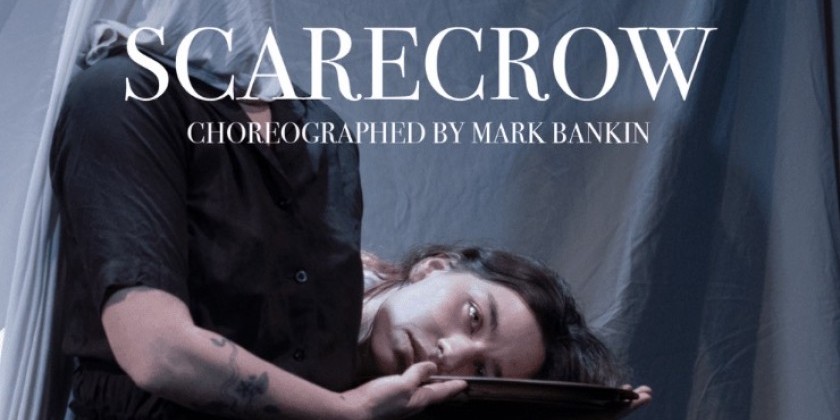
The images created throughout the work respond to this premise. One of the most powerful appears in the program: a dancer with her head placed on a plate, as if decapitated, her hair cascading over another’s hands. Together they fuse into an image at once grotesque and elegant, leaving the audience in a state of disquiet. Also, when a dancer proceeds to complete the mundane task of cutting an apple with a knife, which ultimately is used to lacerate the dancer's skin. Or, too, when one dancer is, with the help of the ensemble, suspended from ropes previously arranged onstage—ropes that also hold white sheets, and which now serve to expose her body. Dressed in black, long, austere garments that merge with the set and choreography, the dancers evoke a remote epoch, impossible to locate yet centered centuries before our contemporary moment.
Another of the most salient aspects of Scarecrow is the moment when the dancers move together in rare passages that shift from horror to jubilation. We see different performers frolicking while others weep. It is precisely this opposition, present throughout the work, that becomes increasingly imperative as we approach the end. In one of the final images, six dancers sob while gazing into infinity, as Sydney Anderson, one of the dancers, sings opera seated on a chair; the chant blends with the piece's music, and the living voice meshes with the recording. This deeply surprising moment returns us to a space of uncertainty, a place where Bankin and the performers both situate us and expel us constantly throughout the eighty minutes of the piece.
When I read the program and later research the work, I realize that Scarecrow is a devised dance piece; its choreography and dramaturgy were created collaboratively with the performers, dethroning the notion of the director as the supreme figure within an ensemble, and complicating the relationships between performers and the work itself. The body creates its own narrative, the performers render themselves to it. The piece also stems from twentieth-century postmodern dance, Nō and Tanztheater, which are presented subtly, in a way that is so hard to find in the United States.
Ultimately, Scarecrow succeeds in spitting us out of the world and returning us to it, all of that with us just sitting on our theater seats. It makes us aware of the beauty of the abject, of the horrific, of finding delicacy within the absurd. It creates images that will remain in our imaginations for days, and days, and nights.
Author:
Sofía Ruvira
Website:
@sofia.ruvira