

More Reviews
Yiran Shu Shines in “The Sun Rising”, Directed by Sekou Heru, at MOPTOP’s 33rd Anniversary

Yiran Shu Brings Zoey to Life for an Enthusiastic Young Audience at School of Rock Parsippany
AUDIENCE REVIEW: "The Thing That Waits For Us" Directed by Sophie Rossman
Company:
Sophie Rossman (Director)
Performance Date:
October 24, 2025
Freeform Review:
The Thing That Waits For Us at Mark Morris Dance Center, Produced by RE/VENUE NYC
Direction: Sophie Rossman
Assistant Directed by Talia Kai, Luke Wisniewski, Camille Foisie, and Micah Meyers
MONSTER: Niraj Nair
CHILD: Sophie Rossman
FATHER: Aidan Ryan
SISTER: Fiona MacPhail
CREATURE: JASON HOOVER
Advisor: Bradley Ellis
Lighting Design: Charlotte Seelig
Stage manager: Payton Wild
SIG-O: Bryce Lowery
Soundtrack sourced from Landscape With Invisible Hant, IT, and Eternal Sunshine of the Spotless Mind
The Thing That Waits for Us captures the full spectrum of human emotion: from grief to joy, from fear to comfort, from anxiety to calm. This poignant physical theater work, written and directed by Sophie Rossman and produced by RE/VENUE NYC, premiered at Mark Morris Dance Center in October 2025, carrying viewers through a child’s journey while navigating family relationships, loss, and hope.
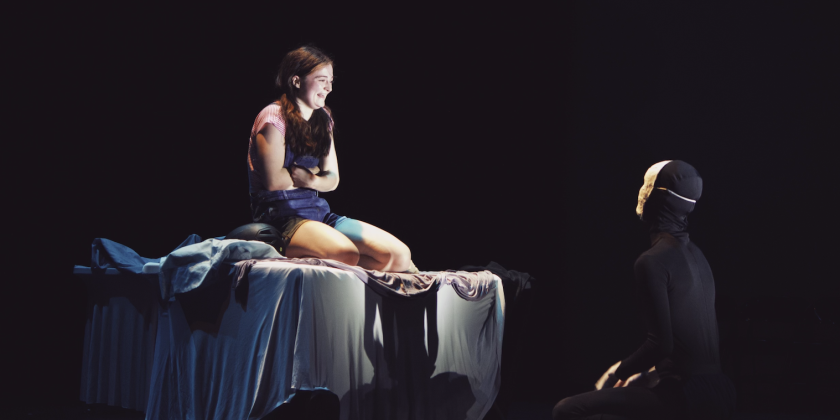
Cobalt light illuminates a long table sitting center stage, draped in a white tablecloth. This calm, opening scene hints at the vast uses this table will serve throughout the work — later transforming into a desk, a hospital bed, a bedroom bed, and a dining table. Its versatility lends itself to the minimalist, satisfying set.
A figure (“FATHER,” depicted by Aidan Ryan) swiftly approaches the table, slumping down against it. FATHER wears a white mask; when he reawakens, he holds a piece of paper, which he peers at repeatedly. He writes a note, or perhaps a letter — the background music is haunting.
From center stage, through the audience, “CHILD” (played by Sophie Rossman) approaches center stage. “If I was making up this story, I would have it gray and miserable outside. But it was sunny and miserable instead!”she exclaims. Another character, a pigtailed figure (‘SISTER,” played by Fiona MacPhail) donning a backpack and a white mask, leaps on stage and instigates a game of catch with a small, stuffed toy dog. Their father, wordlessly, scolds their scuffle through his body language.
After their game resumes, it results in the father’s papers being tossed from the table, scattered on the floor. He appears distraught, as does CHILD. They reconcile — but soon after, SISTER falls ill, convulsing and collapsing.
FATHER swiftly places the sick child on the table, which splits in half. He rolls the table she lays on upstage, as the music transitions from a swelling ambiance into the steady beeps of a heartrate monitor: they have entered a hospital room.
After the father makes a second bed (with the remaining half of the table) for the child, she settles and drifts off to sleep. A hand (the hand of “CREATURE,” played by Jason Hoover) reaches out from under the bed, and grabs the small, stuffed dog snatching it and pulling it out of sight. The child startles, looking around as CREATURE’s hand throws the dog back out into the open. CREATURE reveals itself: hooded, wearing all black, it crawls and grabs at the child’s feet, spooking her.
When the father assures the child, in the light again, that nothing is under the bed, I wonder if he will believe her. Can FATHER see CREATURE? All the while, the SISTER lies in the bed upstage, still doused in blue light.
During a scene where the father and daughter are eating, MONSTER sneaks back into view, this time behind audience members. Only the child notices, leaping up from the dining table. She then notices another figure emerge from the audience, silhouetted: “MONSTER,” played by Niraj Nair.
One of the piece’s most tender moments occurs in CHILD and SISTER’s dance duet. CHILD assists SISTER from her hospital bed, where she has remained for quite some time, and take center stage. The siblings long to capture the vivacious playtime demonstrated in their game of catch; with the physical and emotional support of one another, they recreate its robust energy. Sweeping across the stage with lifts, turns, chases, and embraces, this scene sticks with me throughout the play.
My heart aches when SISTER returns to her hospital bed, the duet seemingly exhausting her character. Clutching at her sternum, FATHER rushes to carry her back to her bed, and I wonder how CHILD will cope. All the while, I remain curious about MONSTER and CREATURE’s relationships with CHILD.
When CREATURE bursts from under the bed, spooking CHILD once more, I admire the dance physicality that Hoover implements in his portrayal. Pattering on tip toes, crawling on his knees, undulating his torso, and wiggling rapidly, his choices add to his character’s ethereal, other-worldly quality. While it appears that CREATURE is repeatedly frightening CHILD, I also notice that they carry a playful energy between them; perhaps running in parallel to CHILD seeking that same playfulness with SISTER.
The two pass the small, stuffed dog between them. Their relationship develops away from timid interactions into full-on friendship, and they too exchange a whimsical duet. CREATURE teachers CHILD how to dance, and they converse through frenzied, exuberant dance moves. The play they share must have been a needed outlet for CHILD, who is enduring so much.
As the steady beeping of SISTER’s heart monitor blares, CHILD and FATHER sitting in a waiting room, anticipation grows. They break the tension by dancing together, their whimsical energy perhaps a byproduct of CHILD’s developing friendship with CREATURE. In the family’s final moments together, CHILD tries to hand the stuffed dog to her sister, lying in bed, whose limp repeatedly fails to grasp the toy. The repetition of trying, insistently, to return the toy adds to the pain. It is only when MONSTER appears behind SISTER’s bed (unknowingly to her) and places the dog back in her possession that the heart monitor booms its final note: a flatline. Her heart stops. The moment when Nair places the toy is arresting, and a stillness fills the room.
CHILD stands helplessly center stage, doused in golden light, processing the tremendous loss of her sister. MONSTER tip-toes next to CHILD, offering an embrace. FATHER — and perhaps in this moment he can finally see MONSTER – taps MONSTER on the shoulder, making way to take his child in his arms. MONSTER takes FATHER’s hands, as he hugs his child, and they exchange a knowing look through their masks.
When CHILD knocks off FATHER’s white mask, revealing his face for the first time, we feel a shift. SISTER returns into view as well, also unmasked. She plays a final game of catch with MONSTER, looking as energetic and happy as in the opening scene, while CHILD and FATHER look on. In MONSTER’s final interaction with SISTER, Niraj Nair employs a jubilant, playful physicality. As they now exist in the same realm — playing catch with the toy dog, beyond the mortal world — it is implied that he will continually be there for SISTER as a support system and companion. Together, they share the joy SISTER so much felt on Earth.While the pain of SISTER’s fate is palpable, hope exists: the family and friends, in all of their forms, will always have each other.
The Thing That Waits for Us serves as a strong reminder that the body expresses infinite emotions and experiences, for times when words fail. I offer my biggest congratulations to the team — Director Sophie Rossman, the Cast, Advisor Bradley Ellis, Lighting Designer Charlotte Seelig, Stage manager: Payton Wild, SIG-O Bryce Lowery — for a hugely successful performance!
Author:
Kristen Hedberg
Website:
kristenhedberg.org
Photo Credit:
Dylan Smith