


Related Features
IMPRESSIONS: Scottish Ballet in "Mary, Queen of Scots" at Lincoln Center
IMPRESSIONS: "The Firebird Variations," Details of Enchantment
IMPRESSIONS: American Ballet Theatre's 2026 Spring Season at Lincoln Center

By Henning Rübsam
View Profile |
More From This Author
Published on April 8, 2026
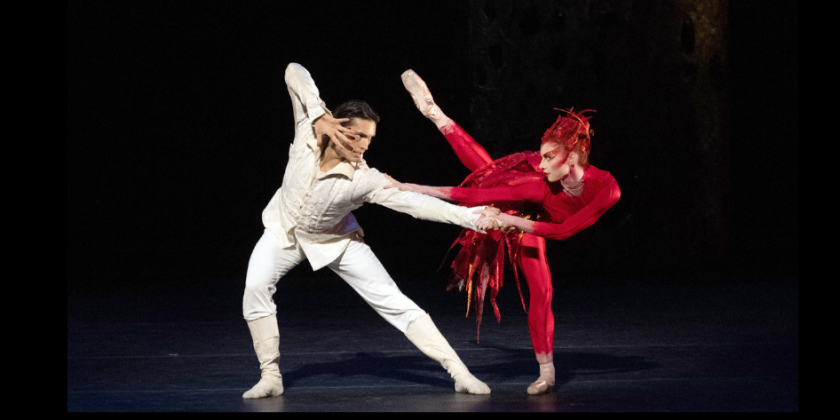
Catherine Hurlin and Daniel Camargo. Photo: Nir Arieli
American Ballet Theatre
Susan Jaffe, Artistic Director
Spring Season: Raymonda, Mozartiana, Nuages, Neo, Firebird
David H. Koch Theater at Lincoln Center, New York City
March 6 - 21, 2026
Susan Jaffe, the artistic director of American Ballet Theatre, has introduced a spring season to the company’s New York City schedule. A few years back, the Metropolitan Opera started to push the ballet season deeper into the summer, so an additional two and a half weeks at Lincoln Center’s David H. Koch Theater in March are a truly welcome addition.
The dancers seem energized and well-rehearsed, as was the case on Saturday evening in Jaffe’s own staging of Raymonda: Grand Pas Hongrois. Marius Petipa's original, 1898 ballet fielded an all-star cast including the first dancer to be named “prima ballerina assoluta,” Pierina Legnani, as well as Olga Preobrajenska, and the Legat brothers. Tragically short-lived Sergei Legat and his older brother Nikolai, did double duty as dancers and ballet masters at the Imperial Ballet in St. Petersburg, before Nikolai settled in England, where he taught and inspired many who claim to have founded ballet in Britain.
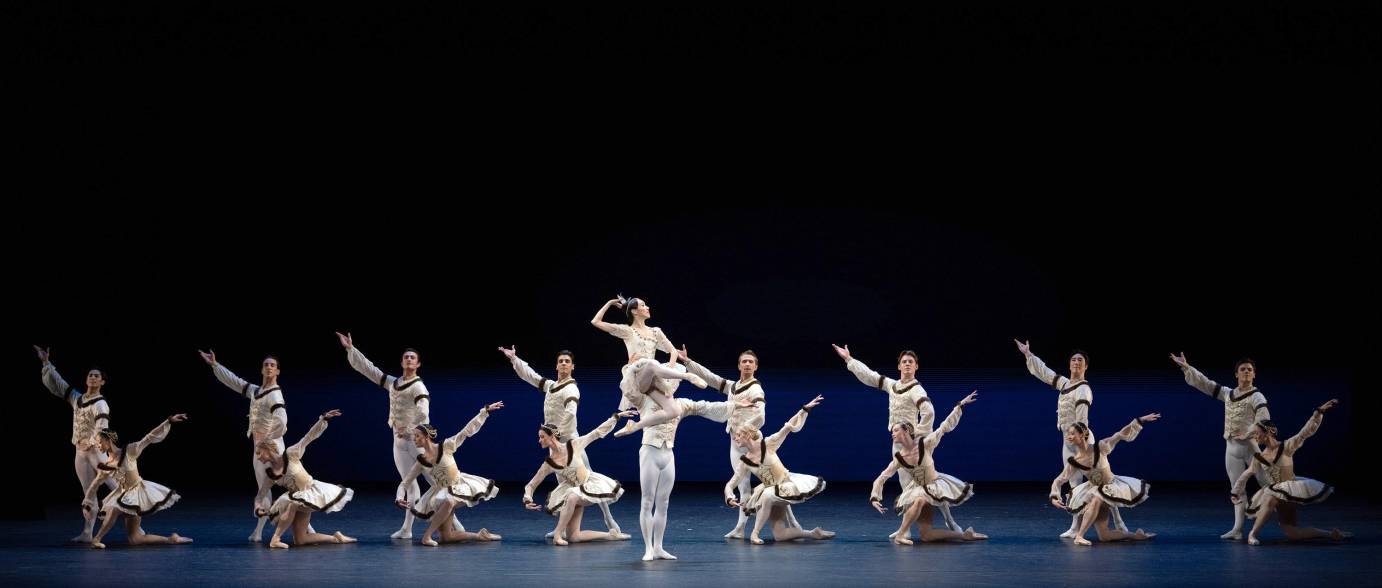
Music by Alexander Glazunov accompanies this showcase for principals Hee Seo and Isaac Hernandez. Seo, who shimmers delicately through her precision, enchants on the relatively small stage at the Koch Theater. I often feel that the cavernous space at the Metropolitan Opera House swallows her alive. Partnered by the sanguine Hernandez, Seo dares to engage. It’s a joy to see classical dancing not just executed well, but to experience the breath and life of it through Hernandez’s phrasing. He does not force his jumps and turns; he simply delivers the natural beauty of the classical canon and thus gives Seo the opportunity to tease her musical phrasing in refreshing ways. She radiates from within, and her exactitude alongside Hernandez never feels robotic.
In the variations, Betsy McBride and Kanon Kimura are two individuals who dance with one another rather than a duo drilled to achieve perfect synchronicity. Breanne Granlund and Yoon Yung Seo convince in their respective solos, and the male pas de quatre for Sung Woo Han, Takumi Miyake, Jake Roxander, and Alejandro Valera Outlaw drive home the message that a full-blooded musical approach beats lifeless perfectionism. Conductor David LaMarche and the company’s own orchestra excellently support the dancers on their noble mission.
While Saturday looked back at Petipa’s final grand ballet, Friday and the following Wednesday recall one of George Balanchine’s last works, Mozartiana, from 1981. Peter Ilyitch Tchaikovsky found inspiration in lesser-known Mozart tunes for this fourth of his orchestral suites. Just as with Serenade, Balanchine takes liberties and switches musical movements around. While the composer starts out with a lively “Gigue” (in G major) based on Mozart’s Little Gigue for Piano, K. 574, the choreographer sets the stage with “Preghiera,” the composer’s third movement after Mozart’s Ave verum corpus, K. 618. By beginning the dance with a solemn prayer in which four young students flank the ballerina, the work has nowhere to go but up. Since Suzanne Farrell (Balanchine’s long-time muse during his later years) originated the ballerina role, it is a coveted part. The freedom of the neck, the generosity of the ports de bras, and the lightness of a held arabesque are just as important as the traveling bourrées, which open the proceedings.
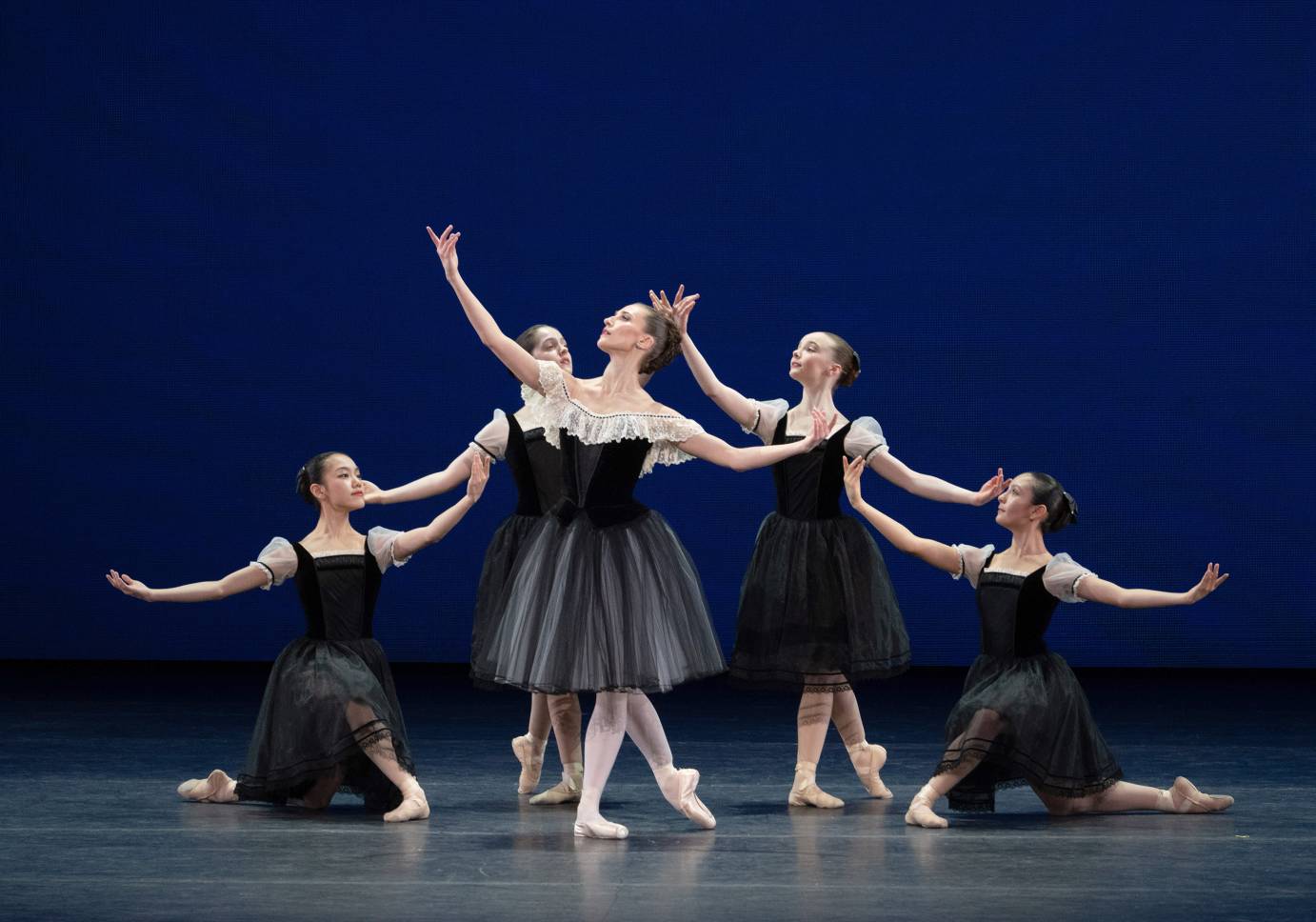
What a treat to see Devon Teuscher back on stage after an injury! On Friday evening, her long arms extended into space and summoned the angels. Yet, throughout the work, I sense that she does not quite trust her own spontaneity to take over the moment. Her carefully studied steps flow melodically but lack esprit and surprise. Joo Won Ahn presents himself as her handsome and stalwart partner, who handles his solo sections in the closing “Thème and Variations” (after Mozart’s Piano variations on a theme by Gluck, K. 455) with ease. Here, in the finale, which takes up well over half the work, Tchaikovsky returns to G major after straying to D major in his second movement, the “Menuet” (after the Minuet for Piano, K. 355), with the “Preghiera” in B-flat major. Balanchine’s order creates a different arc. Even if the sprightly “Gigue” danced by Jake Roxander comes off as a bit too puckish, it offers a welcome change in dynamics after the prayer. The “Menuet” gives four tall women an opportunity to show off arabesques and sissonne jumps, and to travel about and pose. The staging by Maria Calegari, who was a truly spirited ballerina with New York City Ballet, infuses Sierra Armstrong, Virginia Lensi, Ingrid Thomas, and Remy Young with intent and purpose. Both Teuscher and Ahn look good throughout. The orchestra under the baton of music director Ormsby Wilkins deserves an award.
The following Wednesday serves up Mozartiana with a different cast. While the four children (Pilar Gamboa, Savannah Manzel, Savannah Vye, Alisa Xu) rehearsed by Lilia Hamdy give a repeat performance, Scout Forsythe, Tillie Glatz, Courtney Shealy, and Paulina Waski prove that Calegari’s direction elevates the Menuet. Carlos Gonzalez combines elegance and sprightly phrasing with impeccable technique in his rendition of the Gigue. But the best is yet to come. The pairing of Chloe Misseldine and Michael de la Nuez brings the house down. After my rave review of de la Nuez in last summer’s Swan Lake, I commented on his lack of Danish training when he faltered during a traveling sidestep in Giselle’s Peasant Pas de Deux. This season, in Mozartiana, de la Nuez made me eat my hat! His quick batterie and light ballon, tossed off with a noble use of épaulement, came across as Danish par excellence. The role’s creator, Danish danseur Ib Andersen, would have been proud. The way de la Nuez opens his body toward Misseldine in one step, and turns away with the next, speaks to her and to the space itself. Yet, his attention to detail goes further: a tilt in his upper body directed toward and away from Misseldine adds an extra dimension. His focus in a port de bras travels the circle through space before it homes in on his partner. De la Nuez inhabits a world of his own, and then shares it generously with Misseldine. In Balanchine’s oeuvre, the man is all too often relegated to prince consort, yet this gentleman is as interesting as the lady. He pays her due attention and admires her without ever being her lapdog.
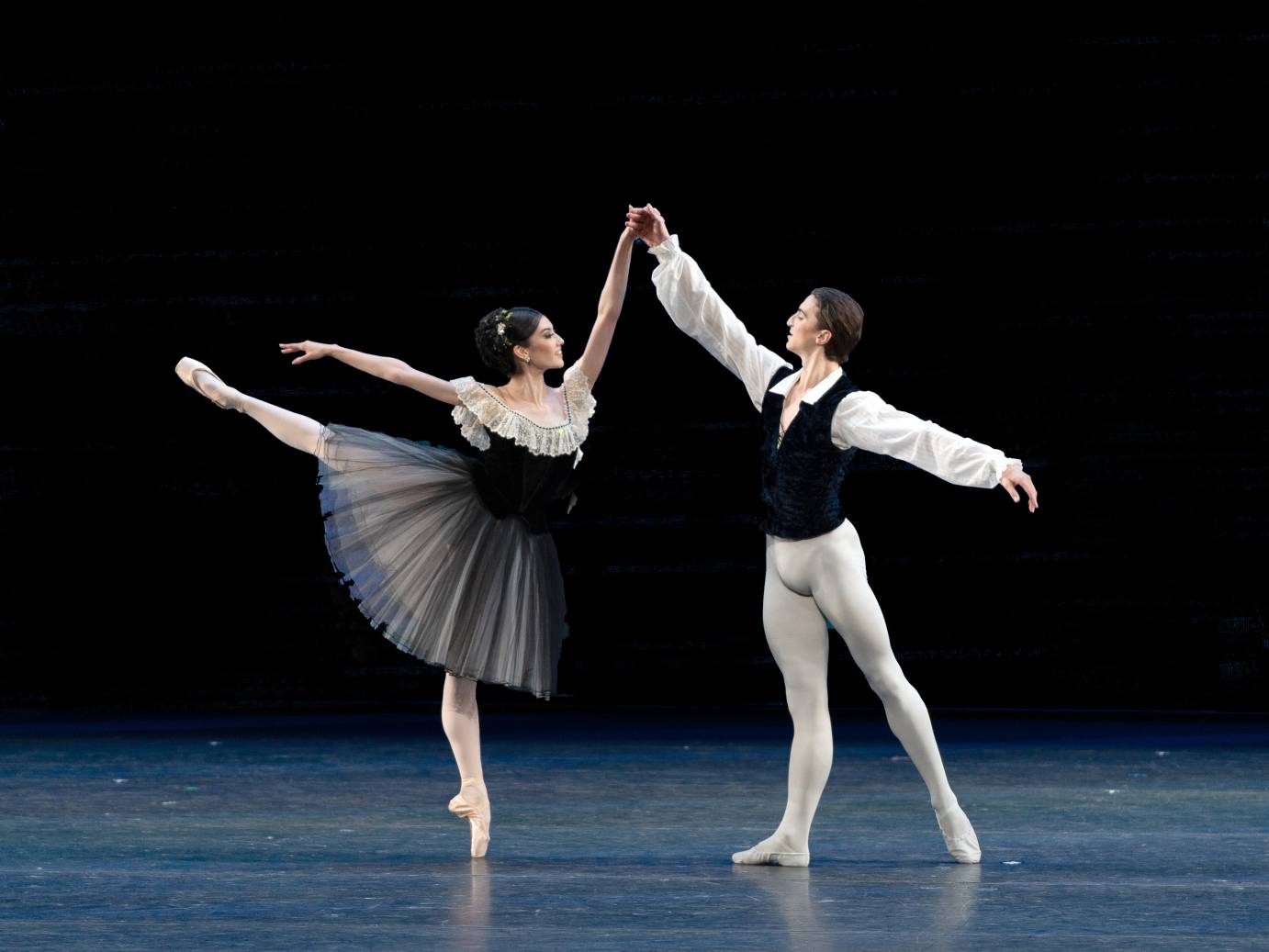
Misseldine enjoys his interest in her, and while they seem engrossed in dancing with one another, her true focus stays committed to the spiritual gift of dance. A fascinating journey follows. Her breath guides her movement. Does a scent reach her nose, making her linger in a coup de pied before she joyfully presents her foot? Her accents seem improvised, and the fresh phrasing captivates me on this exploratory, joyful, and holy mission. Her lines are long, and her flow is harmonious. Excitingly, her rapport with de la Nuez promises a partnership of lasting wonderment that does not recall any glorious pairings of the recent past, namely Ferri/Bocca, Jaffe/Carreño, or Herrera/Corella, but already possesses its own heavenly quality.
The person next to me excused himself after this opening number with the parting words, “I can’t see anything else after this.” I wonder if I should have followed, for it was a performance to be treasured for the ages. Thanks to the dancers, the musicians, stager Calegari, and conductor Wilkins.
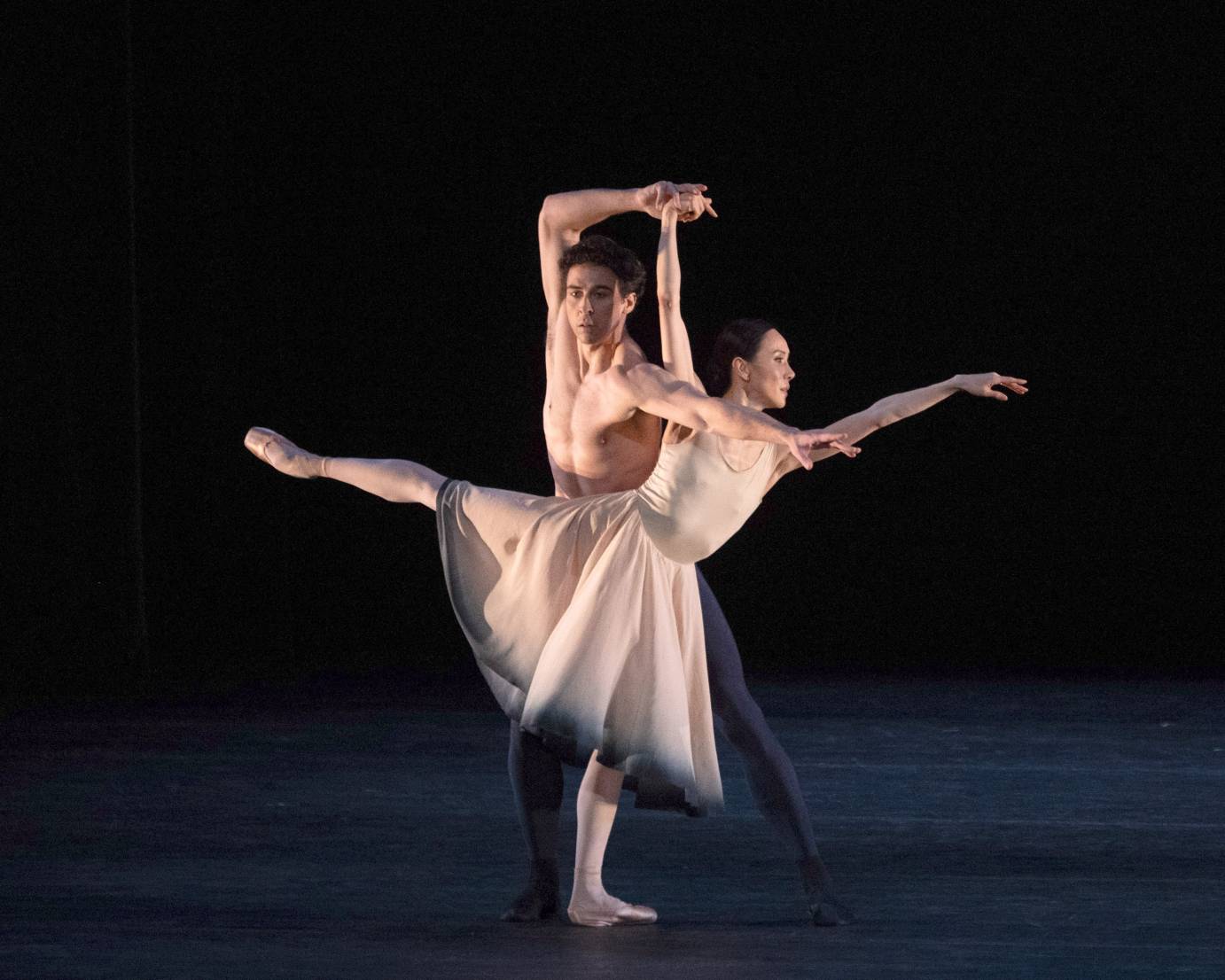
What followed was the crass duet Neo, executed by Christine Shevchenko and James Whiteside, to music by Dai Fujikura played on a shamisen by Sumie Kaneko. It assaults the viewer with split legs and sporty competition, but lacks invention. This display by choreographer Alexei Ratmansky was unexpected, since the previous Friday, Mozartiana had been paired with Jiří Kylián’s Nuages, a poetic pas de deux in which the man initiates every move. While the feminist in me recoils at seeing the woman used to wipe the floor, I do sense a young, male poet in this early Kylián work, for he also uses the woman to paint the sky with diaphanous calligraphy, expressing an admiration that only first love could generate. Kylián choreographed the duet 50 years ago in Stuttgart for Birgit Keil and Jonas Kåge. At ABT, Hee Seo and Thomas Forster connect seamlessly, as he lovingly manipulates her body through impossible pretzel knots and twists. The piece unfolds magically. Trois Nocturnes by Claude Debussy provides the dreamlike soundscape for Nuages under LaMarche’s baton.
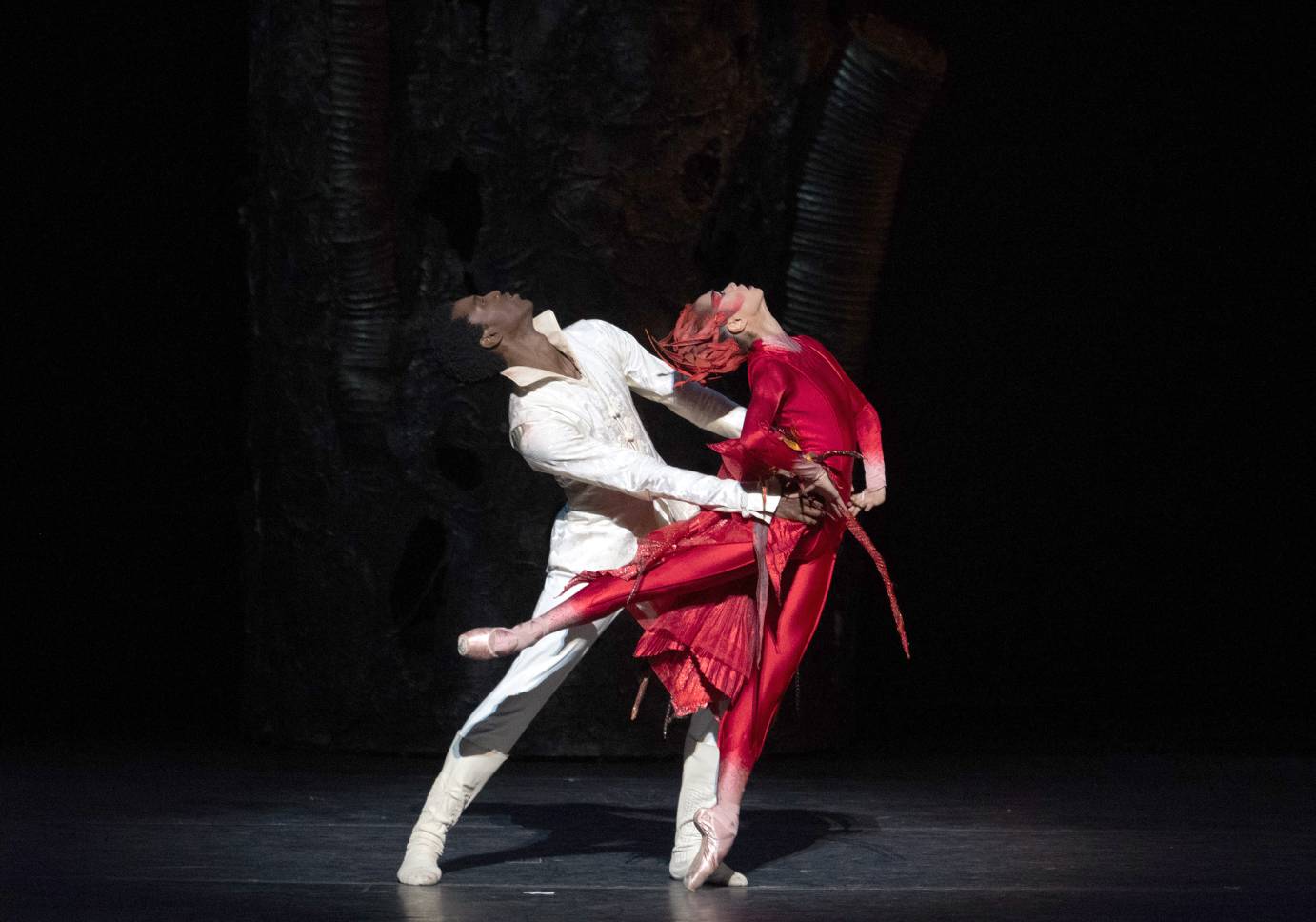
All three evenings close with Firebird. Composer Igor Stravinsky’s first commission from the visionary impresario Sergei Diaghilev for his Ballets Russes remains a musical treasure. The orchestra under Charles Barker (Friday and Wednesday) and David LaMarche (Saturday) does give me plenty of good reasons to stay and immerse myself in the rich score. No wonder this music launched the composer’s career as one of the ballet world’s most important collaborators. It would be fascinating to see what the ballet’s original choreographer, Michel Fokine, came up with in 1909.
The version commissioned by ABT’s previous artistic director, Kevin McKenzie, however, lets choreographer Ratmansky make a mockery of women under the spell of an evil wizard. Clad in ugly green dresses with cabbage-like headgear, the ballet’s “Enchanted Princesses” are doomed to be dunces. That a prince would fall in love with one of these creatures is inconceivable. When Ivan Tsarevich finally breaks the egg that contains the wizard’s spirit, Ivan, the wizard, the lead princess, and the Firebird all touch each other for far too long. It is a ridiculous display of ineptitude. Additional princes who were incarcerated are now freed, toppling two at a time out of five cages. All fall to the floor, and then stand up and wave to the princesses, who wave back. Stalin himself could not have choreographed a cornier number.
While some of the projection effects on the backdrop are stunning, the dance part remains wholly unconvincing. An exception are solos for the Firebird herself, in which Catherine Hurlin (Friday and Wednesday) and Léa Fleytoux (Saturday) shine.