


Related Features
IMPRESSIONS: The Choreographic Ensemble of the Paris Conservatoire at the L’Alliance New York

IMPRESSIONS: Lucinda Childs’ Early Works from 1963-1973 at the Guggenheim’s Rotunda
IMPRESSIONS: Compagnie Hervé Koubi's "Sol Invictus" at The Joyce Theater

By Henning Rübsam
View Profile |
More From This Author
Published on March 18, 2026
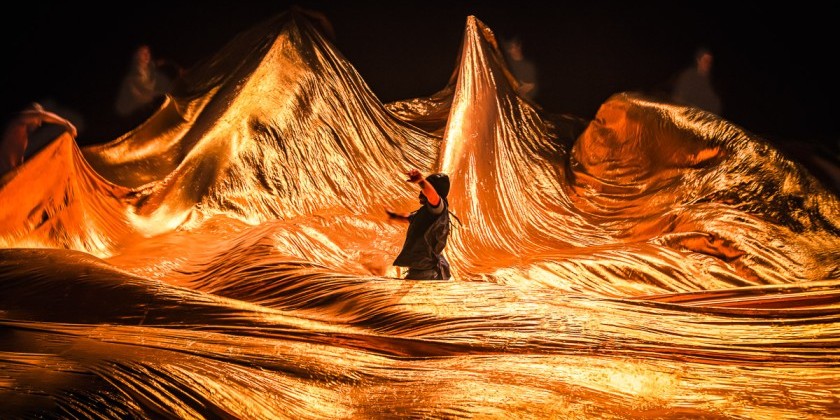
Hervé Koubi's "Sol Invictus." Photo: Daniel Roblin
A Presentation of Dance Reflections by Van Cleef & Arpels and The Joyce Theater Foundation
Choreography: Hervé Koubi
Dancers: Francesca Bazzucchi · Badr Benr Guibi · Joy Isabella Brown · Denis Chernykh · Samuel Da Silveira Lima · Youssef El Kanfoudi· Abdelghani Ferradji · Elder Matheus Freitas Fernandes Oliveira· Ouadli Guennoun · Hsuan-Hung HSU · Pavel Krupa · Ismail Oubbajaddi · Ediomar Pinheiro de Queiroz · Ayoub Roufi · Matteo Ruiz· Allan Sobral Dos Santos · Karn Steiner
Music: Mikael Karlsson / Maxime Bodson / Steve Reich / Ludwig Van Beethoven
Lights: Lionel Buzonie // Costumes: Guillaume Gabriel // Arrangements: Guillaume Gabriel
Artistic Advisor: Bérengère Alfort // External Advisors : Odile Cougoule – Mohamed Zeroali
March 10 -14, 2026
Choreographer Hervé Koubi speaks softly about his work Sol Invictus, before the curtain opens. He shares that he thinks of his work as a manifesto for life: a bright, generous declaration of love by 17 dancers from almost as many different national backgrounds.
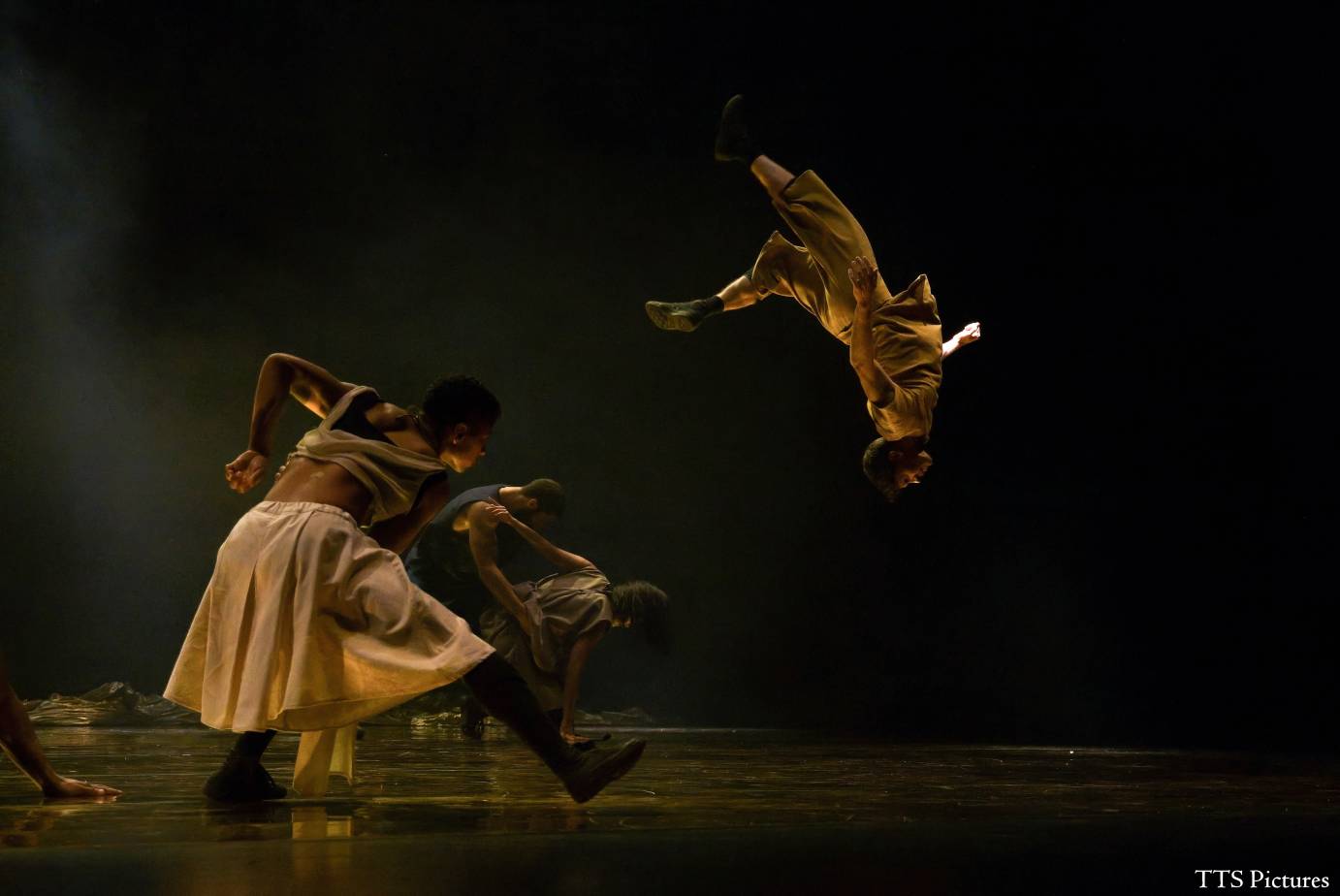
Among the many dancers crossing the stage of The Joyce Theater on March 11, there happen to be only a couple of women, and one performer using crutches. One man sports a wild beard, and another a strikingly large afro. They are all clad in wide pants of different colors and styles; most end just below the knee, and you have to look twice to realize they are not skirts.
Hervé Koubi's Sol Invictus. Photo: Christophe Bernard
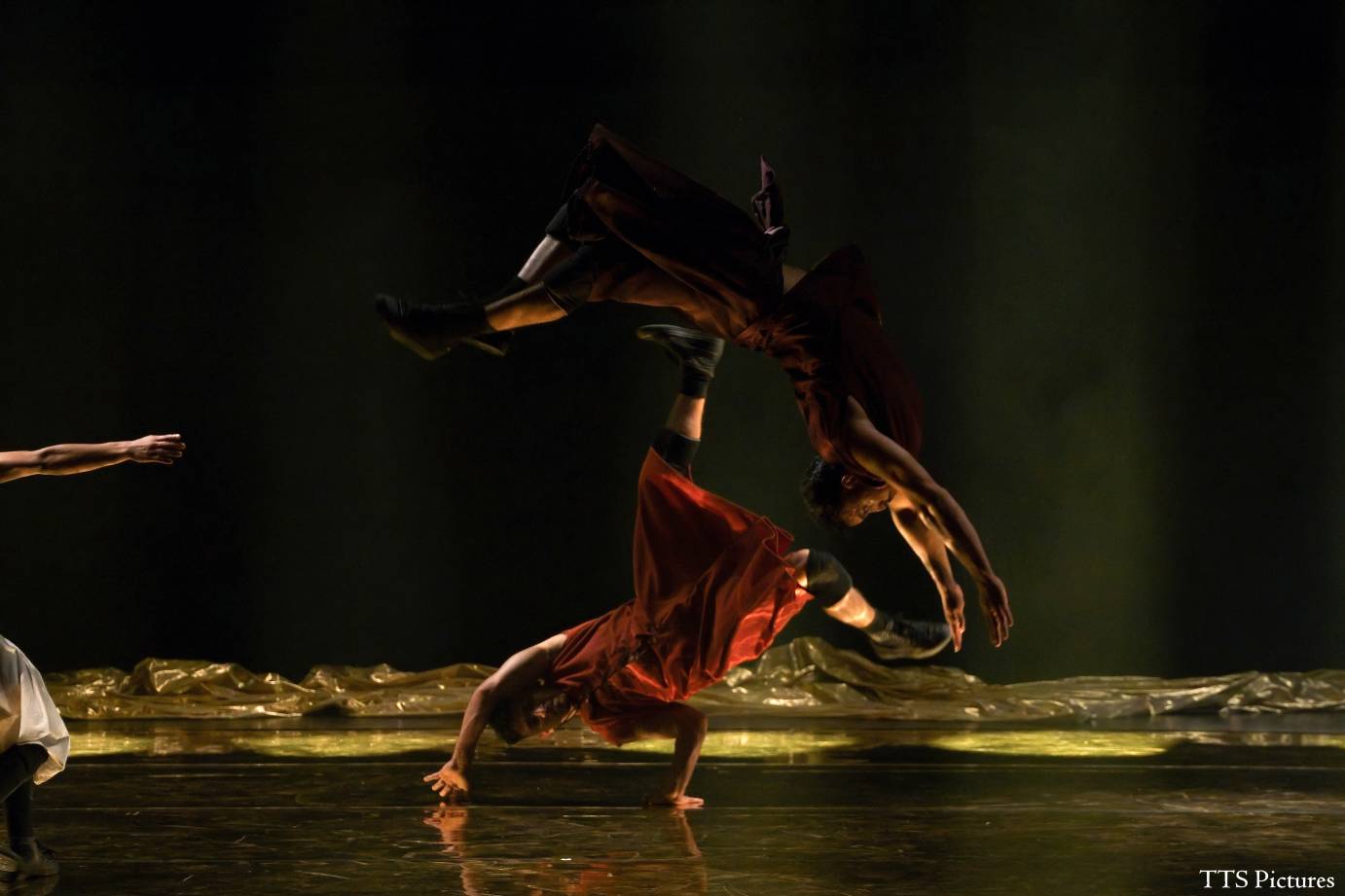
Handstand springs and tumbling follow. There are spins on the floor. Groups of three and four dancers form and dissolve after giving glimpses of contemporary dance phrases performed in unison. A man with a knit cap covering some of his dreadlocks pulls off multiple turns on his head, while others throw themselves across the space. Hip hop meets parkour. The dancer using crutches performs a solo. There is no holding back. He proves as much of a daredevil as anyone on stage. The level of full-out physicality astounds me. I sit in wonder and awe as I witness this group of athletes perform airborne wizardry without a net or cushioning. Each and every part of their bodies seems to have a spring in it.
Hervé Koubi's Sol Invictus. Photo: Christophe Bernard
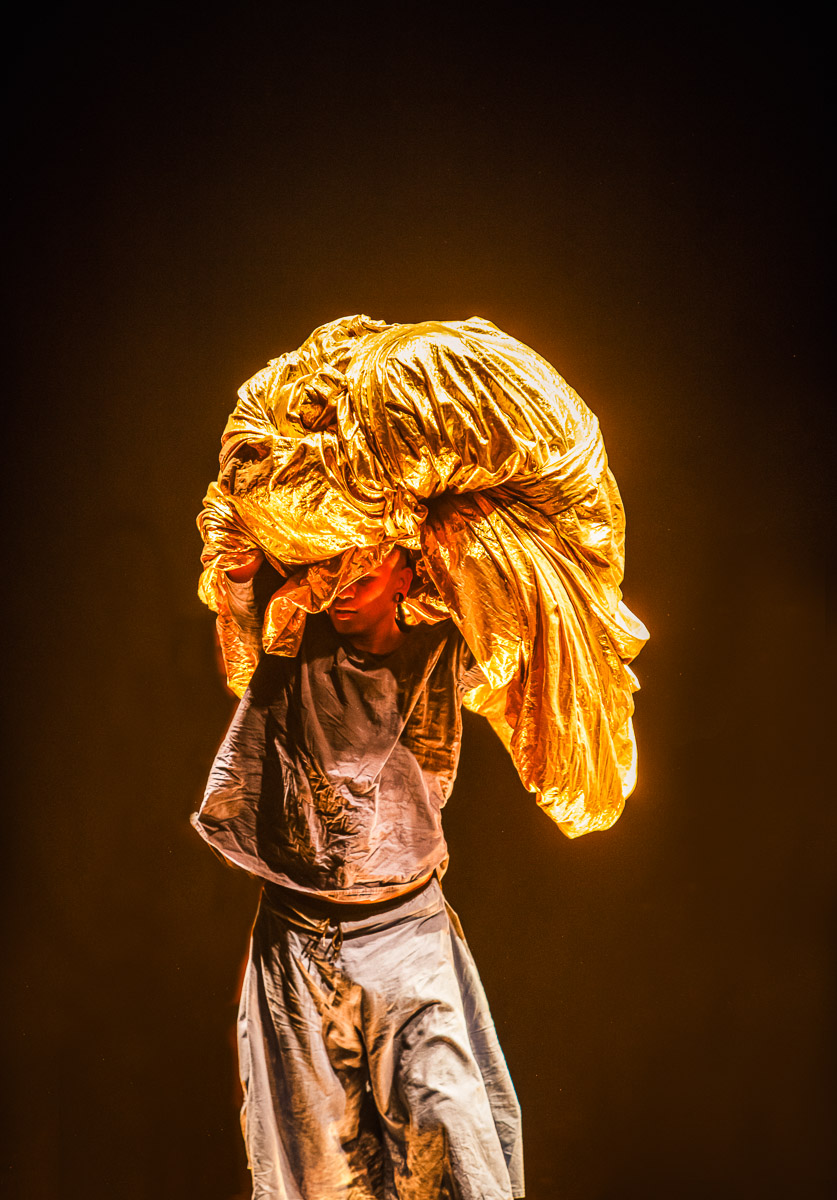
As the soundscape shifts, so does the temperature of the show. One woman slowly pulls a golden fabric that had been placed inconspicuously across the back of the stage all the way to the front, so it covers the whole space. She lifts the cloth and places it over her, looking like a Madonna with a golden veil. The rest of the group steps on the fabric in a line upstage, with everyone but the bearded man looking at her. He happens to be slightly ahead of the others, with his gaze off into space. The woman then steps on the fabric, and the group crouches down and pulls it in such a way that they magically transport her to the bearded man.
Hervé Koubi's Sol Invictus. Photo: Christophe Bernard
Spotlights illuminate the space that just opened, and soon different solos dart in and out of the light. The play between light and darkness is mesmerizing. Is it daytime and nighttime simultaneously? Are we underground, and then atop a high desert plateau? People assemble and lift a woman wearing a bra-like top on their shoulders. Another person gets lifted, and the two circle each other on a higher plane. Beams of light from every direction converge on a central circle. A small group gathers for a folk dance that reminds me of a Spanish Jota. Others exercise martial arts.
I am flabbergasted by how everyone manages to avoid running into each other, and no one seems to get hurt. Their split-second timing, awareness, and care for one another while speeding through space feel supernatural. Intrigued by the tribal quality of the work, I want to travel with them. I think of all the hard work and the sweat, and have second thoughts. I sense enticing danger.
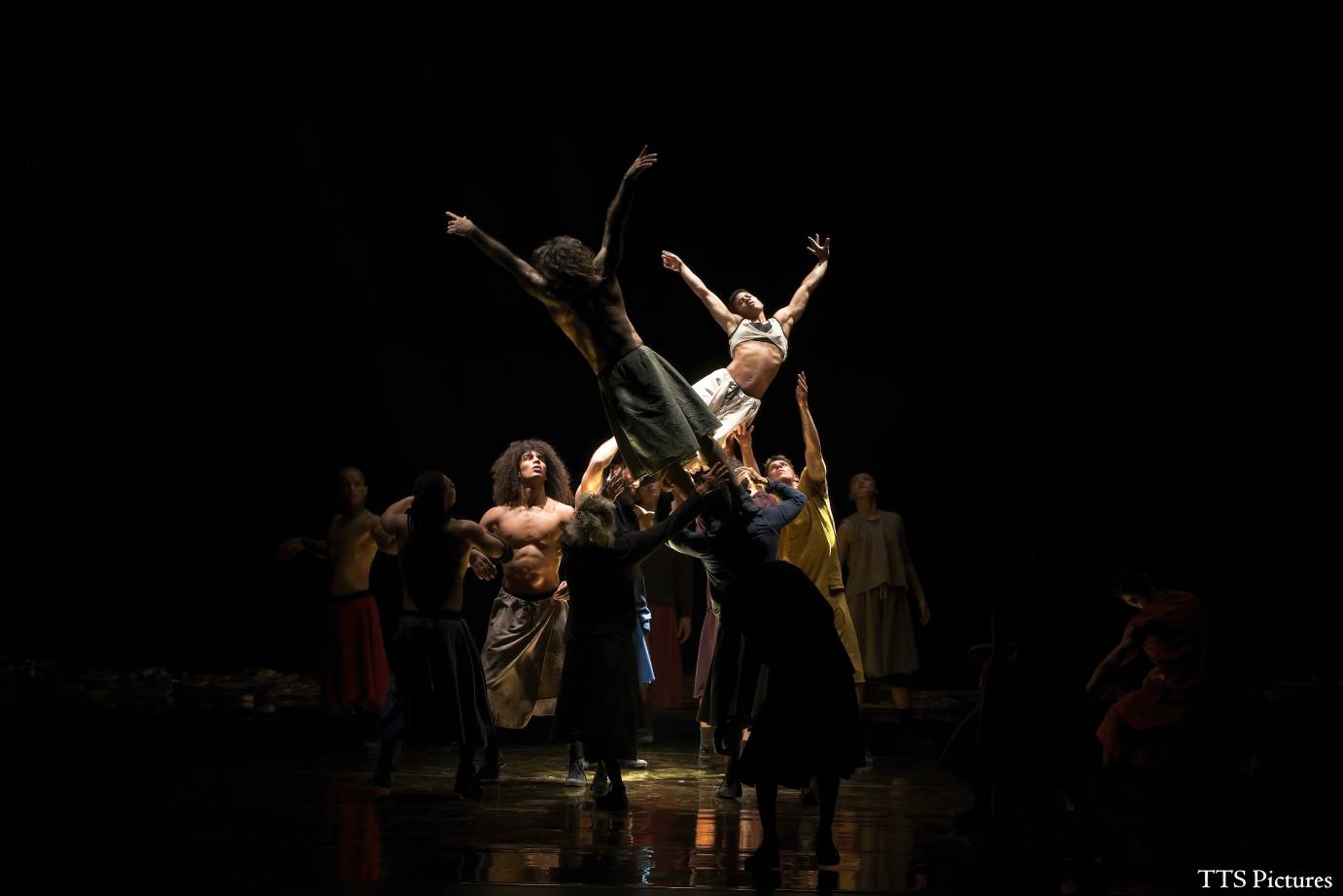
Hervé Koubi's Sol Invictus. Photo: Christophe Bernard
Now the man sporting the beanie mounts the fabric and spins on his head as the group pulls him, like desert travelers heading to the next oasis offstage. That would be a stunning ending, but then dunes form, and the fabric is brought back. The man with the distinctive afro spins under the fabric, assembles it, and drapes it around his perfectly sculpted body. He walks on a diagonal, the lights from the fabric reflecting off his radiant skin. This, too, might have served as a beautiful ending, but the group brings back the fabric for the spinner to have another go, and he coils it up while twirling on his head at its very center. This stunt could have easily been another fantastic ending, but discarding the fabric, the group decides to dance and cavort again.
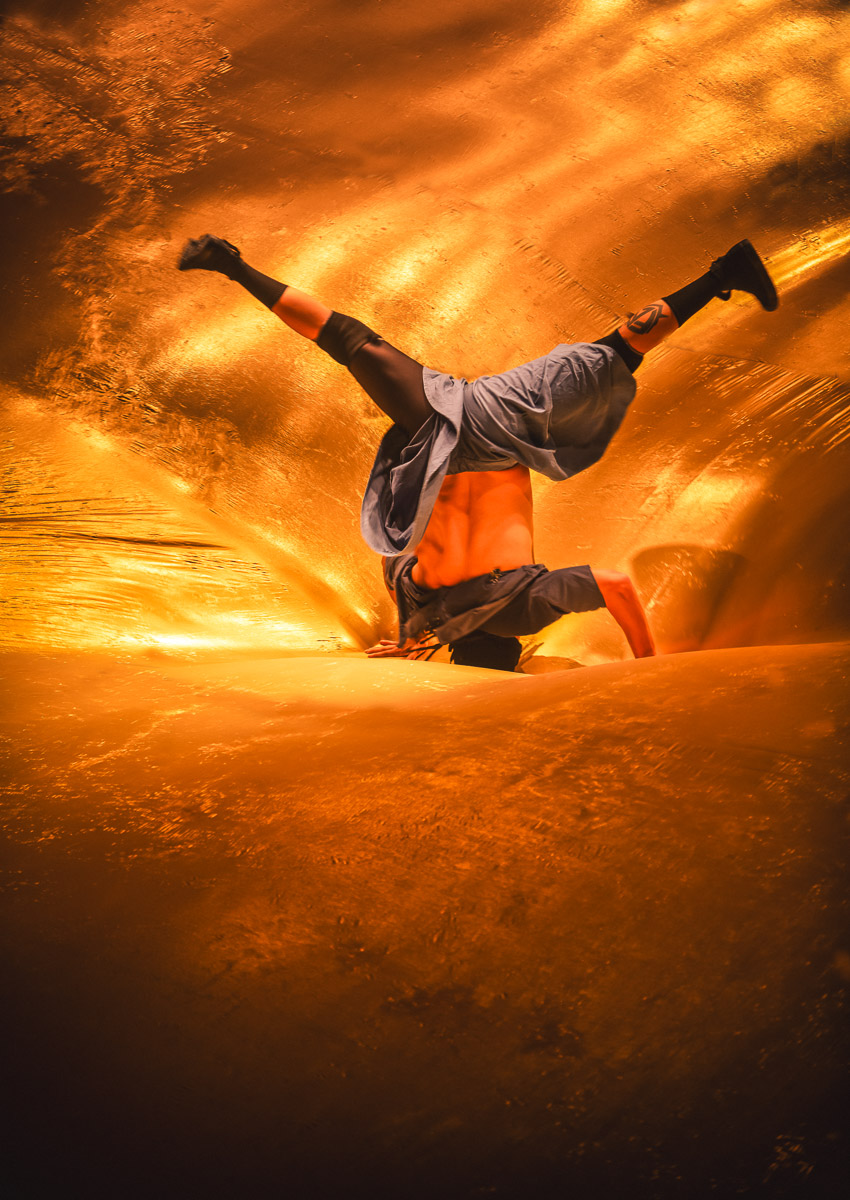
Hervé Koubi's Sol Invictus. Photo: Christophe Bernard
How many false endings can one endure? Does Koubi, who uses Beethoven for part of his soundtrack, think he is Brahms(who was famous for deceptive cadences)? What haven't they done? At last, starting to throw one another through space, one person is catapulted high and caught, giving us the desperately needed finale to an absolutely stunning evening that goes on for three-and- a-half minutes too long.