



Related Features
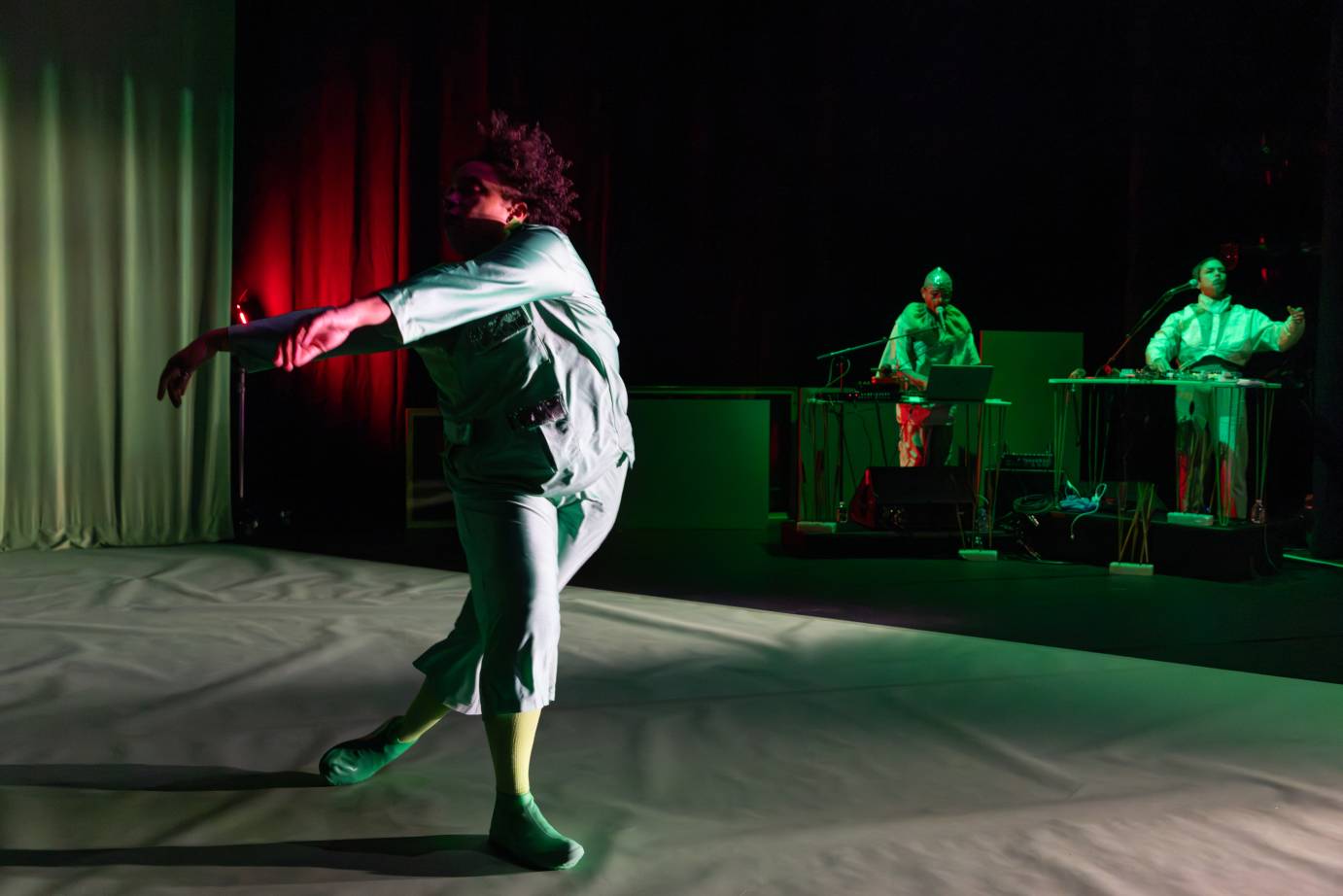
IMPRESSIONS: A Wild Ride with the Young Boy Dancing Group at Performance Space New York
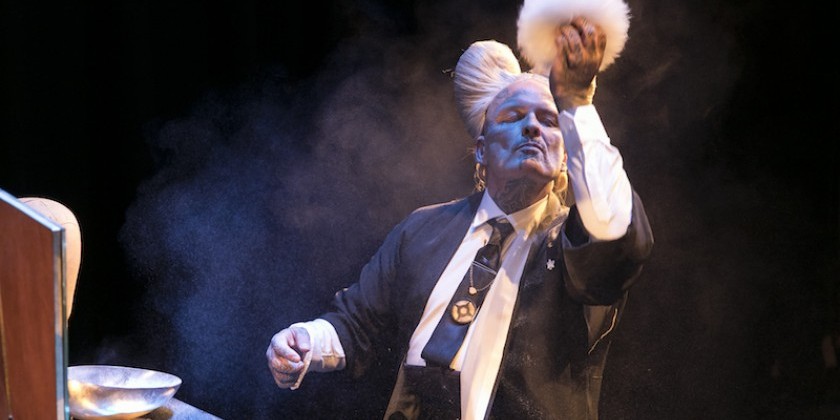
IMPRESSIONS: Mariaa Randall's "Footwork/Technique" as part of First Nations Dialogues: KIN at Performance Space New York

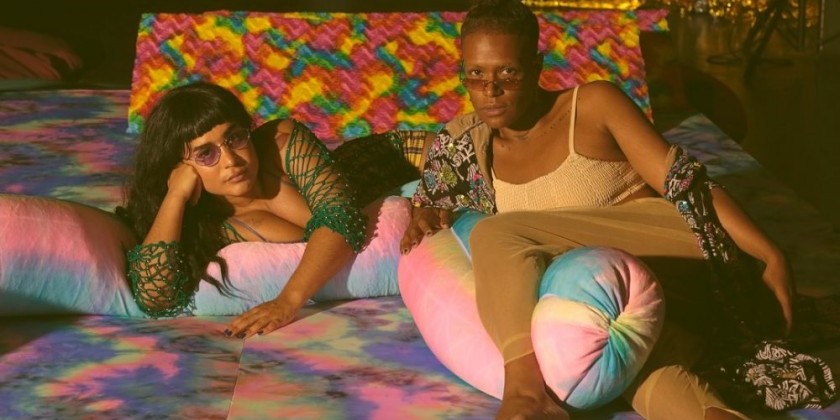
IMPRESSIONS: Will Rawls' [siccer] at the Keith Haring Theatre, Performance Space New York
![IMPRESSIONS: Will Rawls' [siccer] at the Keith Haring Theatre, Performance Space New York](/images/features_large/20251119_WillRawls_siccer_PerformanceSpaceNY_WhitneyBrowne--55.jpg)

By Kristen Hedberg/@kristen.hedberg on Instagram
View Profile |
More From This Author
Published on December 2, 2025
WillRawls' [siccer]. Photo: Whitney Browne
Choreography and Direction: Will Rawls
Performers: Holland Andrews, keyon gaskin, jess pretty, Katrina Reid, Jeremy Toussaint-Baptiste
Sound Design and Vocals: Holland Andrews, Jeremy Toussaint-Baptiste
Technical Director: David Szlasa
Lighting and Scenic Design, Stage Manager, Production Manager: Maggie Heath
Costume Design: Saša Kovačević, Dana Doughty // Dramaturg: Kemi Adeyemi // Studio Rawls Studio Director: Maraget Knowles
Producer: Benedict Nguyễn
November 20, 2025
The five effervescent performers of Will Rawls' [siccer] arrive onstage in full view, arranging seven vivid green panels across Performance Space New York's Keith Haring Theatre. As they build their own Emerald City, Rawls recounts the path that led him here, emphasizing that “this piece isn’t finished yet.”
“A dance piece functions as a container and a continuum,” Rawls describes. “But if it goes on too long, a dance turns into a trap.”
Shutter. Shutter. Shutter. A steady metronome of camera clicks suddenly traces the performers’ world. Behind their panels, they slowly inch toward a stop-motion camera which continuously snaps their portraits — perhaps the trap Rawls refers to. Jeremy Toussaint-Baptiste pops up from behind a glittering panel, a galaxy of green, and we chuckle.
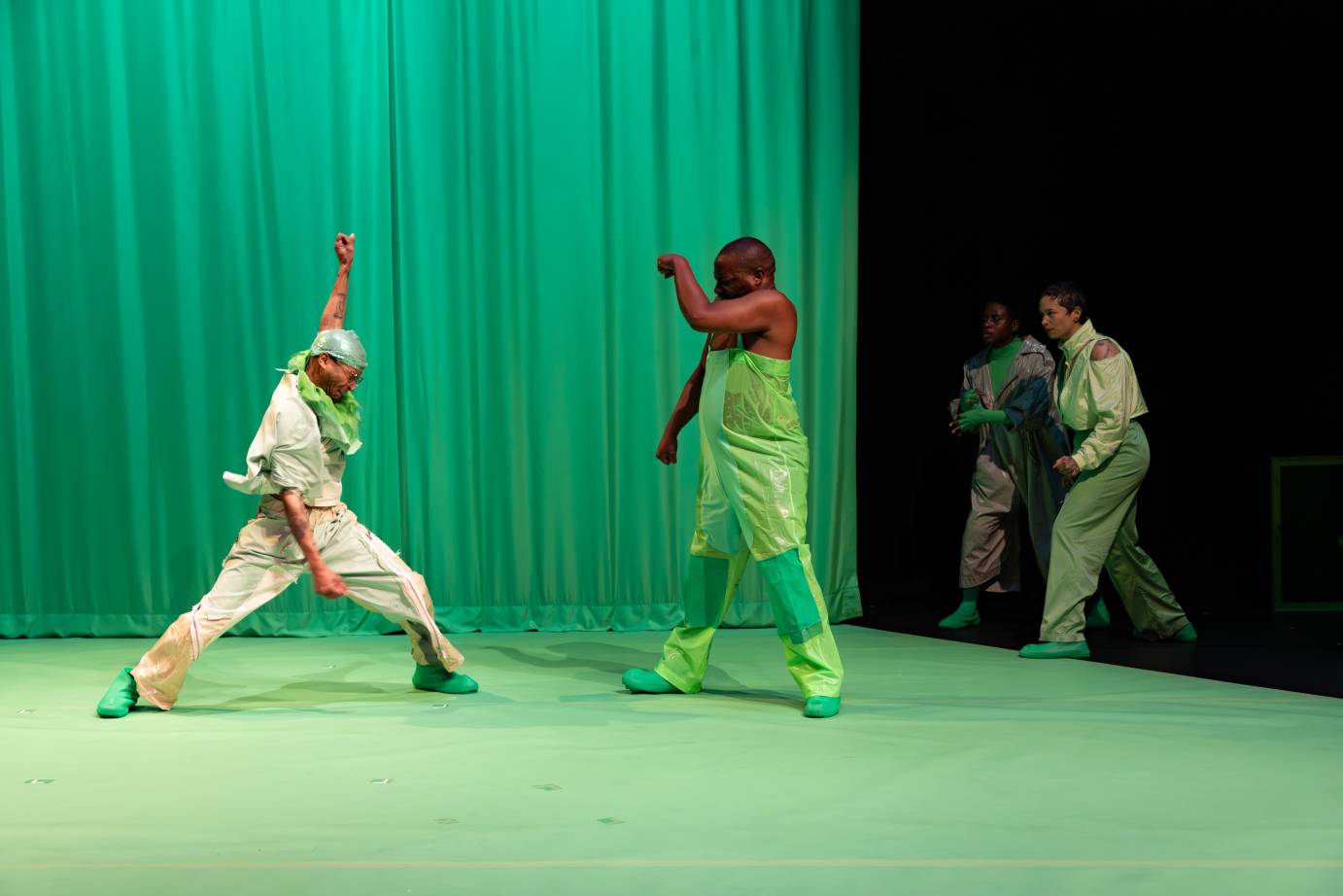
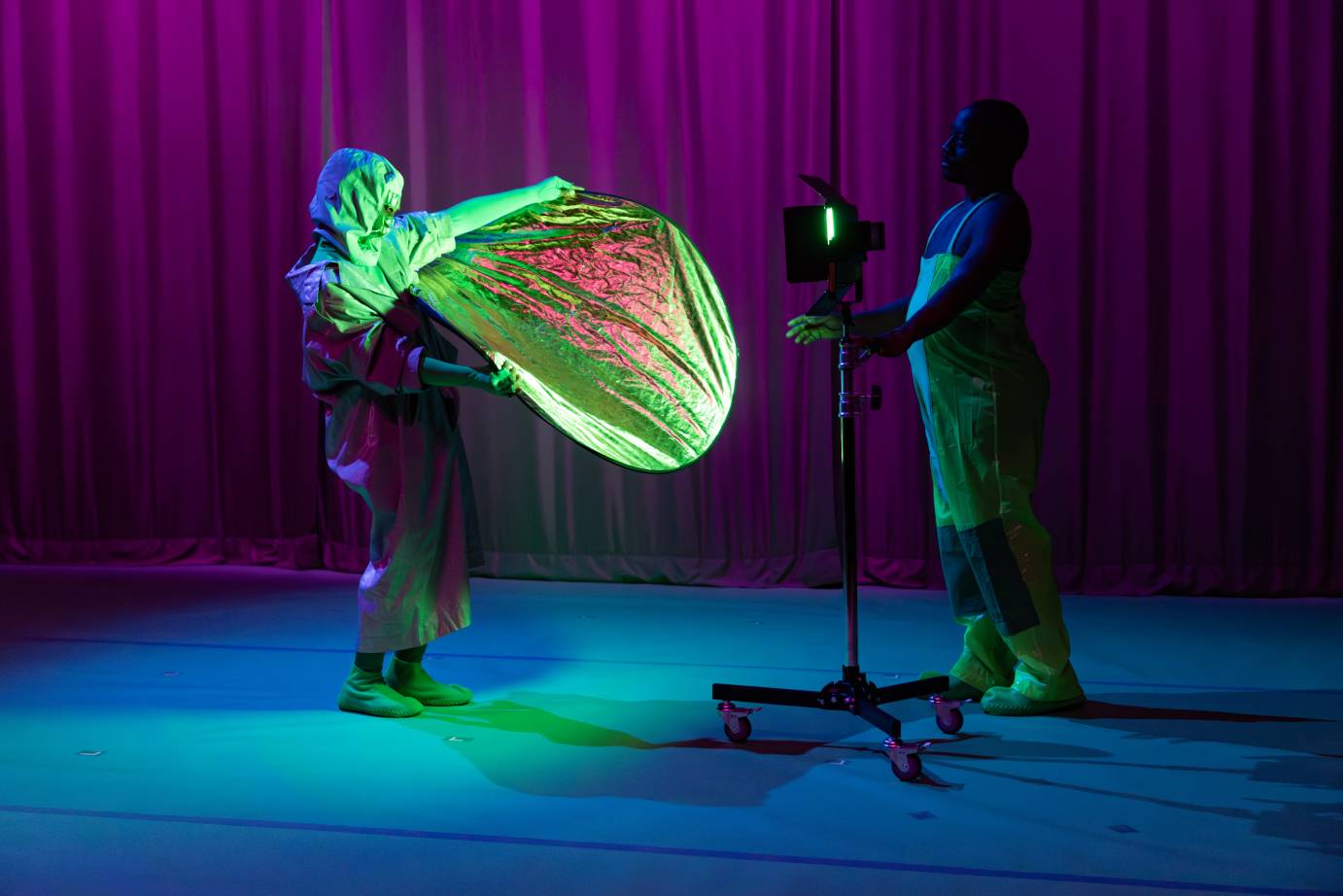
Green saturates the space, living in costumes, panels, and a massive chroma-green backdrop gesturing toward disappearance and hyper-visibility. Mobile lights douse the stage in emerald. A chandelier glints above, while a disco ball hovers over sound equipment that Toussaint-Baptiste and Holland Andrews soon wield for live layering. The performers’ slow-motion swell into full-bodied movement. They cart lights across the stage, continually rearranging their panels. A stormy mood brews as one performer narrates: “Exterior: the air gets damp. Interior: rain begins to fall.”
In this animated world, heavier implications reside. Both the stop-motion camera and the insistent use of green — especially the chroma green screen — point toward the pervasive practices that soften, erase, or recast Black performance. As one description of the project notes, “As a corrective to a corrective, [siccer] utilizes choreographed movement, video installation, green screen, and stop-motion photography to plot paths by which Black performance can reject Western forms of classification without resolution — a state of continuous evolution and becoming.”
Time bends as the piece unfolds, leaping from one evocative scene to the next. Because [siccer] continuously reshapes itself through improvisation of movement and sound, any attempt to pin down an exact narrative seems fittingly futile.
Its title [siccer] draws from the Latin sic, the notation used to mark “incorrectness” in quoted text. It flags deviations from what has been identified as standard grammar: a gesture that carries the weight of Eurocentric correction, especially when imposed on Black vernacular.
This resonates throughout the production: particularly in the performers’ frantic search for Genre, which rings like a name. Genre becomes a missing character, whose presence cannot be contained. “Genre, we NEED you! Genre’s not replaceable!” they shout, seeking their missing comrade. Genre becomes THE answer: an ambiguous ideal of being fully, undeniably oneself, while the performers simultaneously seek and shatter classifications.
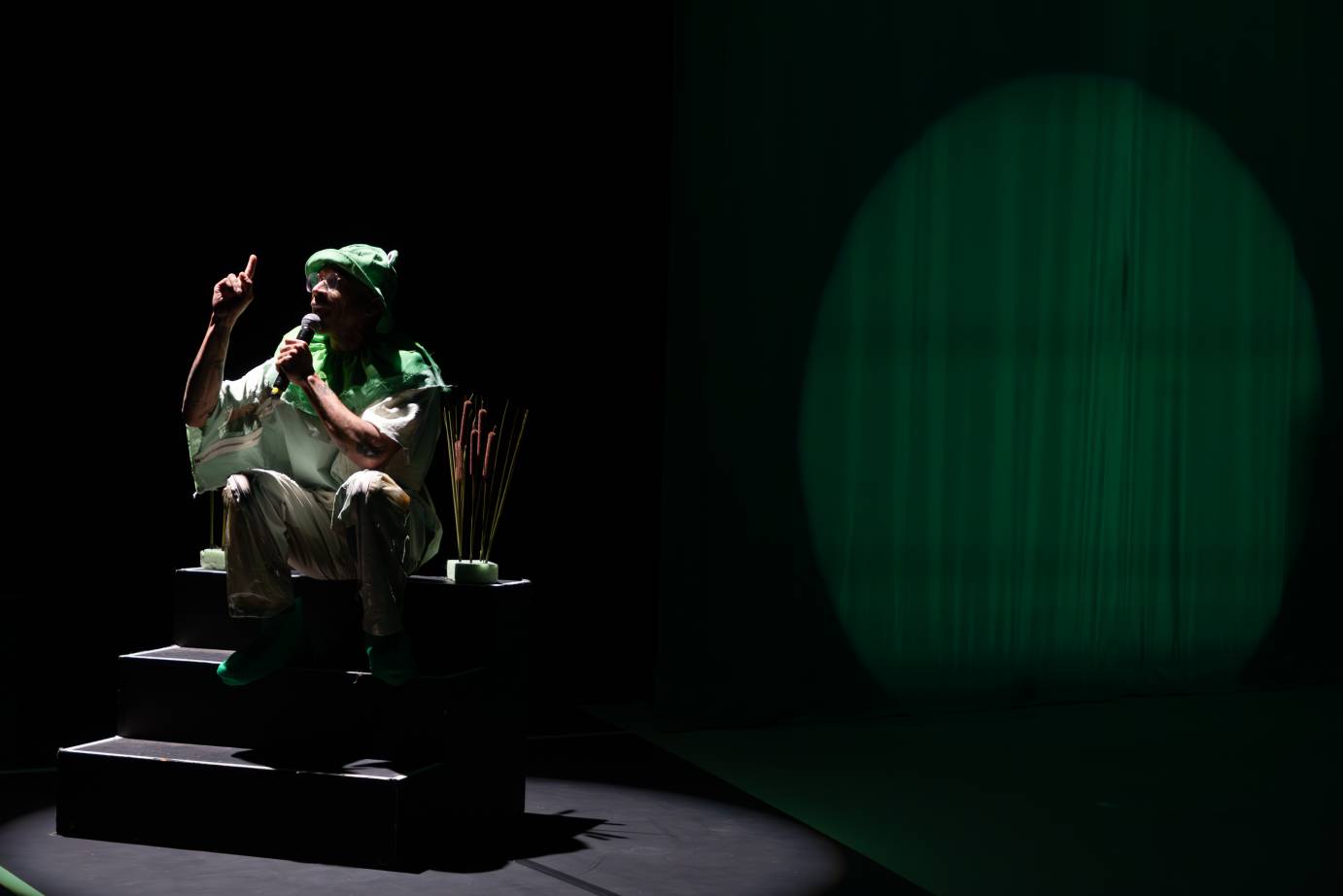
A surreal climax arrives when Toussaint-Baptiste dons a frog hat, channeling Kermit the Frog. The bit lands humorously yet heavily, swelling into a shimmering rendition of “It’s Not Easy Being Green,” sung with haunting resonance by Andrews. As Andrews sings, Katrina Reid circles the space with slow, floating movement, carrying a reflective silver disc that anchors the scene.
[siccer] offered one of the most poignant and powerful performances I have witnessed all year. Its ever-evolving structure felt both unpredictable and utterly right for a work so deeply invested in resisting containment. I found myself moving through waves of emotion as the piece swung between raw heaviness and unexpected humor. Its shifting panels, elastic timelines, and dramaturgy echo Rawls’ necessary critique of the cultural machinery that seeks to mark and sort what resists classification. [siccer] slips out of any single frame, insisting that Black performance cannot be diluted or confined.