
Related Features
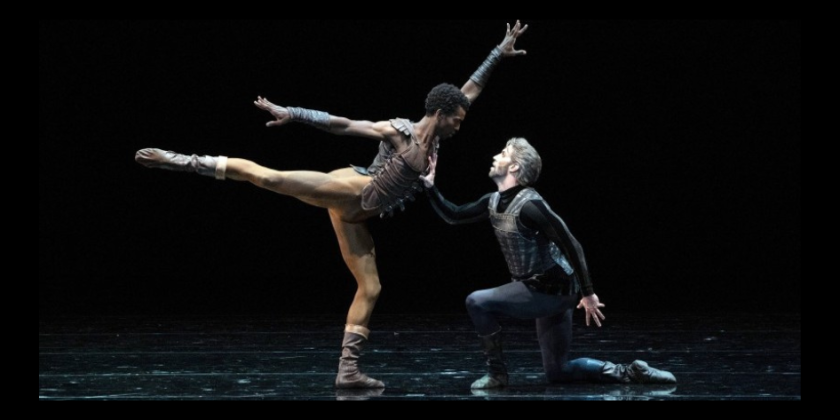
IMPRESSIONS: "The Firebird Variations," Details of Enchantment
IMPRESSIONS: American Ballet Theatre's 2026 Spring Season at Lincoln Center
THE DANCE ENTHUSIAST ASKS: Lar Lubovitch's “Othello: A Dance in Three Acts,” Restaged for American Ballet Theatre

By Kristen Hedberg/@kristen.hedberg on Instagram
View Profile |
More From This Author
Published on February 7, 2026
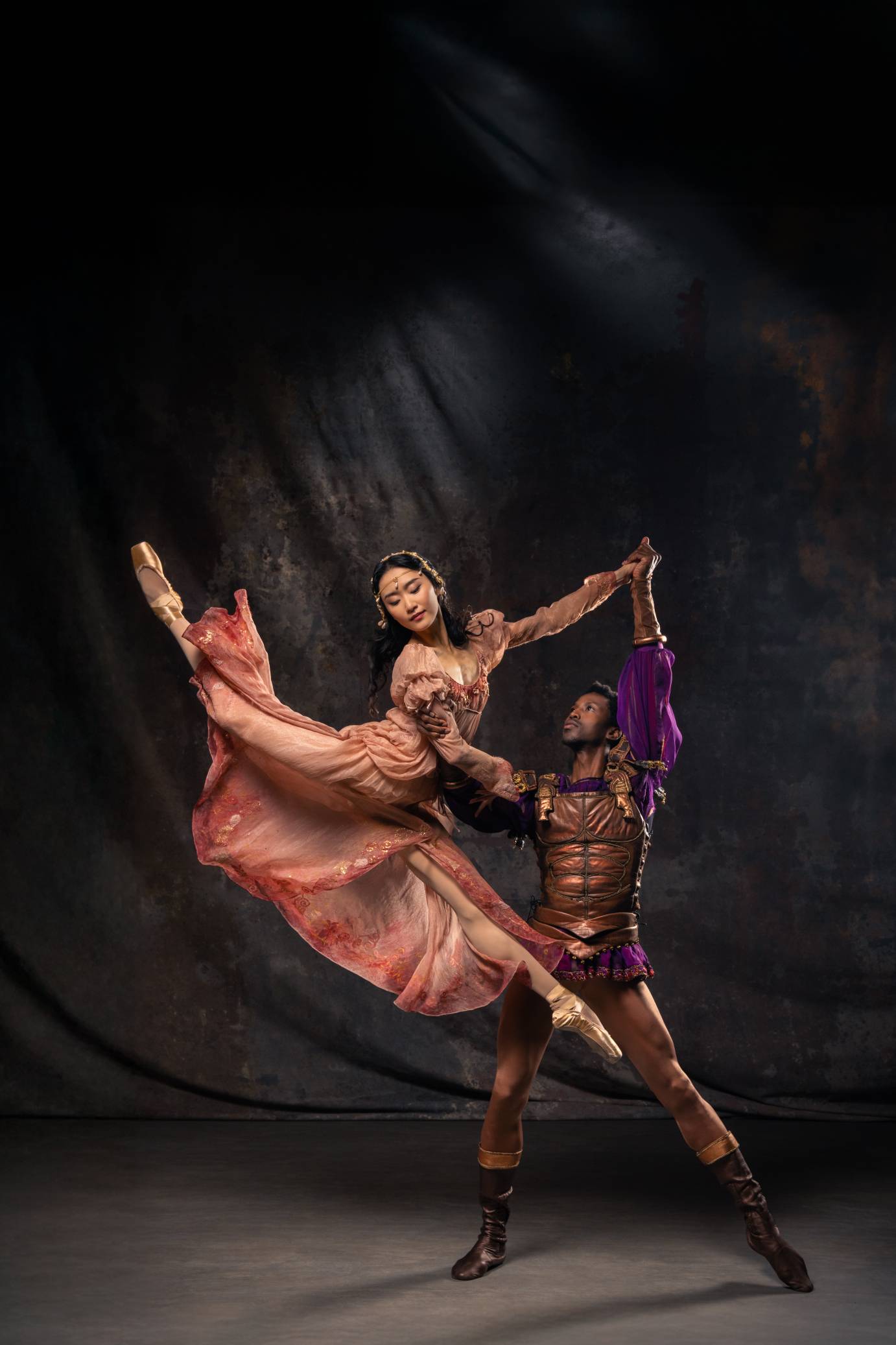
Fangqi Li and Calvin Royal lll. Photo: Quinn Wharton
Lar Lubovitch continues to be one of the most celebrated choreographers of our time. His expansive artistic career extends across movement languages including ballet, modern, contemporary, jazz, theater, and ice-dancing. Lubovitch remains committed to using dance as a vessel to share stories, connections, and themes that are profoundly human, while welcoming audiences to embark on their own journeys when experiencing his creations.
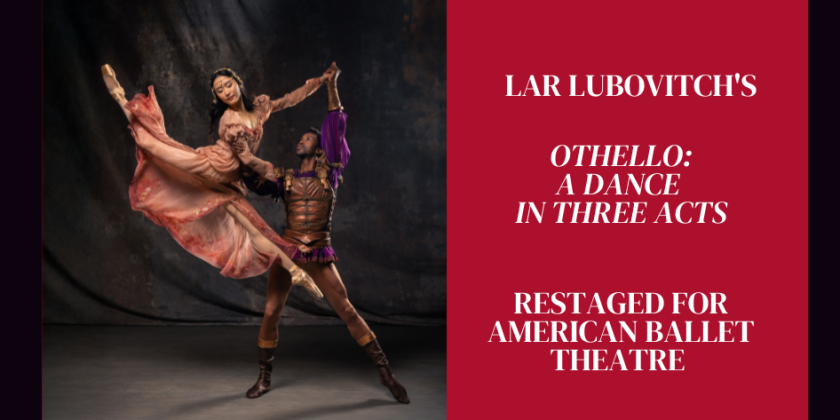
Lubovitch’s acclaimed ballet Othello: A Dance in Three Acts, which he created in 1997 for the American Ballet Theatre (ABT), will be performed from March 6 to 20, 2026 at the David H. Koch Theater during the company’s “ABT @ 85” anniversary season.
A preview of the ballet will be performed on Sunday, February 8th, 2026 at the Solomon R. Guggenheim Museum as part of Works & Process at the Guggenheim, followed by a Q&A with Lubovitch and Susan Jaffe.
The three-act masterwork, set to an original score by Elliot B. Goldenthal, depicts the Shakespearean tragic tale “Othello,” capturing themes of love, jealousy, manipulation, and madness. I had the honor of speaking with Lubovitch about the history behind creating Othello: A Dance in Three Acts, along with today’s rehearsal process.
Kristen Hedberg for The Dance Enthusiast: What inspired you to create Othello: A Dance in Three Acts in 1997 for American Ballet Theatre?
Lar Lubovitch: At the time, I was very interested in story dance. There hadn't been any original story dances for quite a while, so I went to Kevin McKenzie and said that was what I wanted to do. When he asked me, “What story?” I had been considering multiple ideas, but “Othello” came out of my mouth. McKenzie was very enthusiastic about it.
Why Othello? I thought that it was a story that could be universally understood and could be told in images. I felt that the images of “Othello” were so powerful, and that they alone could convey the story’s essence. When we think of Shakespeare, we think of Shakespeare as incredibly exquisite and detailed, but wordy.
The reason I subtitle the ballet A Dance in Three Acts is because it's not simply a pantomime, or an acting out of a play. It's my own spin on the legend in a way that can be told in movement form. Dance works best by creating behavior and finding out the shape of emotional conditions. Moments that can be shared through words are moments that can be felt through sensation.
How was your initial research process for the ballet, before generating movement?
Shakespeare did not write the original story of Othello. It was first written by the Italian writer Giovanni Battista Giraldi Cinthio and titled Un Capitano Moro (A Moorish Captain), about 100 years before to Shakespeare’s.
Un Capitano Moro was an ancient legend of a Moorish general who was fooled by lies, carrying out very heinous actions. But there was no psychology. It was very much melodrama, with extremely violent scenes. Shakespeare reimagined the story by naming characters, adding psychology, and bringing the story much more depth and amplitude. But considering “Othello” was not Shakespeare’s original story gave me the freedom to tell the story in my own way.
How has it felt to restage Othello: A Dance in Three Acts for Works & Process at the Guggenheim and ABT’s upcoming “ABT @ 85” Spring season?
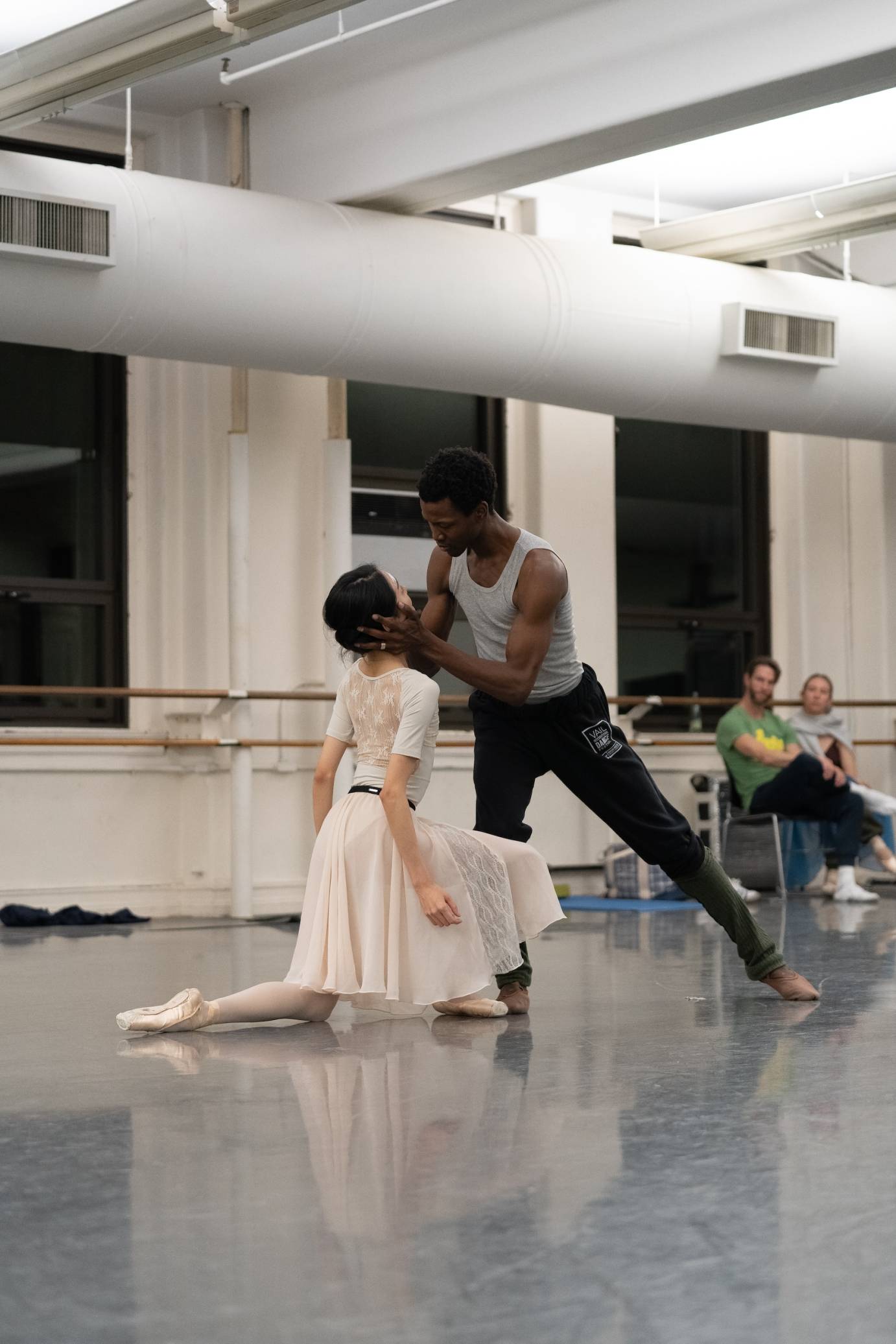
The ABT dancers are fantastic. I have an amazing group in the room with me. I’m in the studio with them every day, for four to six hours. I’m able to refashion many aspects of the ballet in accordance with what they're bringing. I am seeing the work with fresh eyes; I'm taking it to the next level, fulfilling certain ideas that may not have been fully fleshed out in the work’s original form.
Is today’s restaging close to the work’s original form, or has it changed significantly?
The work’s original form is true in essence — however, certain scenes have been modified and/or reassembled. I find myself looking at aspects of the ballet that I feel I can make more meaningful now.
The only way to progress is to tell oneself the truth. And sometimes the truth isn’t immediately evident. But after viewing things repeatedly, realizations become apparent that just weren’t clear in the first moment.
Can you discuss the relationship between Elliot B. Goldenthal’s original score and the movement?
The music was written simultaneously to creating the choreography. The composer, Elliot B. Goldenthal, happened to live almost next door to ABT. I wrote a very elaborate storyboard for him to compose the score, detailing even to the second, even the number of seconds, how long certain ideas would take to unfold — and he wrote music corresponding to that. We met daily throughout the process, coming to a point where we would work very late into the night.
Is there a certain scene in the ballet that, choreographically, brought a certain emotional challenge?
Probably one of the most intense scenes is a solo danced by Othello. During this solo, he is convinced he has been betrayed by his wife, Desdemona. A scarf had been used as a weapon by Iago (a soldier in the Venetian army, and the primary antagonist to Othello’s character) to convince Othello that his wife has been unfaithful to him.
In Shakespeare's play, Iago knows that Othello endures fits where he passes out, and Iago gears into his ability to create a situation so intense that Othello carries out a seizure. And so, I wanted to create a solo that illustrated, or alluded to, this idea. Finding the shapes to do so was a very challenging task.
Across the multiple genres you've created in, what common threads have you observed in each process?
The first thread is that I create in a way to see the music. I think of it as painting the music, rather than dancing the music […] and using the dancers through time and space as a way of sort of painting flowing images
The second is that I aim to build movement that is inevitable. I think that that's a hallmark of the best choreography: that whatever follows is the thing that should follow and feels right. Each step is, you might say, the mother of the next step. That mother becomes the delivery system of the step that follows. There is a kind of flow, naturalness, and connectedness that seems to me the only way it can be.
Dance itself is an incredibly potent representation of humanity at its best. What is happening behind what is on stage are human beings behaving between each other in a way that is democratic — in a way in which everyone cares for the safety of others. There are days, and hours, and weeks, of practice that dancers do to come to this point of mutual care and safety. It is relevant especially now, when we're so confused about the difference between truths and lies - those aren't separate subjects. There is only truth. And it's evident what it is. It's not arguable. I think that's why when people see dance, they feel inspired that they are experiencing this unbelievably beautiful example of humanity.