


Related Features
IMPRESSIONS: "ABT@85: Classics to the Contemporary" at Lincoln Center
IMPRESSIONS: ABT@85: A Retrospective of Master Choreographers (Part Two)
IMPRESSIONS: ABT@85: A Retrospective of Master Choreographers (Part One)

By Robert Johnson
View Profile |
More From This Author
Published on November 10, 2025
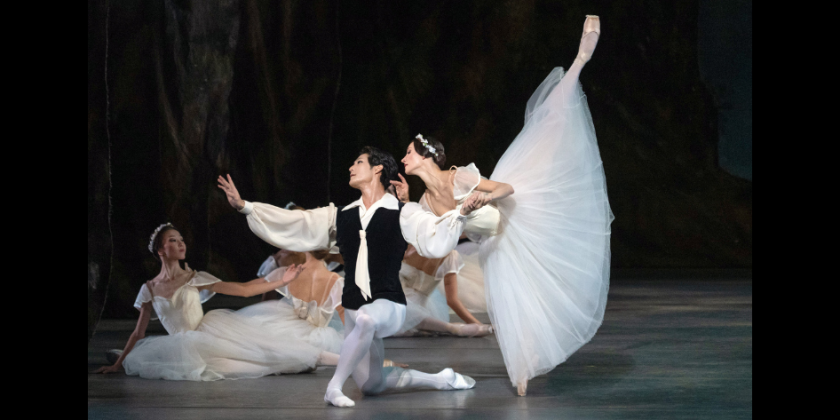
Michel Fokine's "Les Sylphides." Photo: Nir Arieli
ABT@85: A Retrospective of Master Choreographers, Part One
Les Sylphides
Choreography by Michel Fokine
Music by Frédéric Chopin
Orchestrated by Benjamin Britten
Costumes by Lucinda Ballard
Scenery by Peter Cazalet
Lighting by Brad Fields
Conductor: Ormsby Wilkins
With its program titled “A Retrospective of Master Choreographers,” launched October 17 as part of its fall 2025 season at the David H. Koch Theater, American Ballet Theatre recalled the aspirations of its founders, who planned to assemble a ballet museum with Russian, British, and American wings. All the choreographers whose ballets appeared on Friday night were present during the company’s inaugural season in 1940, though Antony Tudor’s Gala Performance did not enter the repertoire until the following year, and Agnes de Mille’s Rodeo did not arrive until 1950. Evidently ABT’s most significant acquisition was Michel Fokine, whose Les Sylphides, remains a touchstone of achievement, as it was on that long-ago opening night.

The importance of Les Sylphides lies in its rejection of ballet technique as an end in itself. This masterpiece exalts artistic imagination and returns physical expression to the summit where, by the turn of the 20th century, an attitude of petit bourgeois accounting threatened to replace it. The ballet’s poet-hero inhabits a sylvan realm where fairy muses attend and inspire him. A suite of orchestrated Chopin piano pieces infuses the scene with wistfulness. Though Les Sylphides is a modern work---hence, an anachronism---paradoxically this Romantic revival laid the foundation for the Diaghilev Ballets Russes’ leap into the future.
Audiences today may interrupt the ballet applauding what they perceive as tours de force, but the dancers’ ability to sustain a delicate atmosphere of reverie and longing is the true test of their virtuosity. They must cast a spell. Speed, lightness, and the performers’ willingness to surrender themselves to fantasy all support this goal. Though Les Sylphides is sometimes described as “abstract,” it is not abstract in form, but in the priority that it gives to rapturous currents of human emotion. The ballet features whispering gestures and even a pose that suggests hands cupped around a captured butterfly; yet these gestures have no narrative function in this plotless work. They are signs pointing to the essence of a myth, as Roland Barthes might describe it. Here inspiration wears a feminine aspect. The sylphs may be the Poet’s constant companions, yet he can never fully possess them. They reflect, fleetingly, all the attributes of the elusive beloved (the “eternal feminine”), from chastity to capriciousness and even wantonness. His destiny is to pursue this ideal with unfailing devotion.
Modern productions all suffer from the starkness of contemporary lighting, whose purpose is to reveal the dancing figures rather than enfold them in a darkling mystery. (According to dance historian Cyril Beaumont, in Les Sylphides “the general colour is a glowing dark green”). While reinventing footlights, ABT would also do well to restore Alexandre Benois’ painterly decors showing a ruined monastery in the background. Yet the company possesses a fine staging, and excellent interpreters, including the all-important corps de ballet, which ornaments the scene with Fokine’s brilliant designs. As pairs of sylphs coyly tilt their heads toward each other or recline in mirrored profiles, as they wreathe human garlands and kneel in attitudes of flight, each individual seems to have absorbed the ballet’s mystic ethos. These corps dancers animate the scene with frisky runs on pointes and lilting, playful balancés. They frame the stage in lines stepping in and out, so the forest seems to breathe with their rhythm.
Among the soloists on Friday, Hee Seo is the spiritual one. She possesses a hushed delicacy, and a quality of introspection that at times makes her appear to inhabit another world. Seo pauses meditatively, and then twirls so smoothly on one pointe that only her skirt, a floating cloud of tarlatan, reveals the impulse. Later, her hands flutter gaily in a lift, and later still she kneels and bends with tender plasticity, her long arms swaying from side-to-side as if erasing her reflection in a pool of water. Then she reaches heavenward with an imploring gesture. Slender Léa Fleytoux imparts a touching fragility to the Waltz, yet she holds positions firmly. She scampers and prances, and one foot flutters in petits battements, before she blows a kiss to someone whose identity remains her cherished secret. Fangqi Li sparkles with feminine intrigue and brings great energy to her part, levitating in repeated rélevés and rushing by like the wind. Amid these airy breezes, the Poet inevitably cuts a more earthbound figure, with his scooping arms and skipping mazurka step. A solid plié is required to move fluently to this rhythm, and Cory Stearns achieves the desired lyricism. At other moments, he supports his partner nobly.
At the Sunday matinee, among another fine cast, Yoon Jung Seo must be singled out for her polished clarity in the Waltz, but above all for the frictionless, motive impulse that is the unmistakable sign of talent. Yoon Jung Seo made an impression in various roles this season, including Twyla Tharp’s delicious and frolicsome Sextet.