

Related Features

IMPRESSIONS: Rosán Sensory Adventures in "Antarctica! Crew Wanted" at The Big Umbrella Festival
IMPRESSIONS: AXIS Dance in “Patterns” at Lincoln Center’s Big Umbrella Festival 2026
IMPRESSIONS: "ABT@85: Classics to the Contemporary" at Lincoln Center

By Henning Rübsam
View Profile |
More From This Author
Published on November 12, 2025
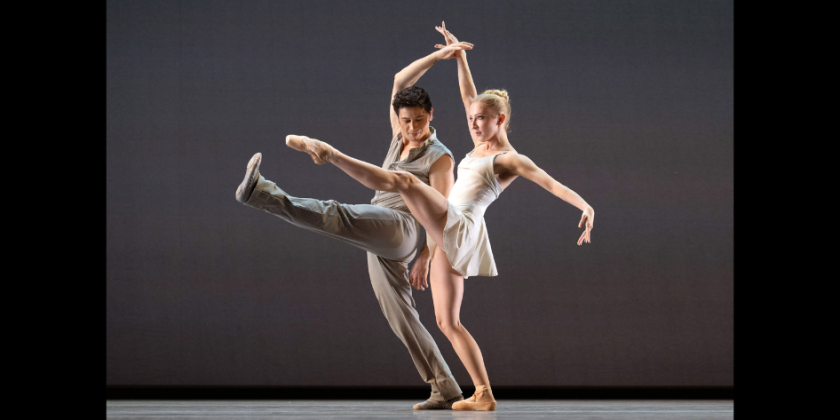
Twyla Tharp's "Known by Heart pas de deux". Photo: Nir Arieli
ABT@85: Classics to Contemporary
Fall Season: October 15 – November 1, 2025
Susan Jaffe, Artistic Director
David H. Koch Theater at Lincoln Center, New York City
Performances attended: Sunday, October 26 at 2pm and Tuesday, October 28 at 7:30pm
See below for program details.
When American Ballet Theatre presents The Kingdom of the Shades as a stand-alone excerpt, rather than as part of the evening-length ballet La Bayadère, as it did during its fall 2025 season at the David H. Koch Theater, the audience does not know they are watching an opium-powered trip by the ballet’s male hero, the warrior Solor.
Yet, when 24 tutu-clad dancers descend a ramp, repeating “step - step - arabesque and cambré back with a port de bras” as they snake their way in a never-ending line toward the audience, one realizes that this mind-altering scene could not have been conceived any other way. One might wish for a perfectly legal substance to expand on the theme, but it’s already as far out in its celebratory repetition as ballet can possibly get. It also happens to be cruel, since the dancers always have to perform that arabesque with the same leg. Dancers 1 and 3, and all uneven numbers lift the left leg throughout, while 2 and 4 (yes, all the way to 24) life the right leg.
If you think the abuse of the corps dancers is over, think again. Now they stand in a tight fifth position and raise their right legs in unison to a slight front diagonal — all at the same angle, at the same height, and hopefully without losing balance. Did I catch a slight wobble? No, it must have been a momentary twitch of my eye. This most merciless of any ballet blanc also happens to be one of the most memorable displays of classical ballet’s rigorous demand for perfection.

On Sunday afternoon, October 26, Hee Seo as the ghost of the bayadère Nikiya, seems sprinkled with pixie dust. She dances without visible effort, yet holds her balances. While I appreciate her not playing to the audience, I wish this dreamy apparition would yield and whisper to Solor, danced by Isaac Hernandez. He feels at home in his dream, nonetheless, and performs all of his material with a matinee idol’s ease. As the steps pour out of him, on his journey across this dreamworld, I experience his vision. He does not prepare or force a statement, he simply lives on stage.
On Tuesday evening, October 28, Chloe Misseldine steps in for an injured Christine Shevchenko and lends the part of Nikiya a more outward glow. Her Solor, Joo Won Ahn, executes his steps faultlessly, and I applaud his technique and vigor. Will he own his dream someday, or will he stay a visitor performing virtuosic movement phrases?
The three Shades solos are obstacle courses offering more technical hardships than any other ballet I can think of. Hats off to the dancers of the company for overcoming each and every hurdle without visible anguish or tribulation. On Sunday, Yoon Jung Seo repeats her triumph from last fall in the first solo variation, and Sierra Armstrong rules over the second variation with even more spectacular authority than in 2024.
All the soloists deserve special mention, however, because they perform wonders in these torturously difficult variations. Ingrid Thoms completes the trio with aplomb on Sunday, and, on Tuesday, Léa Fleytoux, Fangqi Li, and Elisabeth Beyer all delight in their respective trials and turn them into fascinating conquests of artistry and will.
I don’t know if I have ever seen ABT’s corps de ballet look better. The women in this Shades scene almost dance as one organism. It feels as though all the dancers breathe in and out at the same time, and their mastery of the material in turn makes me breathe easier. Could it be that the orchestra under the experienced baton of Ormsby Wilkins infuses the music by Ludwig Minkus with some magic potion of their own? Or is it the arrangement by John Lanchbery that leads to a higher understanding of this composer? I never thought of Minkus as a master, but after these two glorious performances by ABT’s orchestra, I am open to change my mind.

Both evenings end with the third act from The Sleeping Beauty, but, Sunday and Tuesday feature different pas de deux sandwiched in between.
Sunday’s matinee gives us the ultimate chestnut, Victor Gsovsky’s showpiece, Grand Pas Classique. Sunmi Park and Michael de la Nuez blaze through their assignments with great joy, and he performs with a sense of adventure. I love the fact that these dancers risk an occasional imperfection by performing this old warhorse with gusto rather than play it safe. When de la Nuez slightly slips after a turn, one roots for him. Park allows herself freedom when she is in his hands, for he partners like a seasoned pro.
Usually this gala number is reserved for experienced stars, but ABT artistic director Susan Jaffe has young artists take on the technical challenge and grow in front of an audience. Let’s be honest: it does not take a great deal of artistic maturity to bring Grand Pas Classique to life. Fresh faces Park and de la Nuez have the necessary dynamism, and technical chops, and esprit to burn.

Stacy Caddell, who originated the ballerina role in Twyla Tharp’s Junk Duet before it was incorporated into the larger work Known by Heart, has staged the pas de deux for ABT. It obeys the traditional structure: first a duet, then a male solo followed by a variation for a woman, before a coda brings the two together again. What is not traditional is Tharp’s use of partnering and level changes. Breanne Granlund and Herman Cornejo reach out horizontally, although one is upright and the other on the floor. Yet, the two different realities do collide, and occasionally produce wondrous partnering. My favorite moment is a good, old-fashioned piece of shtick: Granlund gets to tap dance on her pointe shoes! Tharp is at home in all corners of the dance world.
In contrast to the pas de deux structure with variations and coda, Le Grand Pas de Deux by Deux by Christian Spuck, does not concern itself with form or structure, but goes for laughs instead. On Tuesday, the audience responds to the ballerina wearing eye-glasses and carrying a handbag as if she were one of them, who just happened to climb onto the stage. Dreams do come true, even if that means you have to park your purse on the floor for a moment in order to pull off some virtuoso ballet moves with your partner. Skylar Brandt and Jake Roxander ham it up to the overture from Gioacchino Rossini's The Thieving Magpie.

One of Frederick Ashton's final works, Rhapsody was created in 1980 for Royal Ballet ballerina Lesley Collier and guest Mikhail Baryshnikov. On Tuesday evening, Léa Fleytoux and Herman Cornejo perform the very brief pas de deux from the piece to Sergei Rachmaninoff's Rhapsody on a Theme of Paganini, Jacek Mysinksi at the piano. Cornejo lifts Fleytoux out of a series of bourrées traveling sideways, and he keeps hoisting her excitedly. She frequently shows off her arabesque line and, in the end, he carries her in an ascending arabesque into the wings. These dancers do look good together — both short in stature, but long on accomplishment and musicality.
As pretty and entertaining as these pas de deux are, I wish for material that makes ABT stand apart. There are duets by long-time house choreographer Antony Tudor that come to mind. The Leaves are Fading contains two magnificent pas de deux that no other New York company presents. And wouldn’t there be a worthwhile pas de deux in his Romeo and Juliet? Tudor’s repertoire is unique to the company. Let’s not forget that Alvin Ailey choreographed The River for ABT in 1970 to a score by Duke Ellington. If one does not want to revive the whole work, maybe there are parts to revisit? And while I want to watch the full, one-act story ballet A Streetcar Named Desire that choreographer Valerie Bettis staged for the company in 1954, two years after its premiere for the Slavenska-Franklin Ballet, there might be excerpts to whet the dancers’ and the public’s appetite. Technically, ABT’s dancers look ready to take on any challenge that will advance their artistry.

What’s not to love about The Sleeping Beauty? While it happens to be one of my favorites, I find it to be a seasonal ballet. Just as much as I associate The Nutcracker with Christmas, each spring I need a kiss from Sleeping Beauty to awaken after a long winter. Yes, it makes sense to excerpt Act III, in order to showcase the talented dancers in a multitude of variations and to end an evening with a grand finale. Making the full-length Sleeping Beauty an annual spring celebration, however, is my suggestion and my preference. Of course, one cannot forget the troubled productions of this beloved ballet under former ABT director Kevin McKenzie. First, in 2007, there was McKenzie’s collaboration with Gelsey Kirkland and Michael Chernov, in which Kirkland burned much more than her hand.
Then, in 2015, Alexei Ratmansky almost ran the company aground with his disastrous retro version of Marius Petipa's masterpiece. Prima ballerina Paloma Herrera refused to appear in that production as her scheduled farewell. Leave it to Jaffe to discard all the discord, and stage her own vision of the third act, with choreography after Petipa and with Willa Kim’s costumes from the 2007 production to give hope.
Under David LaMarche’s baton, the tempi are mostly swift, but the fine dancers do not have trouble keeping up. Christine Shevchenko as Princess Aurora and Daniel Carmargo as Prince Désiré make it a Sunday to remember. Shevchenko’s sweet demeanor, strong technique, and fine musicality match beautifully with Carmargo’s powerful presence, high-flying jumps, and gorgeous, long lines. Best of all, Camargo knows how to partner, and presents Shevchenko as a true princess. There is never a need for adjustment, for he places his hands anticipating her speed and force. It’s a long-awaited dream come true. Remy Young as the Lilac Fairy performs a solo that I seem to remember from the Vision Scene in a previous production. But then, I have seen so many versions of this ballet that I am just happy to witness it danced so well. Léa Fleytoux and Jake Roxander, as Princess Florine and The Bluebird, delight in their fluttery variations and know how to dance together. Even if Puss-in-Boots (Melvin Lawovi) seems allergic to cat hair, since he obviously does not enjoy lifting the lithe White Cat (Lauren Bonfiglio), I enjoy this great company in The Sleeping Beauty from the beginning to the closing Mazurka.
On Tuesday evening, however, Isabella Boylston, as Princess Aurora, has her work cut out for her, because her partner, Calvin Royal III, does not seem as present as in previous seasons. Boylston rises to the occasion, and basically partners herself. She earns the bouquet of flowers presented to her at the curtain call, by holding her balances, and not allowing his all-too-obvious maneuverings to bother her. Her sunny personality and steely strength help her through the evening. I have often admired Royal’s artistry, but I find it lacking on this particular evening. His feet don’t point, and his jumps and turns don’t finish in tight positions. Was he stuck in traffic and did he not have enough time to warm up properly? Virginia Lensi as the Lilac Fairy makes up for any shortcoming.
And while Patrick Frenette and Kanon Kimura are the cat’s meow in Puss-in-Boots (without any sign of allergies), the truly fantastic highlight of the evening is the pairing of Yoon Jung Seo and Takumi Miyake as Princess Florine and The Bluebird: her extensions and hops on point, and her ever-so-supple arm movements are all harmonious. When Miyake takes flight, he does not seem to touch the ground anymore. I watch him take off happily just like a hummingbird, and I respond to his buzzing energy with a smile on my face.
Did I mention the outstanding quality of the orchestra and corps de ballet? American Ballet Theatre is a national treasure.