


Related Features

IMPRESSIONS: Cathy Weis' SUNDAYS ON BROADWAY with Cayleen Del Rosario, Mina Nishimura, Stephen Petronio and Nami Yamamoto
THE DANCE ENTHUSIAST ASKS: Cathy Weis on Her History as an Artist and Her Performance Series, Sundays on Broadway

IMPRESSIONS: A Sunday in Spring 2026: Cathy Weis Projects’ Sundays on Broadway

By Hannah Lipman/Substack at @hannahlipman.
View Profile |
More From This Author
Published on June 30, 2026
Alex Tatarsky. Photo by Rosa Allegra Wolff
Featured Choreographers: Lysis, Alex Tatarsky, Sakura Shimada, and Luis Lara Malvacías
Co-Curators: David Guzman and Zo Williams
Stage Manager: Leo Janks
Videographer: Peter Richards
Assistant Company Manager: Liza Kastrilevich
Project Coordinator & Marketing: Sarah Richison
Shoeless audience members fan themselves languidly, chatting quietly in the loft’s warm, humid glow. I sink into a cushy velvet sofa alongside other early arrivals; latecomers file in, finding their places atop colorful floor cushions. The bohemian atmosphere encourages a sense of openness in this artistic cocoon nestled in the heart of the city’s chaos. This loft space is home to Cathy Weis Projects, an artist-run nonprofit that produces Sundays on Broadway, a performance salon for experimental artists. Driven by Weis’s commitment to building community through dance, these curated performances are still going strong in periodic weekly installments since 2014.
On the final night of the Spring 2026 season, artists Lysis, Alex Tatarsky, Sakura Shimada, and Luis Lara Malvacías gathered to showcase their work. Ranging from comedic to somber, the pieces were united by a clear commitment to fierce stylistic differentiation.
Lysis. Photo by Rosa Allegra Wolff
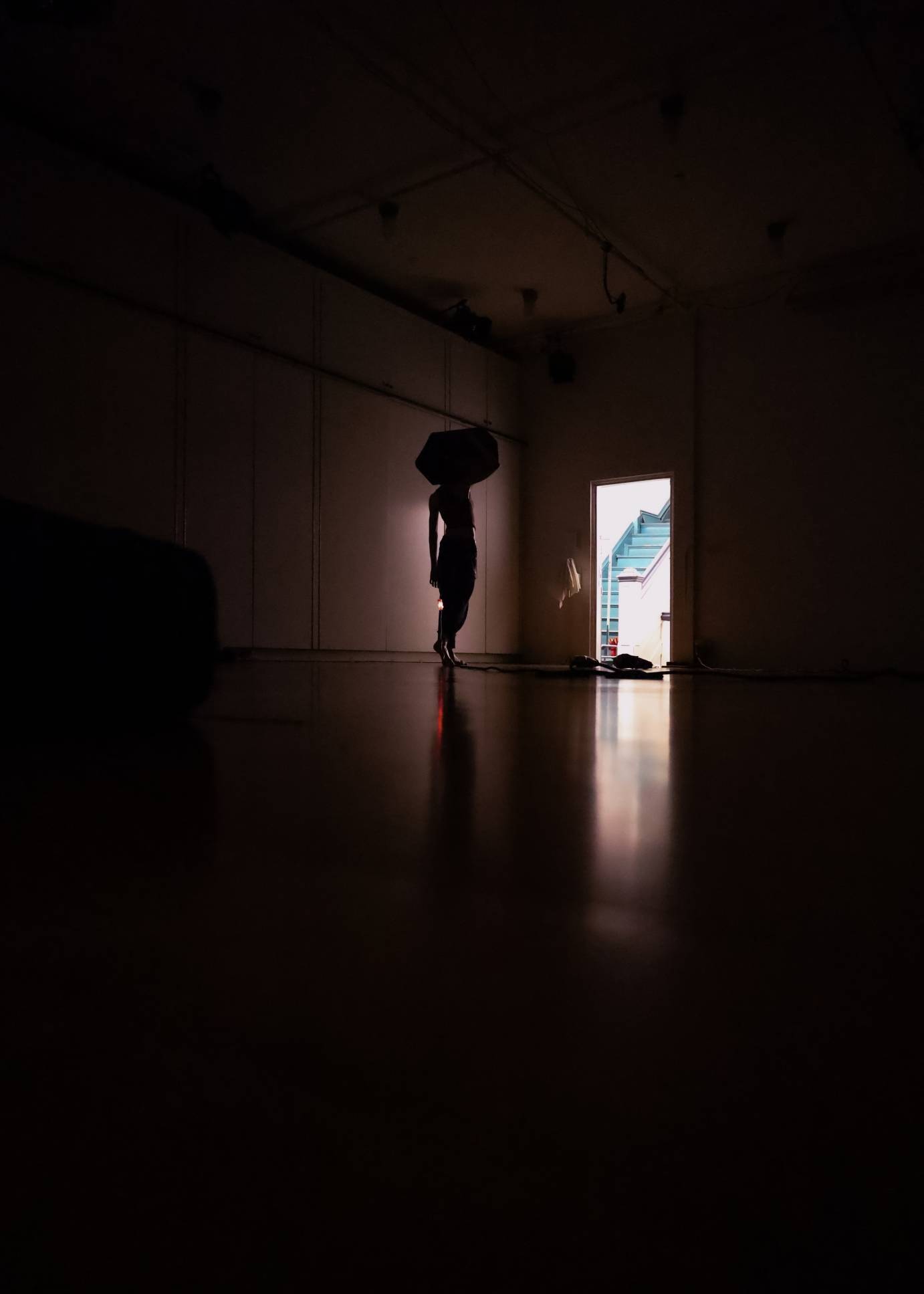
The darkened space echoes with the loud soundscape of footfalls, doors slamming, and keys jangling — the noise indistinguishable and overwhelming — as Lysis’s loose, looming frame enters through the door. Their white platform heels land with hoof-like elegance against the wooden floor as they clomp slowly in a wide circle, cultivating spectacle through simplicity. A carabiner and keys hang from the waistband of their paint-splattered black pants, jangling as their piercing, solemn expression remains immutable. Lysis walks to the back of the loft, bending down to lie atop a large PA speaker, their movements slow and delicate. Shedding their shoes, they collapse to embrace the source of sound.
Rolling over with the speaker to lie under its weight, they transform into a squashed bug, limbs splayed and motionless. Through prolonged stillness, they spur an acute presence simmering with anticipation. Only their breath moves the speaker up and down; the wires make a tangled nest around them. Sitting up to cradle the giant piece of equipment and rock it like a baby, a maternal relationship unfurls between the source of the echoing sound and its creator. Lysis hoists the speaker over their shoulder and shoves their feet into their shoes. As they make their way towards the exit, the harsh thudding sounds of their footsteps accompany their meander, and I wonder where they will go next.
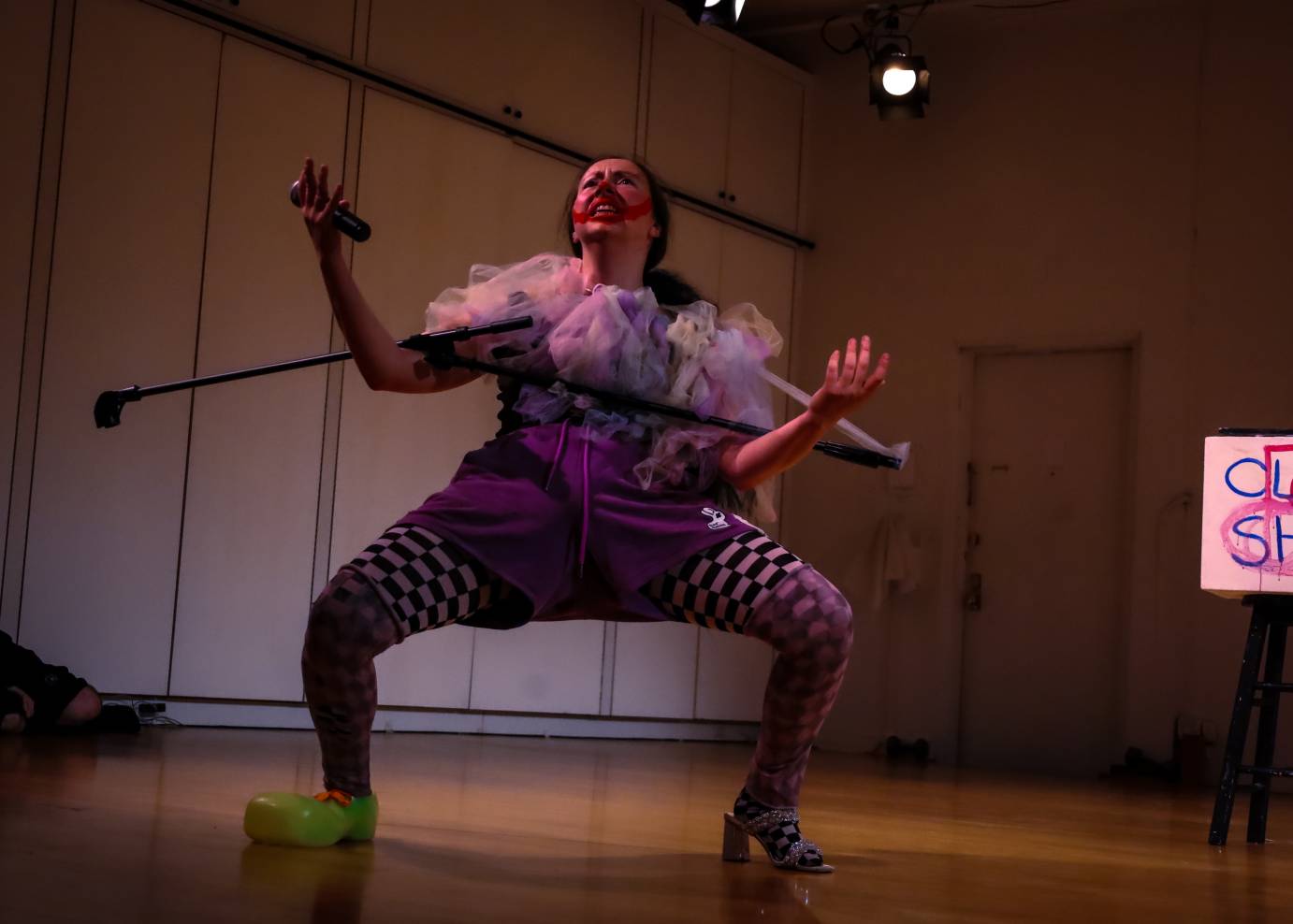
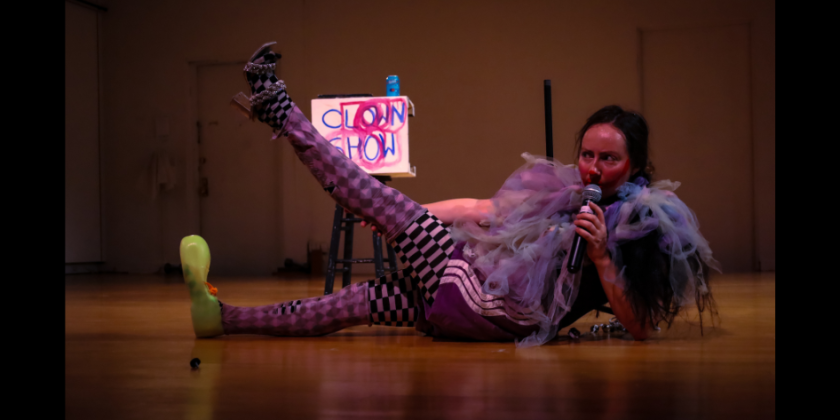
As soon as she shuffles into the warm light, Alex Tatarsky — clown, performance artist, dancer — wastes no time making a memorable impression. Wearing a zany, mismatched, multicolored ensemble complete with a tulle jester’s ruff, it is immediately evident that she has arrived to entertain. She places a box that reads “Clown Show” atop a stool. After painting red circles around letter formations such as “Low”, “Ow”, “Own”, and “How”, she paints her nose and mouth to fully assume her role as jester.
Tatarsky’s wry, self-deprecating jokes punctuate each unpredictable vignette, from chasing a microphone in front of her face to demanding that an audience member spank her forcefully. She discusses artists’ strife while thrusting her hips and lying on the ground despondently, poking fun at the notion of “putting in the work” while physically reposed. Her flamboyant physicality satirizes any self-serious musician as she stands with beveled legs and strums a duct-taped guitar, singing a pseudo-folk song about her landlord in a wavering British accent. As she growls about a man she met at a bar and impales her crotch with the microphone, moaning, she expertly blurs distinctions between pleasure and pain. Embracing her audience’s attention while still fiending for it, Tatarsky is spurred on and exhilarated by the culmination of her act. She is a force of searing intelligence, melded with candid humility, baring it all for us to enjoy.
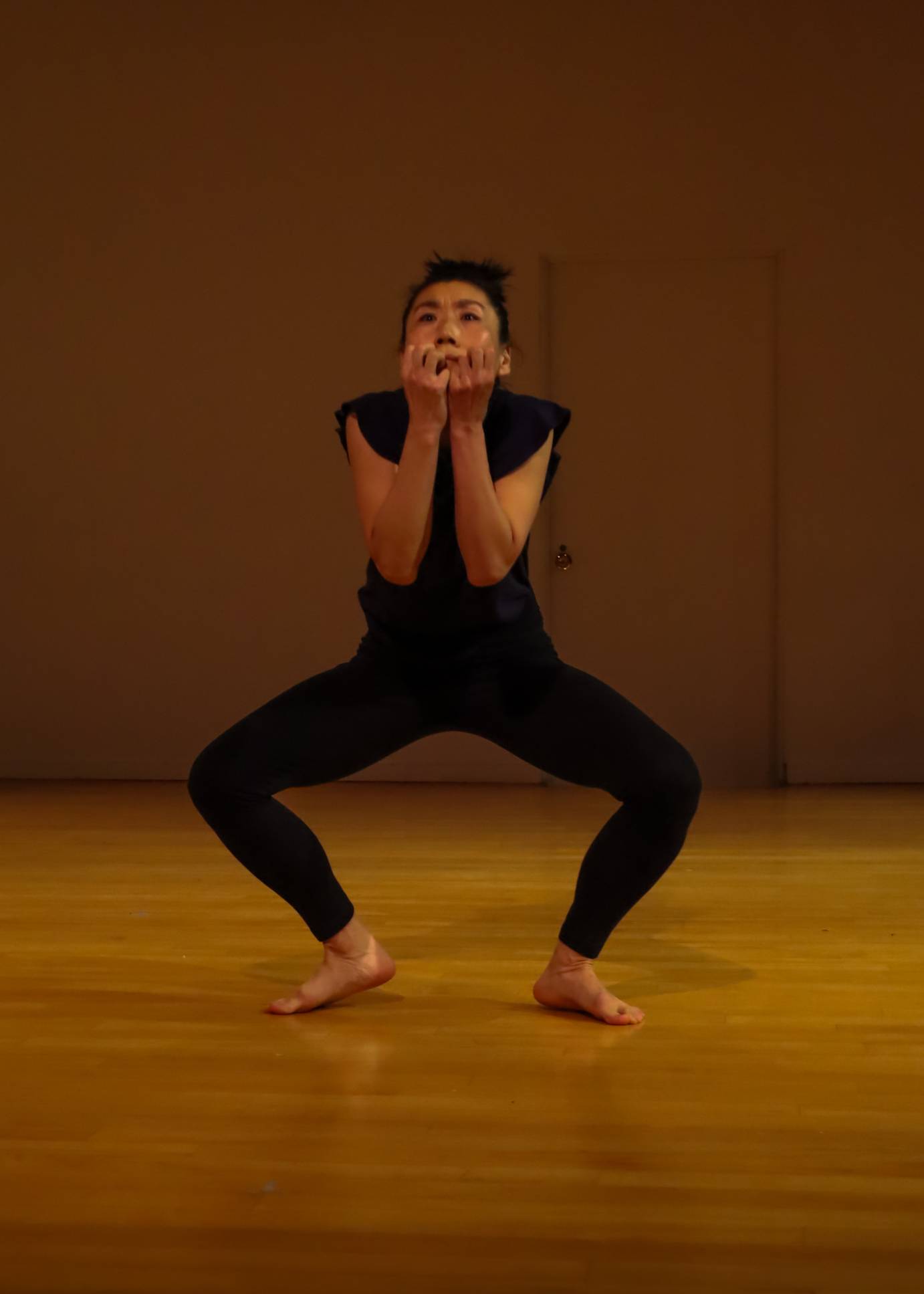
Sakura Shimada. Photo by Rosa Allegra Wolff
Sakura Shimada is an investigator of play; her movement evokes stop-motion through her trembling vessel and twitching, expressive face. Bach’s “Goldberg Variations” play with an air of elegance, alongside Maria Olga Pineros’ sparse, haunting voice in her unaccompanied song “Copla de Ordeno,” concluding with the folky sounds of the Incredible Street Band, which paints the room with bucolic harmonies. Shimada folds and bends, creating loose shapes that blend seamlessly into one another like gradient watercolors. Flitting between upright balletic positions and concave fetal ones, she appears like a marionette, wobbly yet tightly controlled. Her expressions range from inquisitive to pleased, changing with utmost speed as she tumbles into the next sequence of steps.
The playbill describes her work as being “about her habit of constantly raising questions. The power of being ordinary and the basic practice of moving attention.” She articulates this sense of attentive wonder as she quickly bourrées in parallel and hides her face behind her hands, breaking through them like a curious child. Shimada’s unique movement vocabulary functions like a rubber ball: bouncy and evasive, yet endlessly engaging.
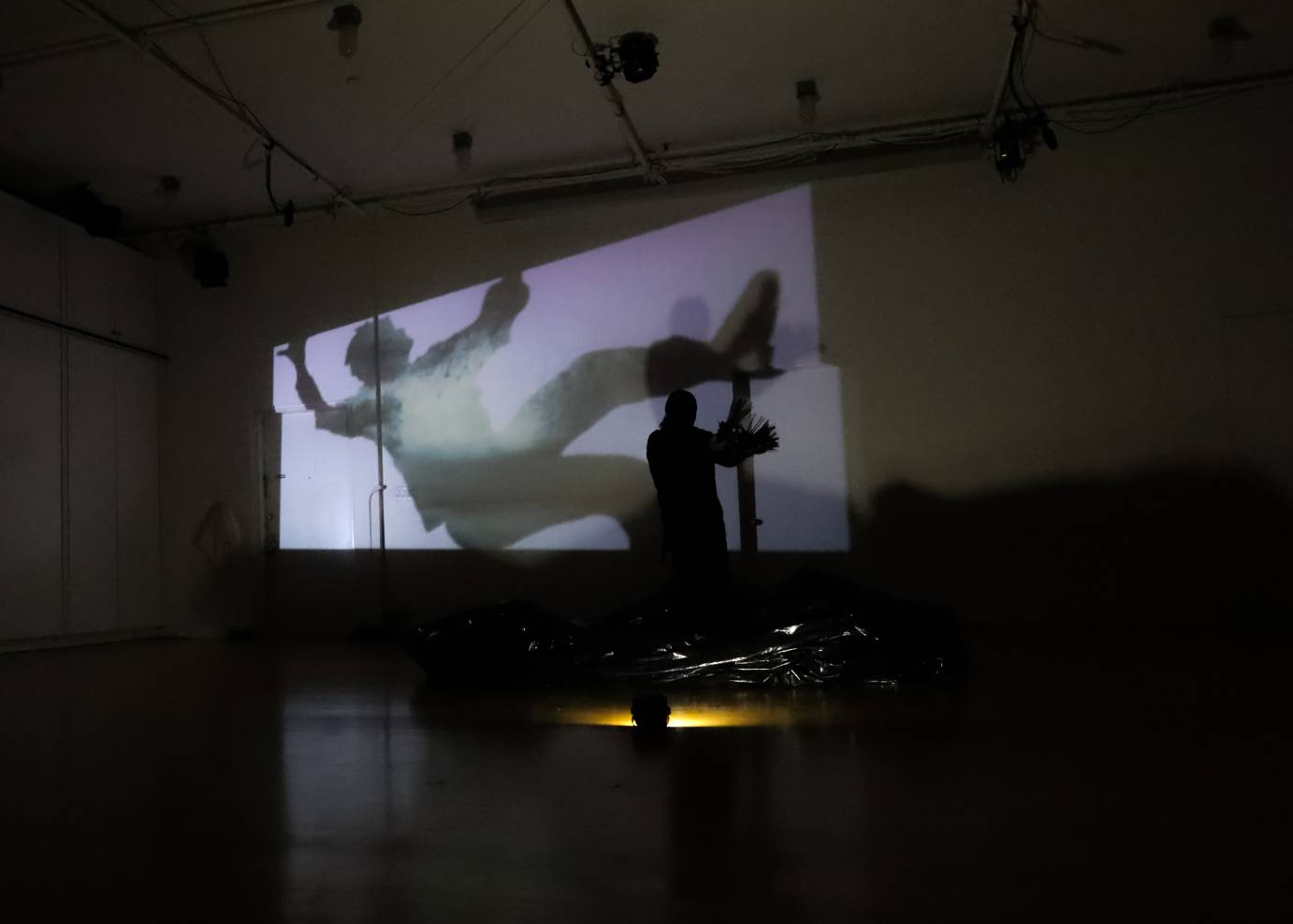
Luis Lara Malvacías. Photo by Rosa Allegra Wolff
Emerging from a massive swath of black plastic bags, Luis Lara Malvacías lurches downstage, his body a jagged extension of the ominous cloud. Leonard Cohen’s raspy baritone cloaks the room, as Malvacías’ shadow hovers, enlarged on the back wall. Projections of a man in a tunnel appear, switching to all-caps questions and quotations about power, as he places a crown made of woven cane atop his head. Erecting a leafless tree-like sculpture from the dark mass of plastic, he decorates the room, transforming it into a carefully crafted oasis.
As he crawls around and undresses to the airy piano arpeggios in the karaoke version of Thom Yorke’s “Suspirium,” he changes from an all-black outfit into an all-white outfit. Walking menacingly around the stage, he watches as a stagehand recites the lyrics to his original song, titled “Pow Pow”. The lyrics arrange and rearrange plays on words and sounds — power, hungry, hunger, pow, play — to instigate an undercurrent of resistance in the audience. Looking down at the printed handouts of the song lyrics distributed prior to the performance, the audience joins in, loudly chanting the words to give voice to the nebulous spirit Malvacías has conjured. As he looks down at his own sheet of lyrics on the floor, he laughs, his smile infectious and empowered.
As I pull my boots back on and prepare to leave the creative nest, I find myself enchanted with the traces of movement still percolating in my mind.