


Related Features
IMPRESSIONS: Hilary Easton + Co’s “Nothing is perfect, nothing is finished.” at Gibney
IMPRESSIONS: Shamel Pitts’ “Black Box: Little Black Book of Red” at Gibney

IMPRESSIONS: Hilary Easton's Thoughtful Dance-Theater "Ringelblum" at Gibney Dance

By Catherine Tharin
View Profile |
More From This Author
Published on December 22, 2025
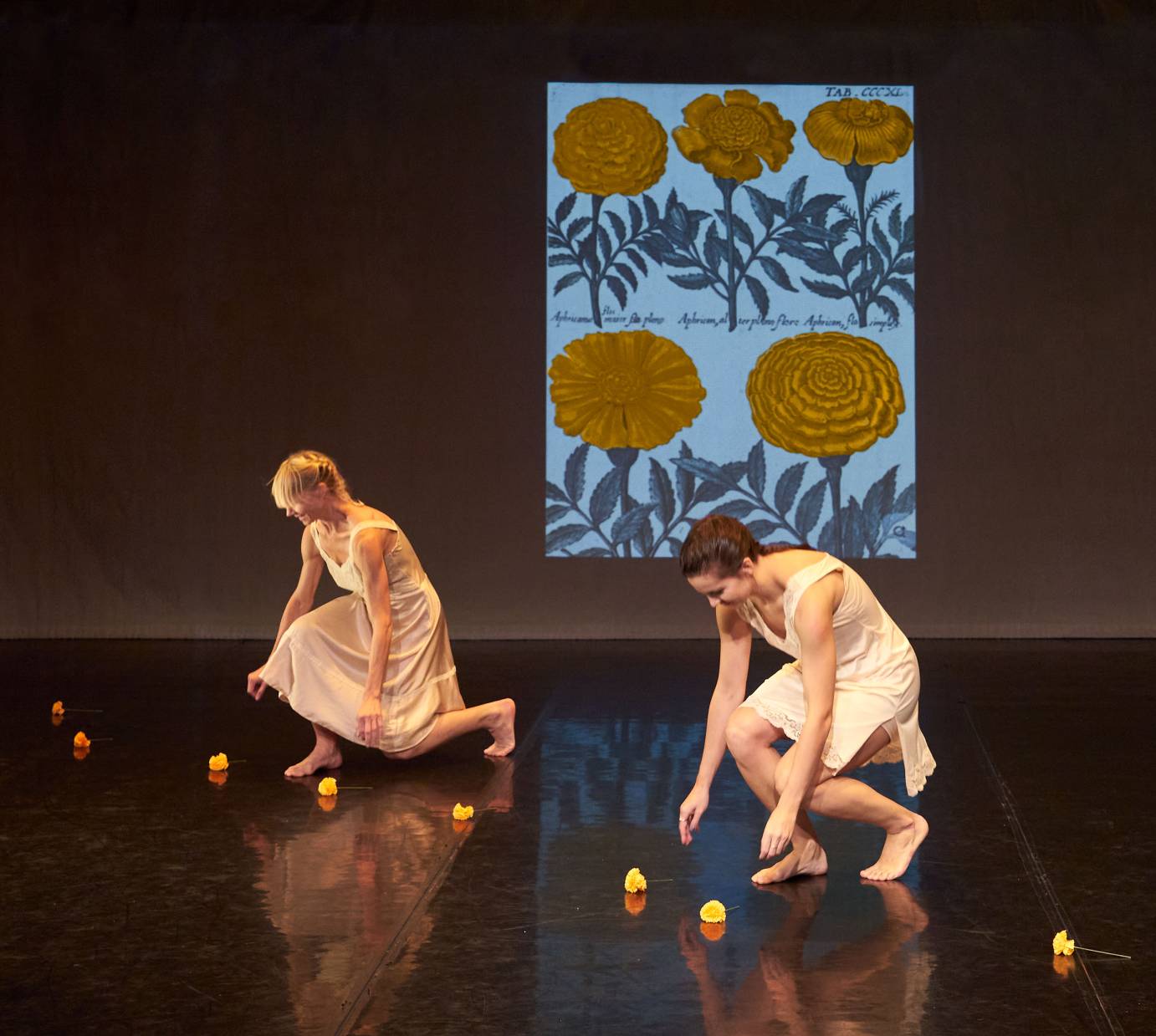
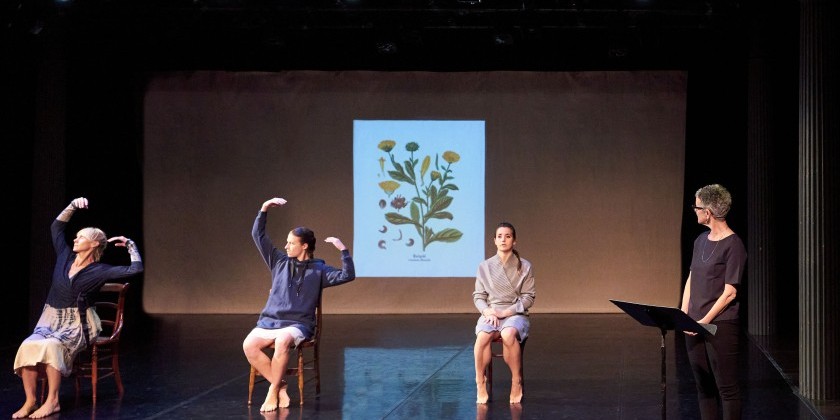
Hilary Easton's "Ringelblum." Photo: Joshua McHugh
Ringelblum
Choreography and Text: Hilary Easton
Performers: Ingrid Kapteyn, Emily Pope, Louise Benkelman, and Hilary Easton
Costumes: Kimberly Manning
Lighting: Dominique Watson
Introduction: Emilia Stuart Lynch
Testimonials: Sebastian Winter, Julia Ciesielka, Gerard Mryglot, Robert Fleitz
Music: Gabriel Fauré, Robert Schumann, Claude Debussy, Erik Satie
The Theater at Gibney
September 18 - 20, 2025
“Greetings esteemed colleagues, I’m Emilia Stuart Lynch, and I’d like to welcome you to the 3rd annual conference of the Global Community of Dance Historians, sponsored by the Mitosky Foundation.”
So begins Ringelblum, choreographer Hilary Easton’s intellectually rich and thoughtful dance-theater work, presented at The Theater at Gibney in mid-September. Lynch’s introduction describes Easton, the featured speaker at a (we learn, fabricated) conference, as “one of our most celebrated voices — a renowned historian and cultural anthropologist,” at which point my companion and I turned to each other in disbelief: “I didn’t know Hilary wrote reams of books about history and cultural anthropology! Where have we been?”
We experience a momentary, believability hiccup. Easton continues to be, in real life, a choreographer and storyteller, and a maker of myths who anoints this work with a complex point of view. Ringelblum, a dance within a dance that explores a “Rashomon effect,” gathers multiple, contradictory accounts: danced solos, videotaped interviews, spoken testimonials, and filmed recollections moderated by Easton. Her central questions, “Who will write our history?” and “What is recorded, remembered, and changed?” live at the core of this multilayered work, probing the transmission, preservation, and distortion of memory.
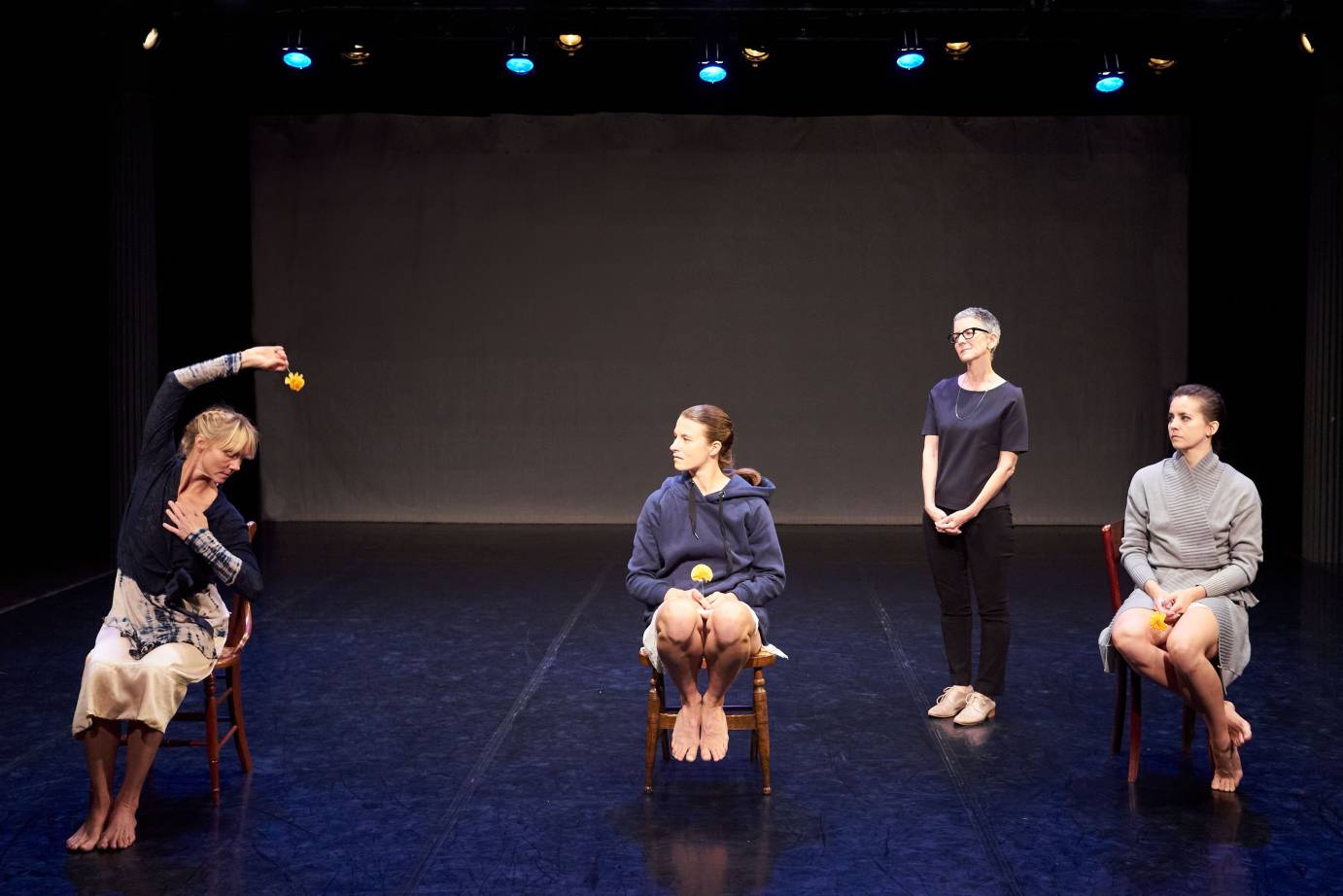
The marigold flower (the meaning of “Ringelblume” in German) plays a metaphoric role. Marigolds appear in the hands of the three marvelous soloists — Ingrid Kapteyn, Emily Pope and Louise Benkelman — and Easton, also an excellent mover, wields them herself. The dancers clutch two upright stems, wrapping them in the fingers of both hands, holding them aloft or touching the shoulder or wrist, and creating a silent, mysterious code. Sometimes the blossoms become stage dividers or boundary markers. As Easton notes, “From my study of floriology it is often associated with despair and grief.” (“Floriology,” a term Easton made up, is an example of her witticisms). In performance, the marigold functions as a poetic stand-in for sorrow, memory, life’s beauty, and the boundaries between personal and collective experience.
Jewish historian and activist hero Dr. Emanuel Ringelblum, whose life and work anchor the piece in historical fact, persevered in the Warsaw Ghetto. He preserved the Ringelblum Archive in large milk cans, which were unearthed in 1944, the year he and his family were exterminated. The historical weight of Easton’s Ringelblum resonates with the decimation of Jewish communities in Eastern Europe during the Holocaust, underscoring the urgency of preserving and transmitting cultural memory. At the same time, the 'Ringelblum dance' is a deliberately unstable and fictionalized remembrance that galvanizes viewers toward social consciousness and protest, demonstrating the capacity of art to awaken awareness.
Easton’s lucid choreography evokes an earlier era. It is measured, assured, and deliberate, paced like a heartbeat, with expansive second positions, long stretched extensions, and suspended swings. Movements are oriented toward shape and line with phrases lengthened on relevé as if reaching back through time. Here, precision signifies fidelity to memory, and poise brings the attention, focus, and awareness necessary to carry forward a work that spans multiple witnesses and eras. The movement becomes a language, transmitted over generations. At some point, the transmission of the dance is broken, leaving only the essence preserved. The dancing carries symbolic weight, suggesting the body as an instrument of recollection. The three solos form the nucleus of the dance, concentrating its movement, symbols, and layered memory.
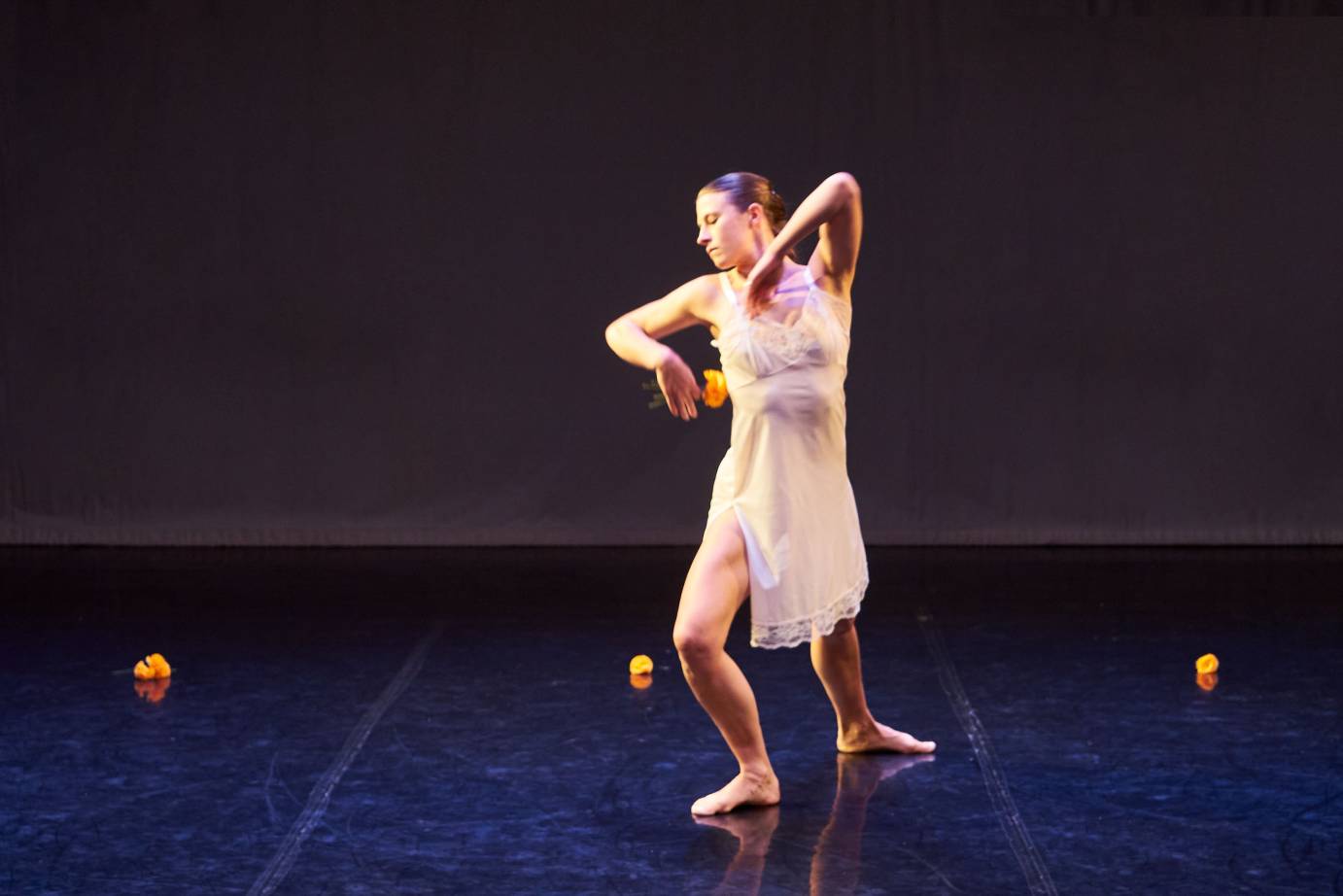
Filmed perspectives offer images of composers, a dancer, and a linguist, describing experiences of the 'Ringelblum dance' across Eastern Europe. The witnesses include a grandmother who “burned it into memory,” and her elderly Latvian neighbor who spoke of its transformative impact. The three soloists wear white slips, echoing one account of the 'Ringelblum dance' danced in a slip under a single bare light bulb.
The recorded accompaniment, prewar piano solos by Gabriel Fauré, Robert Schumann, Claude Debussy, and Erik Satie, are lyrical, introspective, ethereal, and at times, subtly dissonant. The choreography mirrors their pacing with its ritualized phrases, while they reinforce the intimacy and contemplative tone of the dance.
Ringelblum feels like a voyage through imprint and reenactment, revealing its gestalt only through varied and differently retained accounts. Around Ringelblum’s enduring essence, the edges remain blurred, shaped by the many ways memory shifts and fractures, much as in any retrospective account. The vision Easton creates is not fixed, though its core remains steady, powerful, and life-altering. It prompts us to contemplate how we remember, what we carry forward, and what is willfully forgotten or purposefully rewritten. Easton reaches a pinnacle with this fully realized dance — a 2025 highpoint for this reviewer — seamlessly navigating her intertwined roles as choreographer, dancer, and guide, orchestrating the multiple layers of memory, testimony, and embodiment that define Ringelblum.