


Related Features
IMPRESSIONS: A Sunday in Spring 2026: Cathy Weis Projects’ Sundays on Broadway
IMPRESSIONS: Karley Wasaff’s "Growing Takes Time" at Noo Arts Wildflower's Green Roof

IMPRESSIONS: Brokentalkers' "Bellow" at the Irish Arts Center and Kinoshita Kabuki's "Kanjincho" at Japan Society

By Catherine Tharin
View Profile |
More From This Author
Published on February 2, 2026
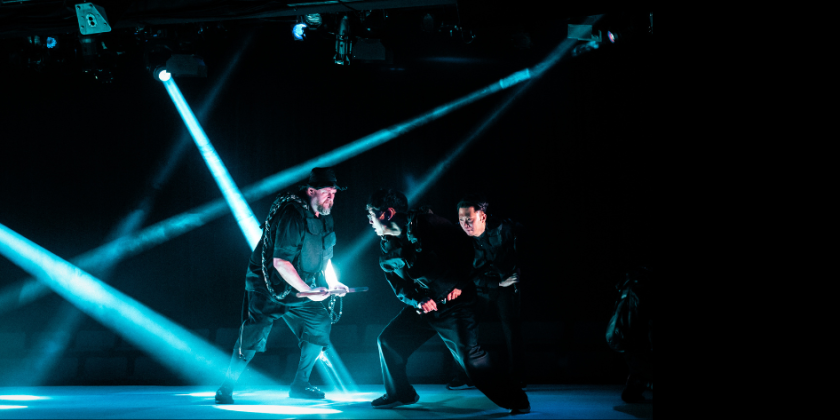
Kinoshita Kabuki's "Kanjincho." Photo: Ayumi Sakamoto
Bellow
A Brokentalkers production
Presented by Irish Arts Center as part of Under the Radar
Creation and Direction by Brokentalkers
Written by Feidlim Cannon, Gary Keegan and Danny O’Mahony
Performed by Danny O’Mahony, Gary Keegan, and Emily Kilkenny Roddy
Irish Arts Center
January 7 - 18, 2026
Kanjincho
Presented by Japan Society as part of Under the Radar
Conceived by Yuichi Kinoshita
Creation and Dramaturgy by Yuichi Kinoshita
Direction and Stage Design by Kunio Sugihara
Performed by Kinoshita Kabuki
Japan Society
January 8 - 11, 2026
Under the Radar
Mark Russell, Founding Director
Meropi Peponides & Kaneza Schaal, Co-Directors
ArKtype, Festival Producer
Appearing in Under the Radar, Brokentalkers’ Bellow at the Irish Arts Center and Kinoshita Kabuki’s Kanjincho at Japan Society approach inherited traditions from different cultural lineages, yet both ask how the past is carried into the present through bodies, objects, and ritual.
Each constructs a “stage within the stage” that functions as more than scenic design. In Bellow, a raised platform holds four accordions like living reliquaries, while in Kanjincho, a raised corridor becomes the principal site of passage and surveillance. In both, elevation serves as a means of focusing attention.
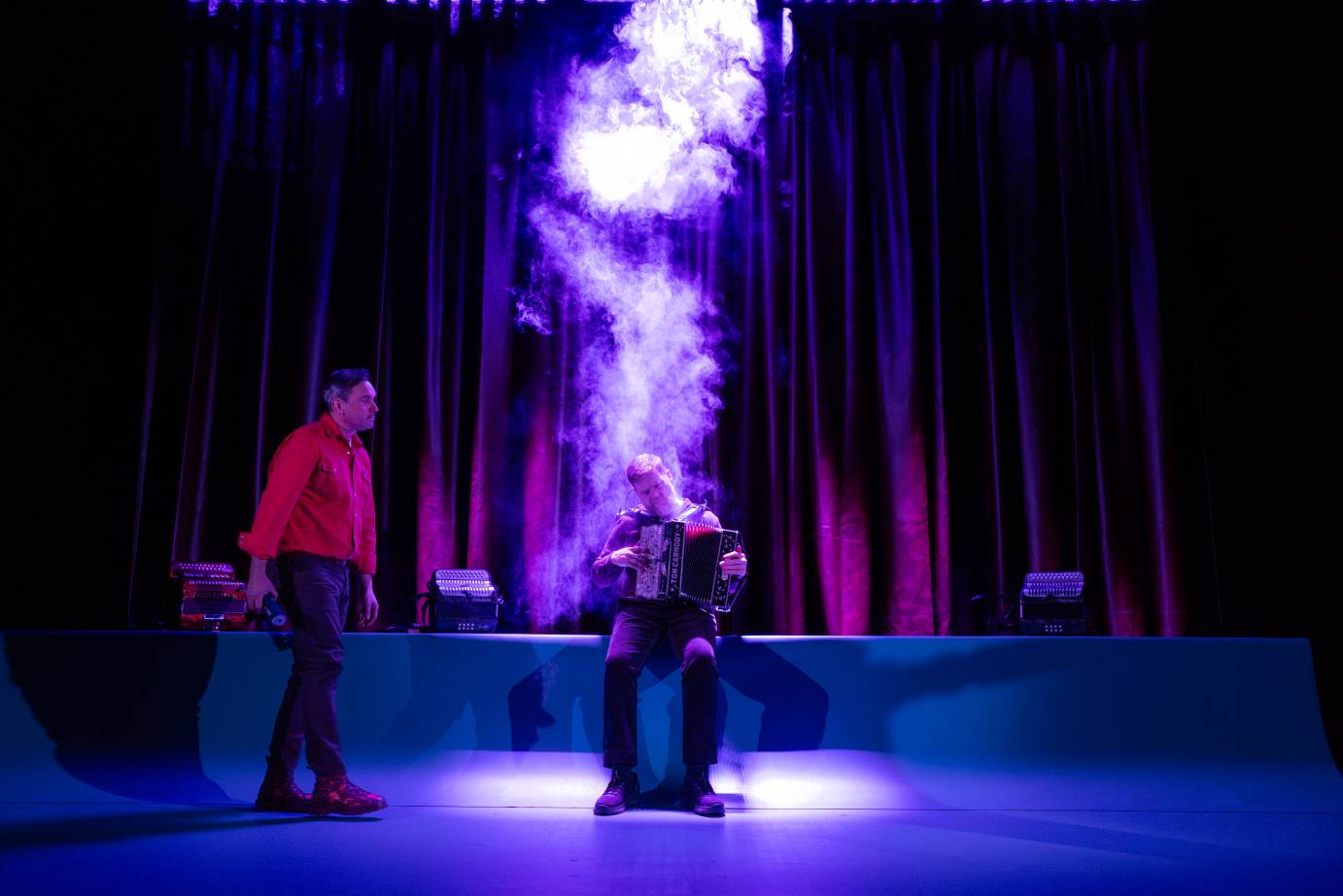
Bellow tells the story of lauded Irish accordianist Danny O’Mahony’s life as a musician, structured around his four accordions, each with its own history. Danny appears onstage as himself, and the music we hear is the sound of a master musician in full command of his instrument, with biography told through text, rhythm, movement, and the accordion’s bellow.
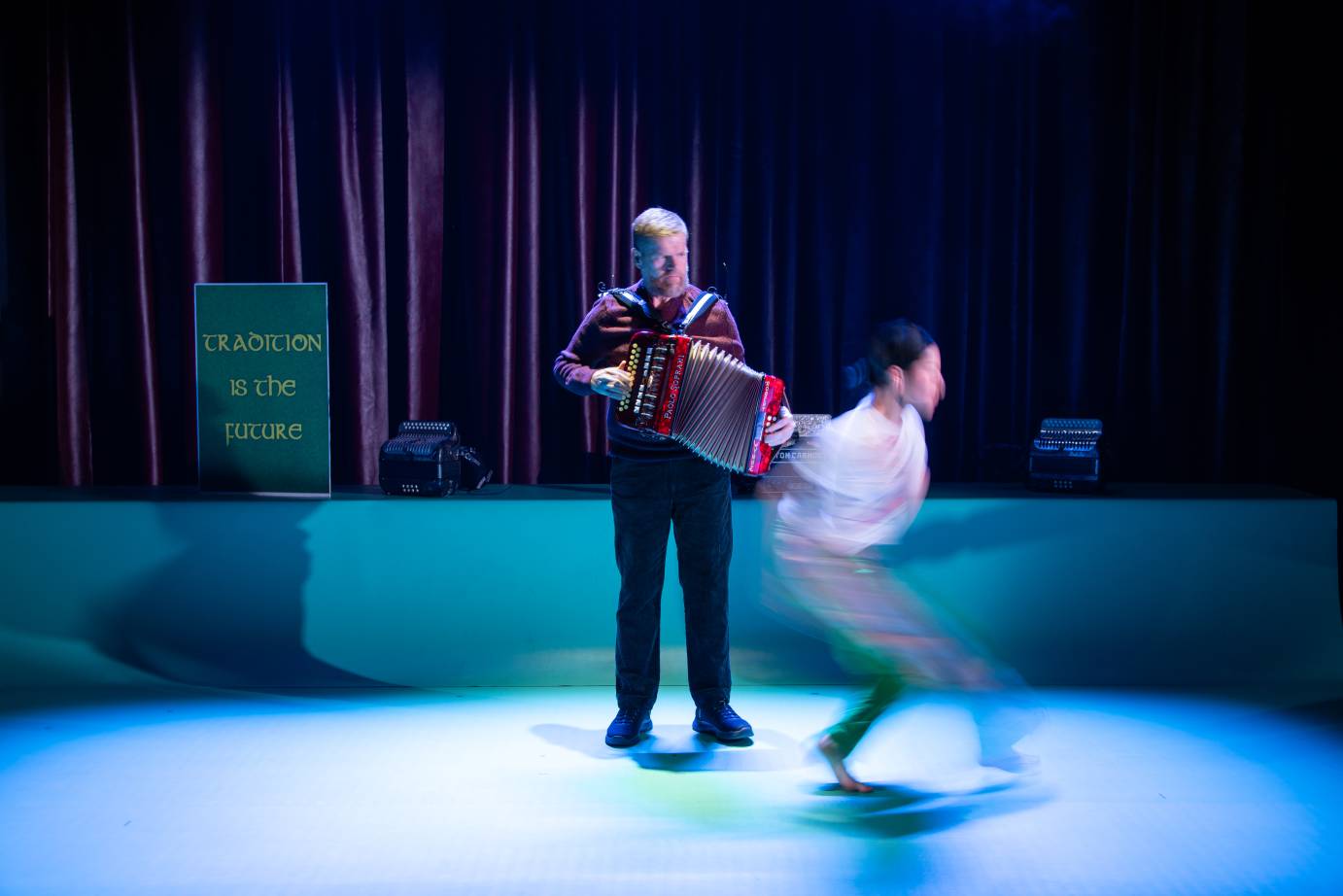
Emotion becomes visible most powerfully by dancer Emily Kilkenny Roddy. Absorbing Danny’s emotional life, Roddy’s dancing moves in long, sustained passages. At times tightly contained, each cell seeming to buzz, the movement breaks suddenly into falling, rolling, and rebounding back to standing. Risk sharpens movements that remain spare and economical, exact and expansive at once.
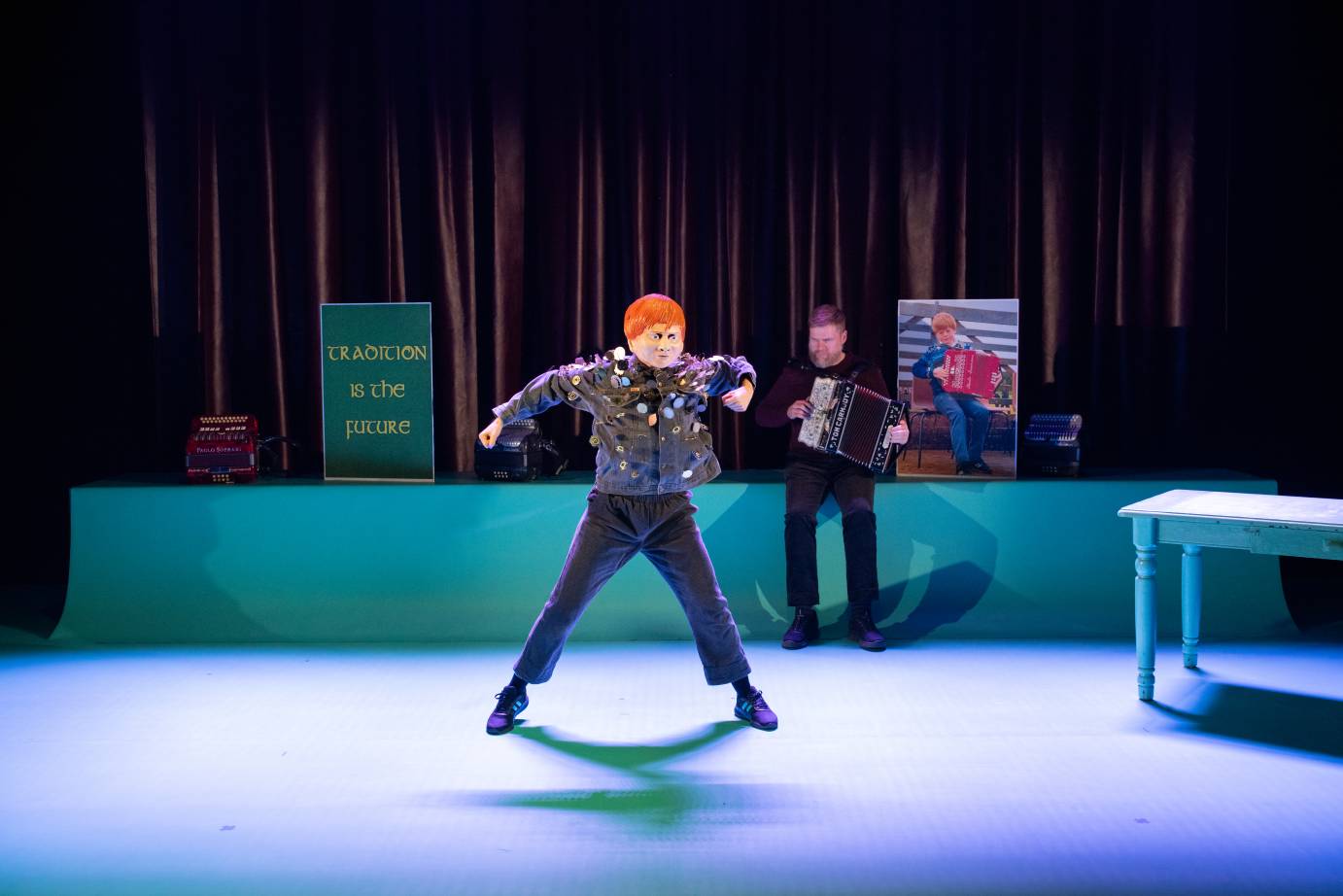
Wearing an abstracted mask of Danny’s young face with red hair, Roddy reads less as a character than as a somatic vessel for memory. Her breathing aligns with the push and pull of the bellow, binding body and instrument through shared pressure and release, even as Danny plays bright, virtuosic traditional tunes.
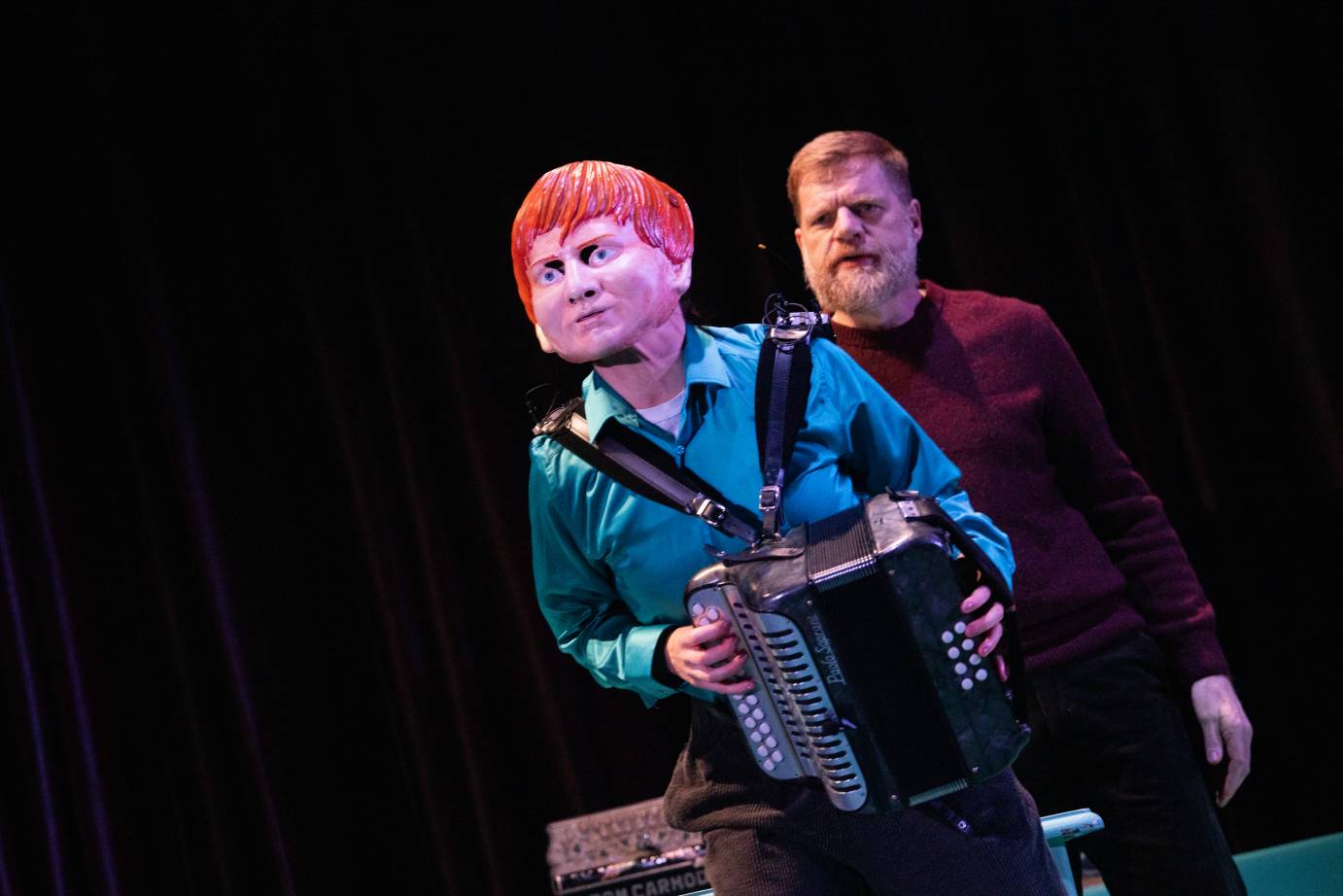
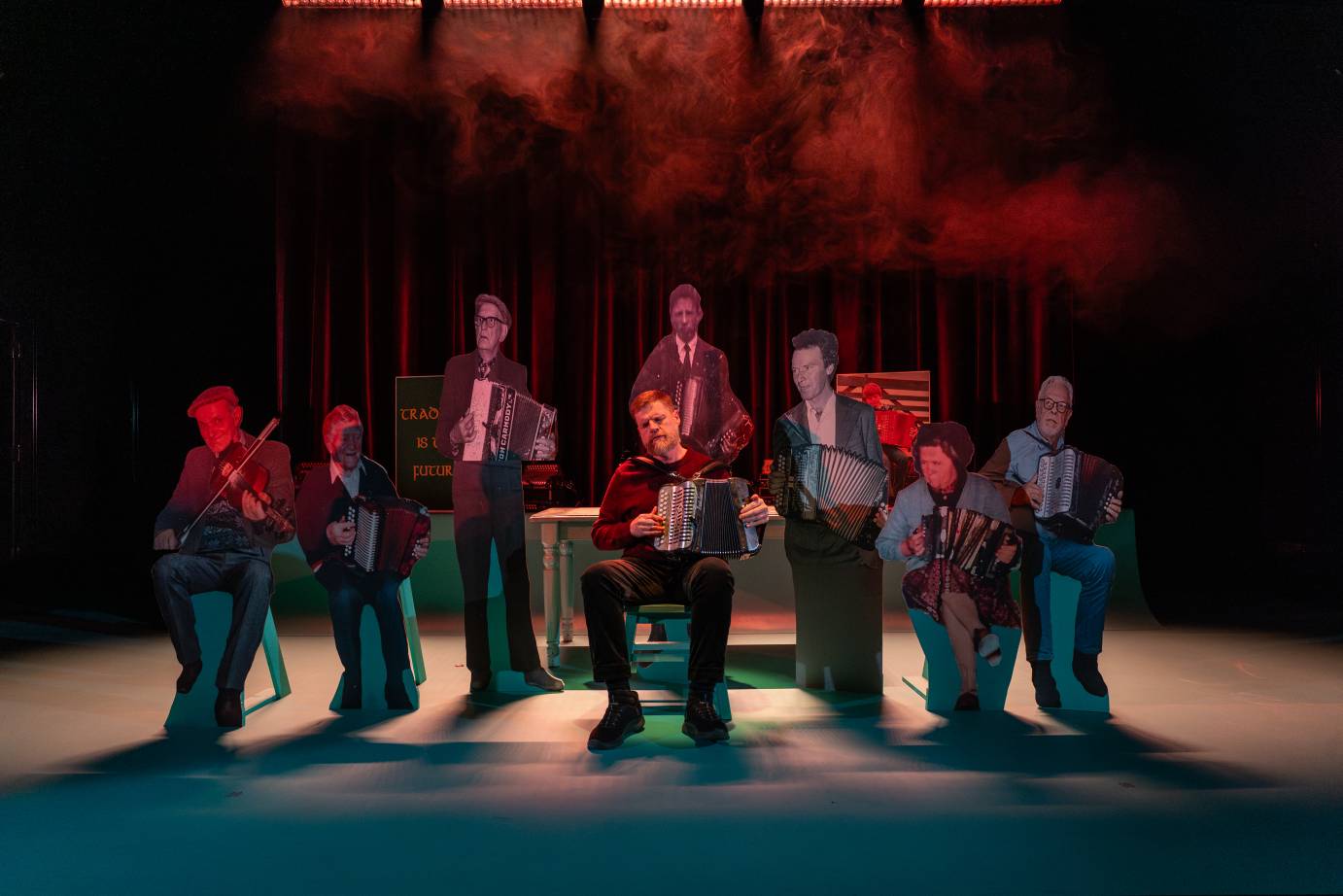
Gary Keegan moves through the work as both companion and provocateur, stepping into scenes to question and cajole, keeping the action on course as Danny’s story takes shape. In the final image, life-sized cutouts of O’Mahony’s accordion mentors are arranged by the performers around a seated Danny into a family portrait, making musical lineage visible as both inheritance and responsibility.
In contrast, Kanjincho, performed by Kinoshita Kabuki expresses meaning through a rigorously controlled physical language. Kabuki, a classical Japanese theater form, here staged in a contemporary adaptation, combines codified gesture, stylized movement, music, and heightened narrative. It depends on precise bodily placement. Derived from an earlier Noh drama, Kanjincho is set during the Genpei War (1180–1185) and follows refugees loyal to Lord Yoshitsune as they attempt to cross a guarded checkpoint disguised as priests, while soldiers search for them in plain sight.
_2_%C2%A9%20Ayumi%20Sakamoto.jpg)
Performers work within a tightly regulated physical vocabulary of stance, pacing, and spatial alignment, frequently arranged face-to-face across the narrow raised corridor, known as hanamichi, which functions as the drama’s central passageway. A bank of audience members lines the back edge of the bridge, facing the full house. Measured walking, frontal confrontations, and prolonged held positions generate tension through stillness.
_4_%C2%A9%20Ayumi%20Sakamoto.jpg)
Much of the suspense builds through repetition and ritual, yet it is pierced by moments of devastating emotional consequence, most powerfully when the priest Benkei beats his own lord, Yoshitsune, in order to save his life, only to collapse in grief and shame afterward. The moment is forgiven, but the system that produced it remains intact. An anachronistic party set to rap music briefly interrupts the action, before the work reasserts the logic of pursuit and disguise.
_11_%C2%A9%20Ayumi%20Sakamoto.jpg)
Seen together, Bellow and Kanjincho illuminate distinct ways inherited forms are carried forward. In Bellow, tradition resides in instruments, repertoire, and lineage, passed on through performance; in Kanjincho, it is transmitted through codified movement, timing, and collective discipline. Both use elevation as a dramaturgical device. Bellow sanctifies memory by lifting the accordions into view as living presences, while Kanjincho turns its raised corridor into a passage shaped by surveillance and historical repetition. What survives across generations, both suggest, does so not through preservation alone, but through retelling and reworking, either by reshaping inherited music, or by carrying a classic forward with contemporary inflections.
_8_%C2%A9%20Ayumi%20Sakamoto.jpg)