



Related Features
IMPRESSIONS: A Sunday in Spring 2026: Cathy Weis Projects’ Sundays on Broadway
IMPRESSIONS: Karley Wasaff’s "Growing Takes Time" at Noo Arts Wildflower's Green Roof
IMPRESSIONS: Carolyn Carlson's "In The Tree (Fragments of Poetics on Fire)" in Paris

By Ann Moradian
View Profile |
More From This Author
Published on February 13, 2026
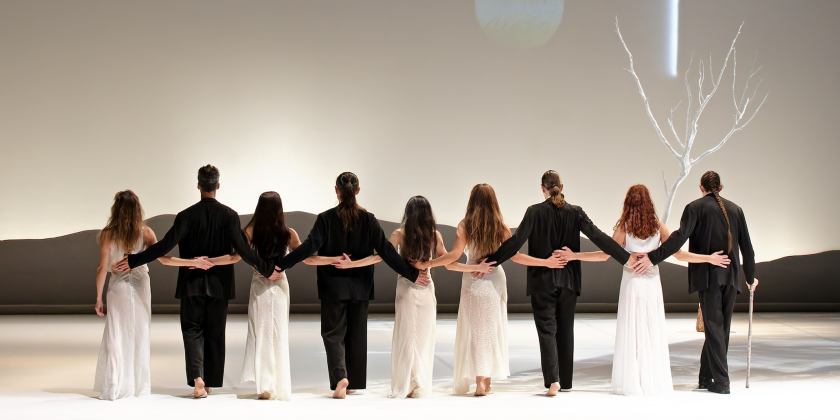
"The Tree." Photo by Sigrid Colomyès
At Théâtre des Champs-Élysées, 8th Arrondissement, Paris
Carolyn Carlson Company
The Tree (Fragments of Poetics on Fire)
Théâtre des Champs-Élysées
January 30 - 31, 2026
Choreographer and Set Designer: Carolyn Carlson
Choreographic Assistant: Colette Malye
Performers: Isida Micani, Chinatsu Kosakatani, Juha Marsalo, Céline Maufroid, Riccardo Meneghini, Yutaka Nakata, Alexis Ochin, Sara Orselli, Sara Simeoni
Musicians: Aleksi Aubry-Carlson, René Aubry, Maarja Nuut, K. Friedrich Abel
Lighting Designer: Rémi Nicolas
Painter of Projections: Gao Xingjian
Costumers: Elise Dulac and the Théâtre National de Chaillot workshop
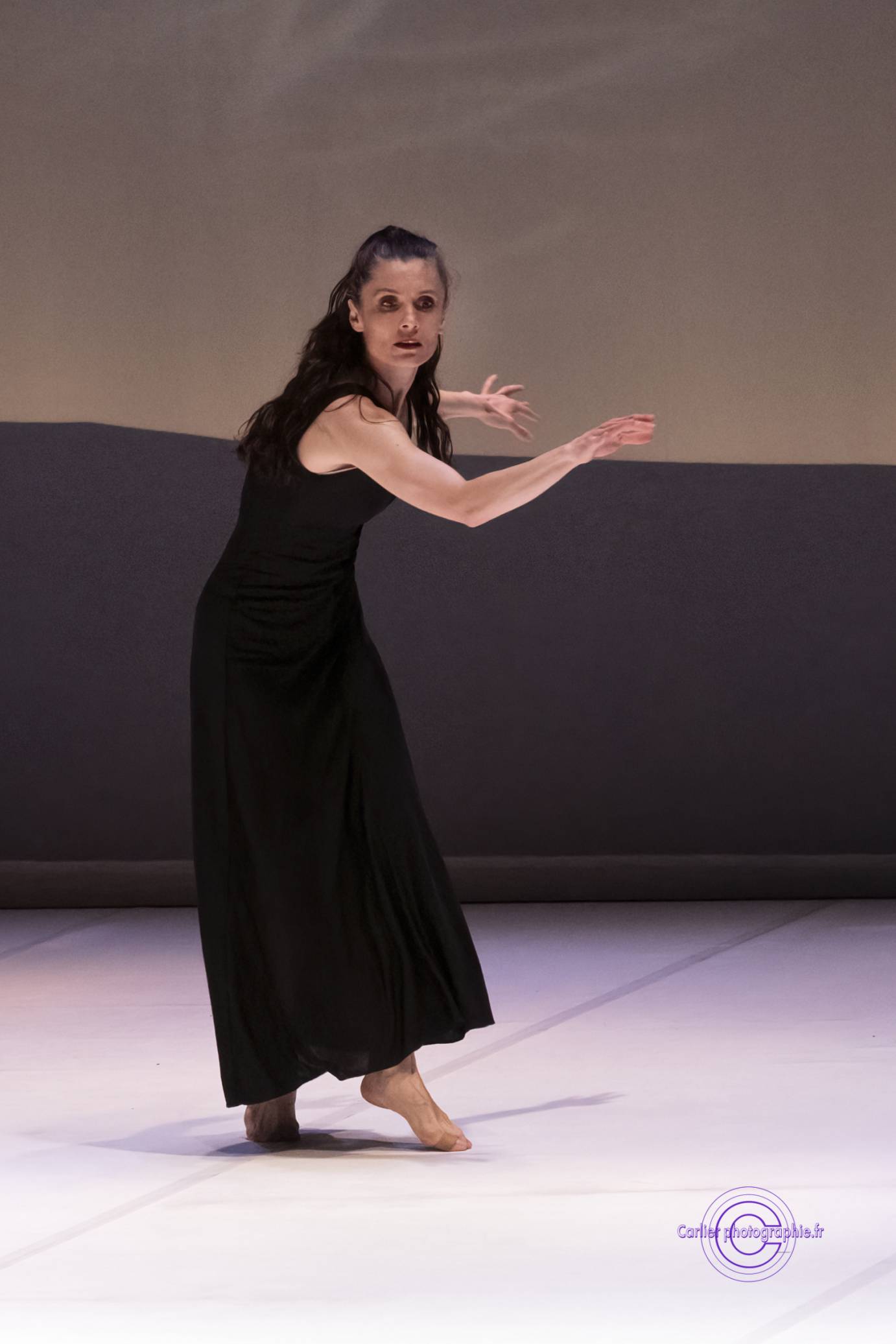
Franco-American choreographer Carolyn Carlson describes her work as visual poetry. In The Tree (Fragments of Poetics on Fire) she combines visual composition, metaphor, symbolism and gesture to create a world that is spacious and serene. The dancers are remarkable, initiating their movement from a deep central core and from their breath, which gives their movement a delicate simplicity and precision in all they do.
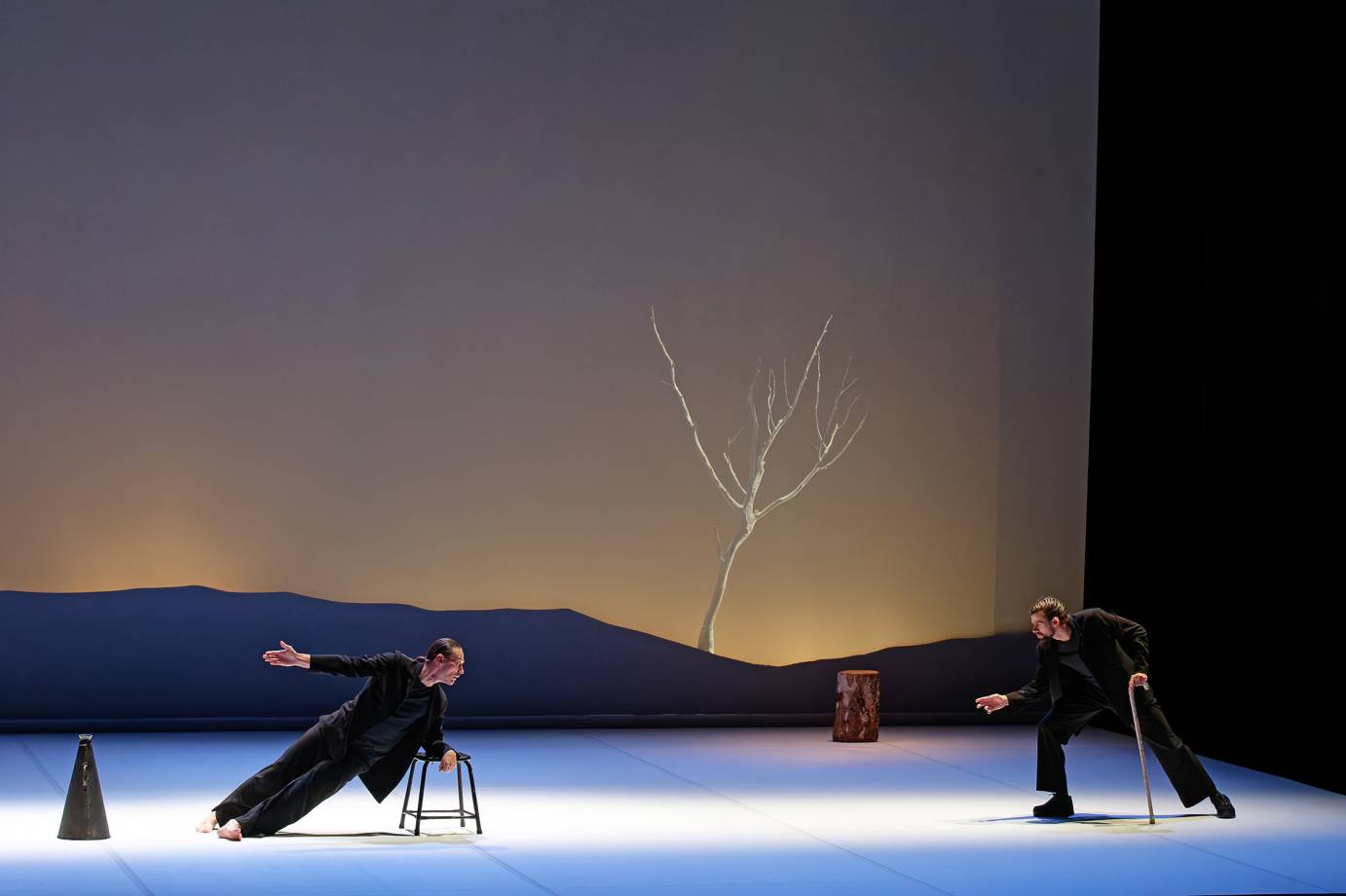
The curtain opens to reveal a small dead tree and a tree trunk in the upstage corner. A woman in white is seated, cradling a sapling. A man in black stands beside her with a cane in one hand and white owl perched on the other. In the foreground, three men in black pants and jackets roll up seamlessly from the floor to sit on stools. They spiral around slowly to kneel behind them as if in prayer.
The Tree is full of feeling, expressed in tight, sharp hand gestures, chainé turns with hair awhirl, and long flamingo-like legs that lift and stretch as they step or hiccup. But the emotions are never overt. Even amidst the women’s anguished flailing torsos or the men’s more combative relations, the air seems unperturbed and there is a sense of gentling. Whether this is an aesthetic expression of Carlson’s Buddhist practice (which spans more than 50 years) or not, it is an intriguing quality.
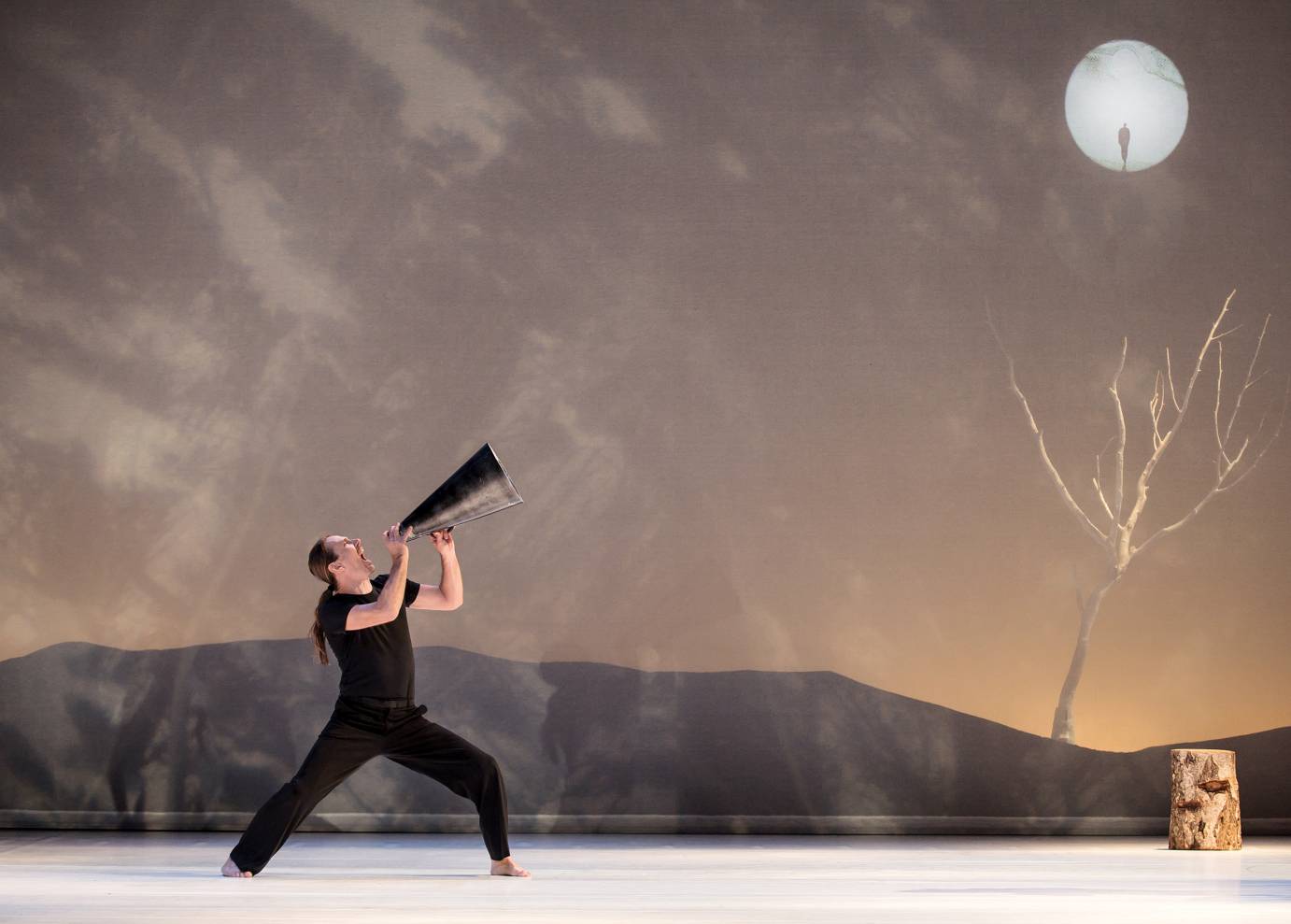
Juha Marsalo uses staccato, mime like gestures, taking his heart out of his chest to hear if it is still working. His heart seems to be trying to get him to listen, but to what, specifically, is not clear. The music is sharp, quick and pulsing, driving his movement at high speed, yet it does not feel aggressive. Marsalo shifts a megaphone from one place to another, but doesn’t use it here.
We hear sawing and the fall of a tree as the dancers pause, looking up. Later, birch logs are shouldered across the back behind a dreamlike scrim. In another section, the women might be spirits of fallen trees — and, in response to Carlson’s question in an interview with Delphine Baffour in 2020, yes, trees do cry.
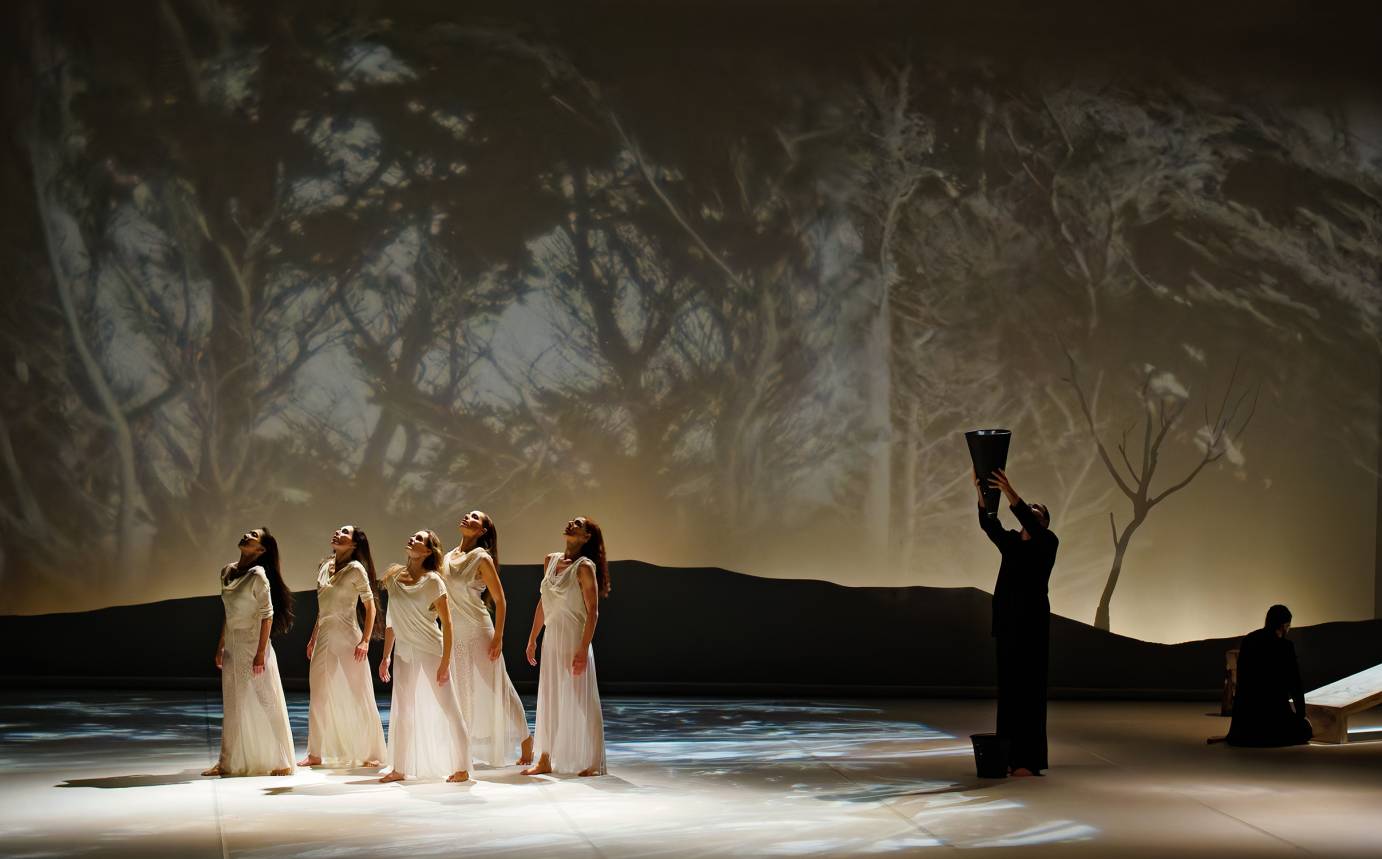
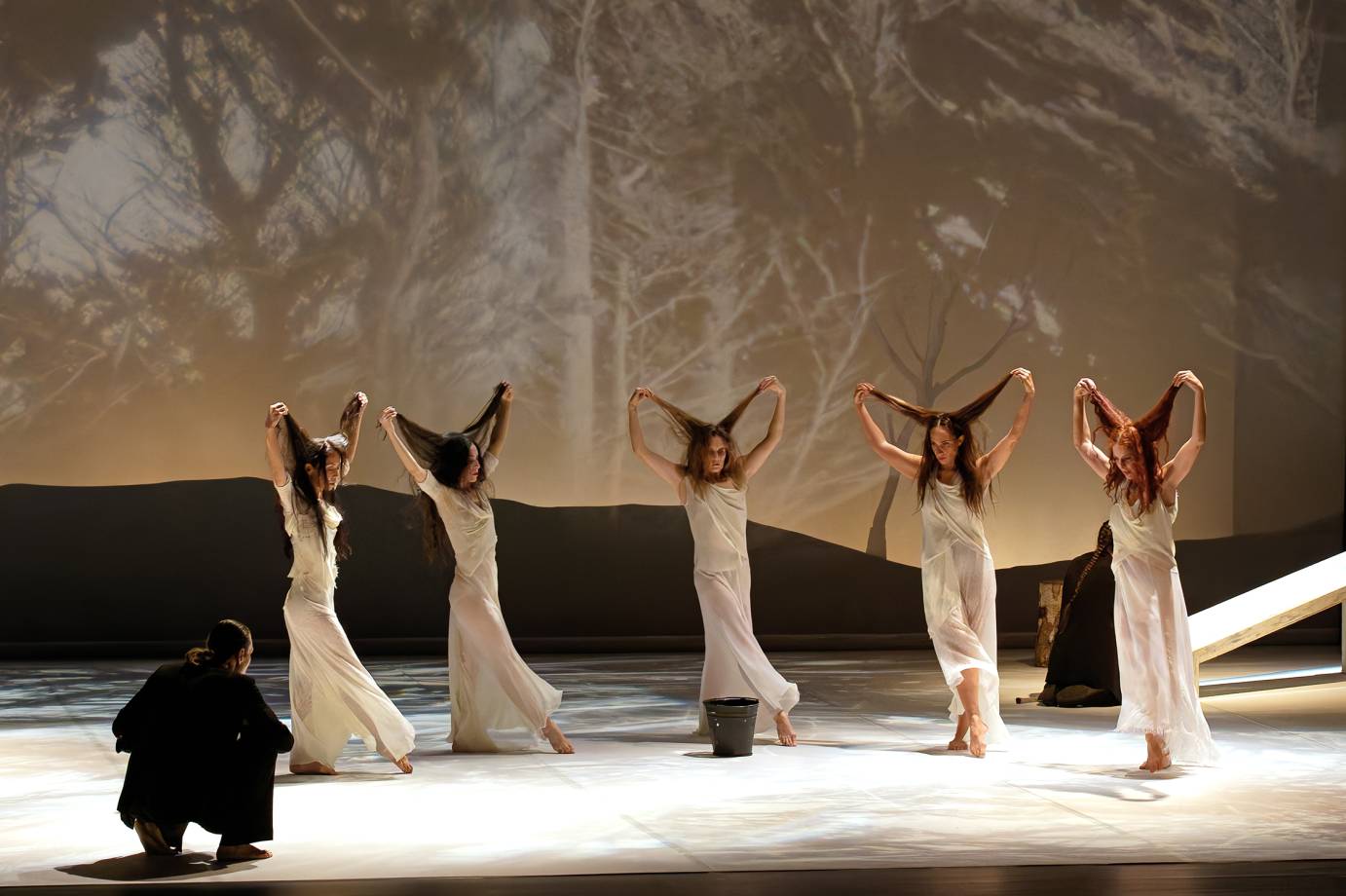
There is an ambiguity throughout the work that raises questions of meaning, as poetry often does. Are the people lying down dead, or are they contemplating the passing of clouds in the sky? Or both? Because of the strong use of gesture and the dancers’ overall verticality, they seem human throughout the piece, but I am not sure that was the intention. Clearly Sara Orselli in a muted-red overskirt that flutters as she moves toward and away from an electric fan alludes to the element of fire.
There is beauty in every moment of this work. The projected painting of a forest by Gao Xingjian adds dimension and context as it appears and disappears throughout the dance. The lighting gently sculpts the space. The music is effective, both in its quiet moments and in its percussive sections, and at its best when the dancers’ actual breath becomes part of the score. The section for Isida Micani in black with skittering feet and legs continues to haunt me.
The men are costumed in black pants and jackets except for a moment in off-white, while the women keep changing, from white to soft beige dresses, from black to khaki pants and tops. The fabrics are luscious, light and fluid, caressing the shape of the body or extending its movement.
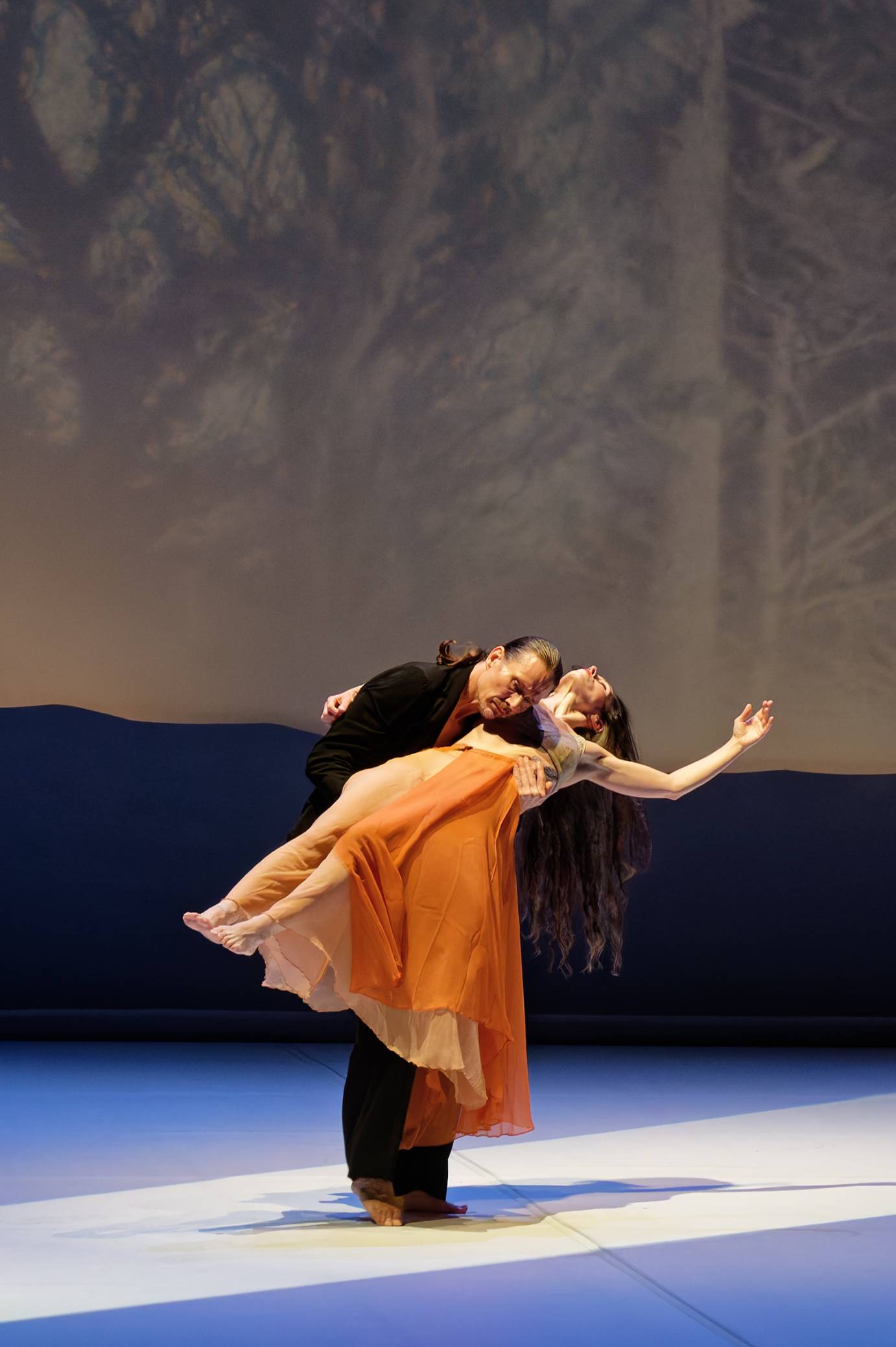
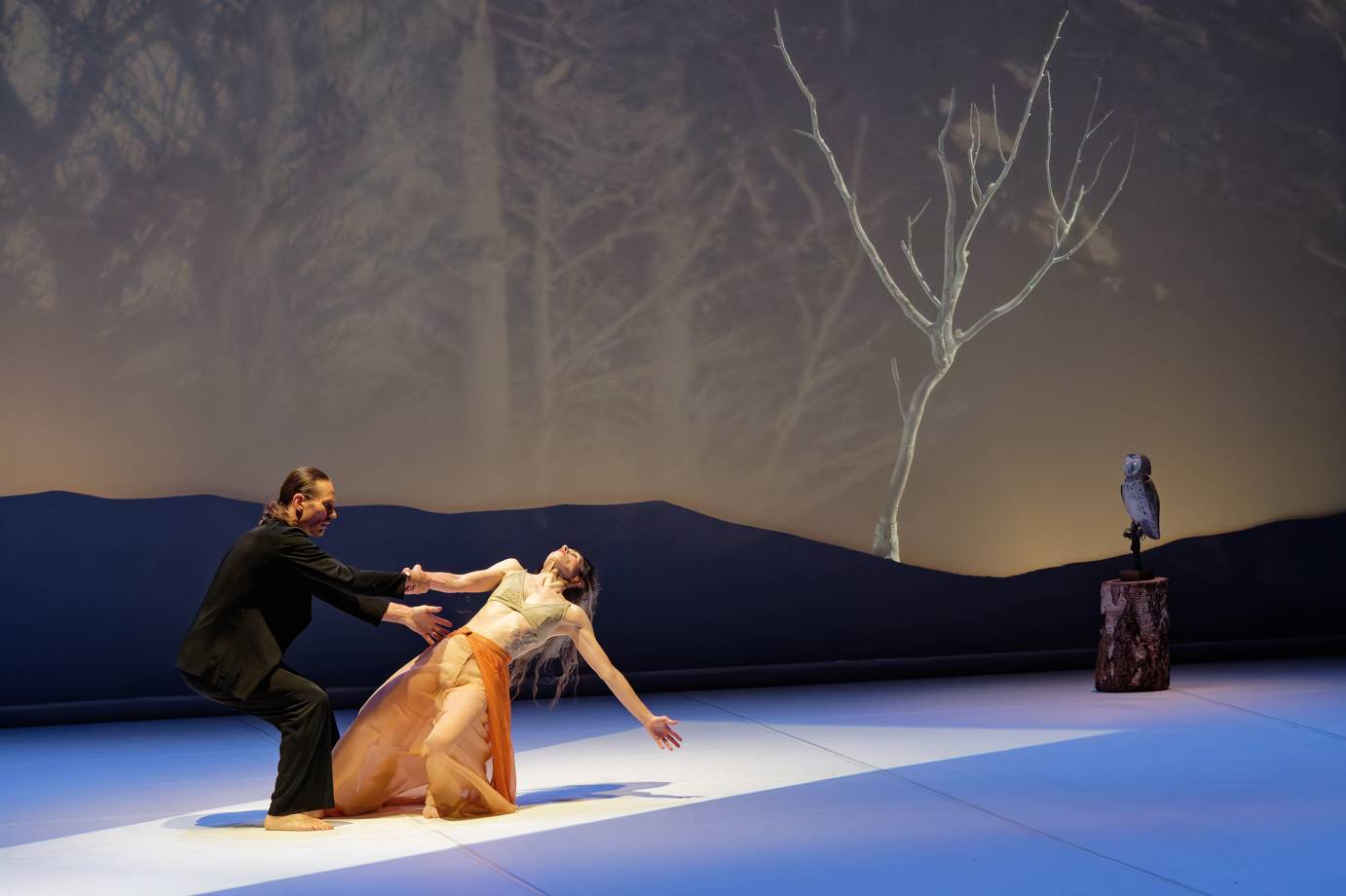
The dancers make Carlson’s very personal gestural language their own with a quiet authority that comes only with experience. It is the subtle quality of these gestures that conveys their intention, yet this is difficult to see in a grand theatre like the Théâtre des Champs Elysées. Some of the props are also hard to decipher at distance: a small fireplace looks like a space heater, and I cannot tell that the small container set down at the front of the stage is a jar of water. This matters, because Carlson’s use of symbolism is an integral part of this work.
There is tangible beauty, deep human emotion, and undeniable artistry, craft and skill apparent in this work, yet I left the theatre feeling like I was supposed to understand something but didn’t. Program notes tell us that The Tree is the last in a cycle of works (along with eau, Pneuma and Now) inspired by philosopher Gaston Bachelard. His Fragments of a Poetics on Fire includes essays on Prometheus and the Phoenix, but if we are not familiar with this work, it does not really help us.
I would love to see this work in a smaller theatre or on film where detail and subtlety are better revealed.