



Related Features

DANCE NEWS: The Dance Enthusiast Launches Fall 2026 “Your Voice Matters” Audience Review Contest
DANCE NEWS BOSTON: The Platform, a New State-of-the-Art Performing Arts Center, Opens In November in Cambridge's Kendall Square
IMPRESSIONS: Mark Morris Dance Group's 45th Anniversary at the Brooklyn Academy of Music

By Lisa Jo Sagolla
View Profile |
More From This Author
Published on April 11, 2026
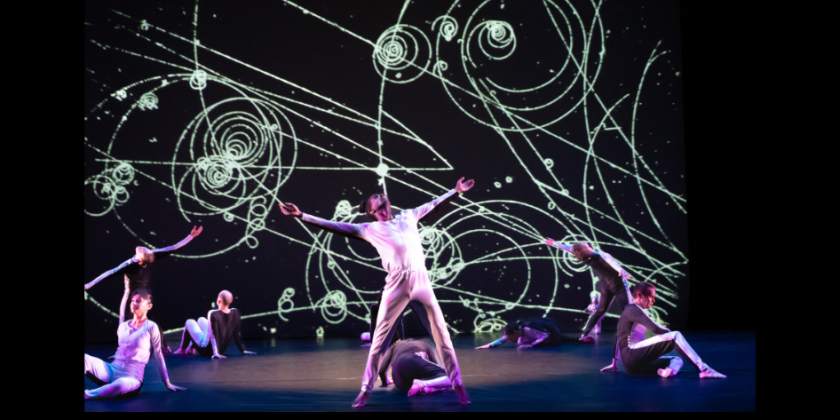
Mark Morris Dance Group. Photo: Steven Pisano
Performing “MOON,” “V,” and “Via Dolorosa"
Choreography: Mark Morris
MOON
Music: György Ligeti, Marcel Dupré, Claude Debussy, George Gershwin, Ted FioRito/Albert von Tilzer/Harry MacPherson, Bill Monroe, Ned Miller, Richard Rodgers/Lorenz Hart, Desmond Carter/Mabel Lane, NASA’s Golden Record
Projection Design: Wendall K. Harrington
Costume Design: Isaac Mizrahi
Lighting Design: Mike Faba
Sculptures: Ottmar Hörl
Musicians: Colin Fowler, Milad Daniari
V
Music: Robert Schumann
Costume Design: Martin Pakledinaz
Lighting Design: Michael Chybowski
Musicians: Georgy Valtchev, Vlad Hontila, Gregory Luce, Ian Lum, Colin Fowler
Via Dolorosa
Music: Nico Muhly
Scenic Design: Howard Hodgkin
Costume Design: Elizabeth Kurtzman
Lighting Design: Nicole Pearce
Musician: Parker Ramsay
Dancers: Mica Bernas, Karlie Budge, Kara Chan, Kyle Halford, Colin Heininger, Sarah Hillmon, Courtney Lopes, Dallas McMurray, Alex Meeth, Aiden Moriarty, Brandon Randolph, Christina Sahaida, Billy Smith, Joslin Vezeau, Noah Vinson
BAM Howard Gilman Opera House
March 26 - 29, 2026
As I write this review, Artemis II is orbiting the moon, marking the first time anyone has traveled that far from Earth since 1972. The spacecraft’s four astronauts (three Americans and one Canadian) are testing systems in preparation for a near-future moon landing and are observing parts of the far side of the lunar surface never before seen by human eyes. Wow!
For me, the globally exciting event also triggers what, in hindsight, has become one of my most treasured childhood memories — the night my father insisted I drag my cranky, 10-year-old self out of bed and come downstairs to watch him snapping Polaroids of our TV set as it broadcast real-time images of astronaut Neil Armstrong descending from the lunar module and taking mankind’s first steps on the moon. I still get goosebumps remembering how I witnessed human history’s most exhilarating technological achievement.
So, it was with both nostalgic and topical eagerness that I anticipated the New York premiere of choreographer Mark Morris’s MOON, a light-hearted, 55-minute dance piece celebrating our personal and cultural fascinations with the moon. Performed by Mark Morris Dance Group at Brooklyn Academy of Music the weekend preceding Holy Week, the piece constituted the first of two programs presented by the Brooklyn-based company.
The second program comprised two equally timely Morris works: V, a magnificent pure-movement piece dedicated to New York City that premiered in the U.K. a month after the September 11 attack on the World Trade Center (that event’s 25th anniversary will be commemorated this year); and the New York premiere of Via Dolorosa (2024), a weighty dramatic dance inspired by the Stations of the Cross (a 14-part, processional devotion tracking the final day of Jesus’s life), appropriately timed for this pre-Easter weekend engagement.
MOON is set to a variegated assemblage of musical selections, including disquieting experimental piano music by György Ligeti, lively Bach-inspired organ inventions by Marcel Dupré, Claude Debussy’s Clair de Lune, scratchy old recordings of moon-referencing American country and pop songs, and excerpts from NASA’s Golden Record, the collection of natural, linguistic, and musical sounds representative of life on Earth that was launched aboard the Voyager spacecraft in 1977.
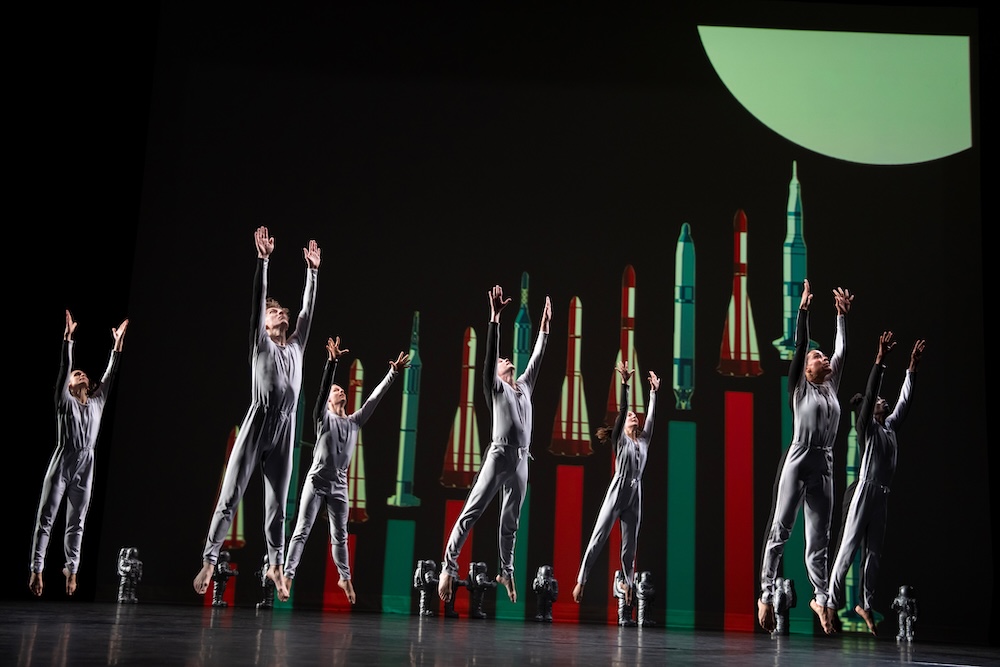
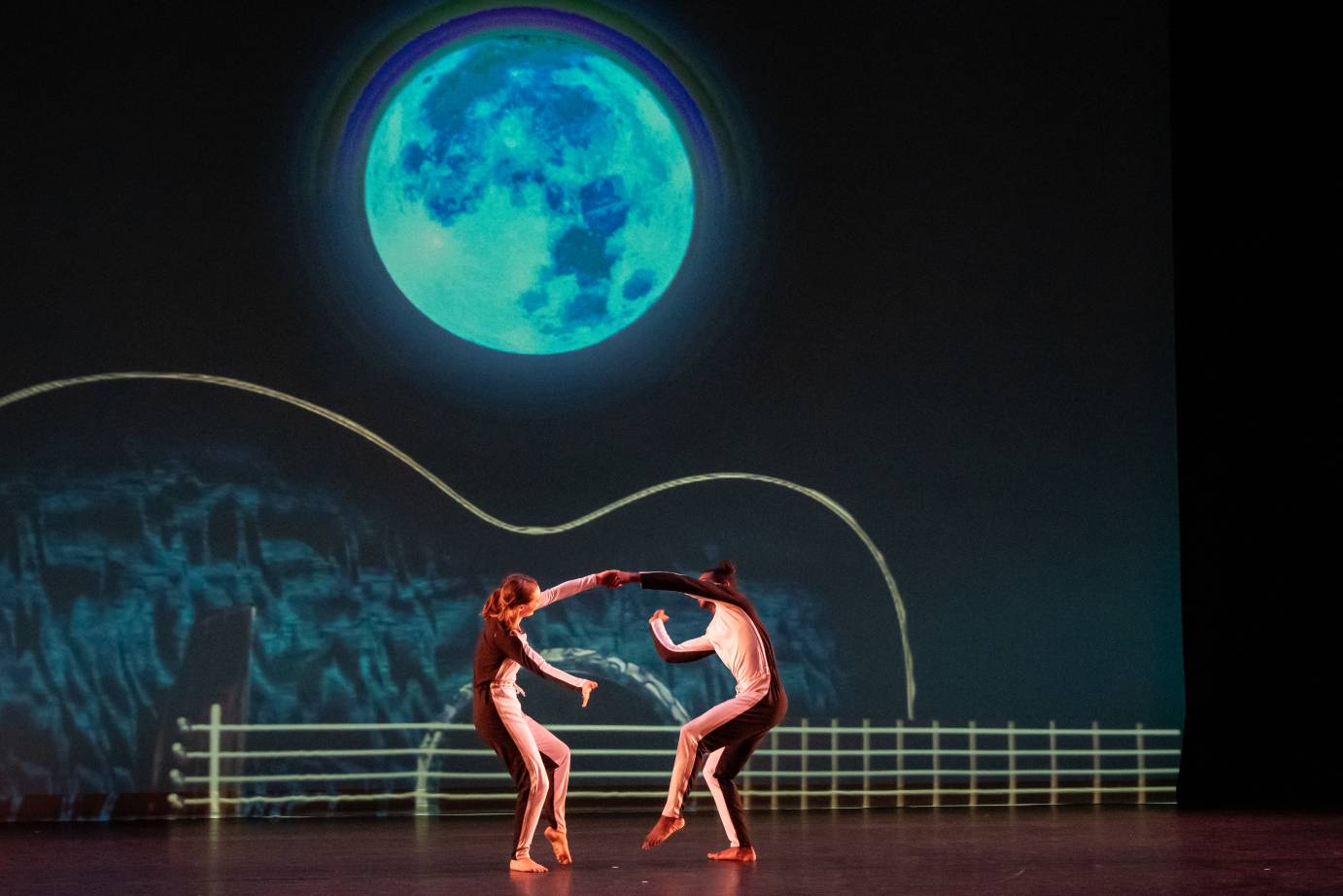
While MOON’s aural landscape taps into the array of human emotions elicited by the moon — romantic, spooky, and otherwise — striking visual projections, by Wendall K. Harrington, invite us to contemplate the orb scientifically and politically. We are shown realistic images of its harsh, crater-ridden surface, first barren and, later, stamped by astronaut footprints. Animated graphs, featuring bigger and bigger rockets trace the American-Soviet Space Race, while blackboards full of mind-boggling equations and geometric calculations show how it was math that got us there.
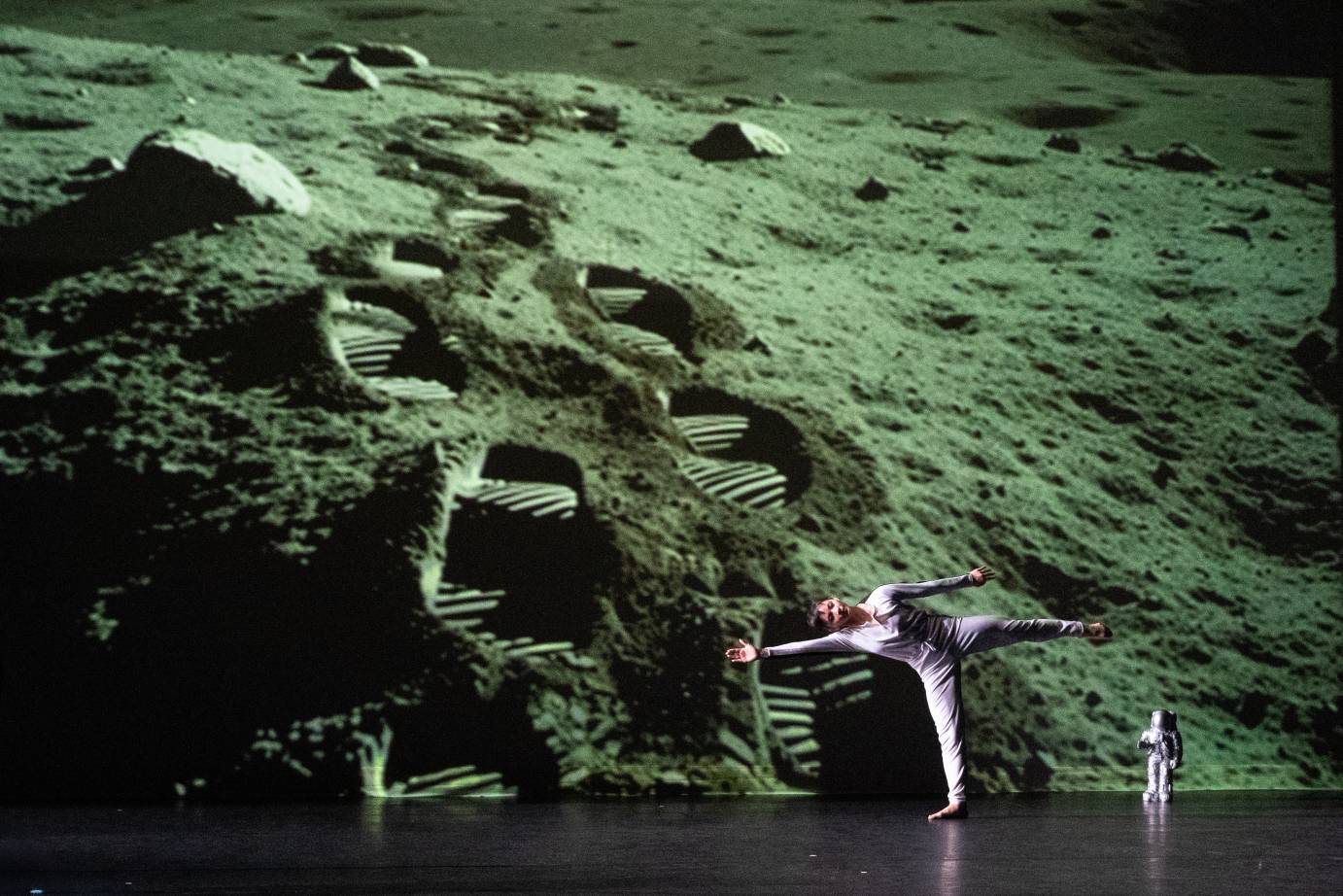
Throughout the piece, the stage is littered with adorable little astronaut statues, created by Ottmar Hörl, that look like action-figure toys. Their presence insists that one view Morris’s moon “explorations” without ever losing that child-like sense of wonderment. Though the statues are re-arranged from time to time — in framing lines, or clumped in corners like opposing armies observing the action — they are not really integrated into the choreography. The kid in me wanted to see the dancers play with them a bit more. Costumed by Isaac Mizrahi in loose-fitting, long-sleeved jumpsuits – white on the front, and black on the back — MOON’s nine dancers suggest the light and dark sides of the moon, or perhaps pajama-clad youngsters lured to view the mysterious object shining in the nighttime sky.
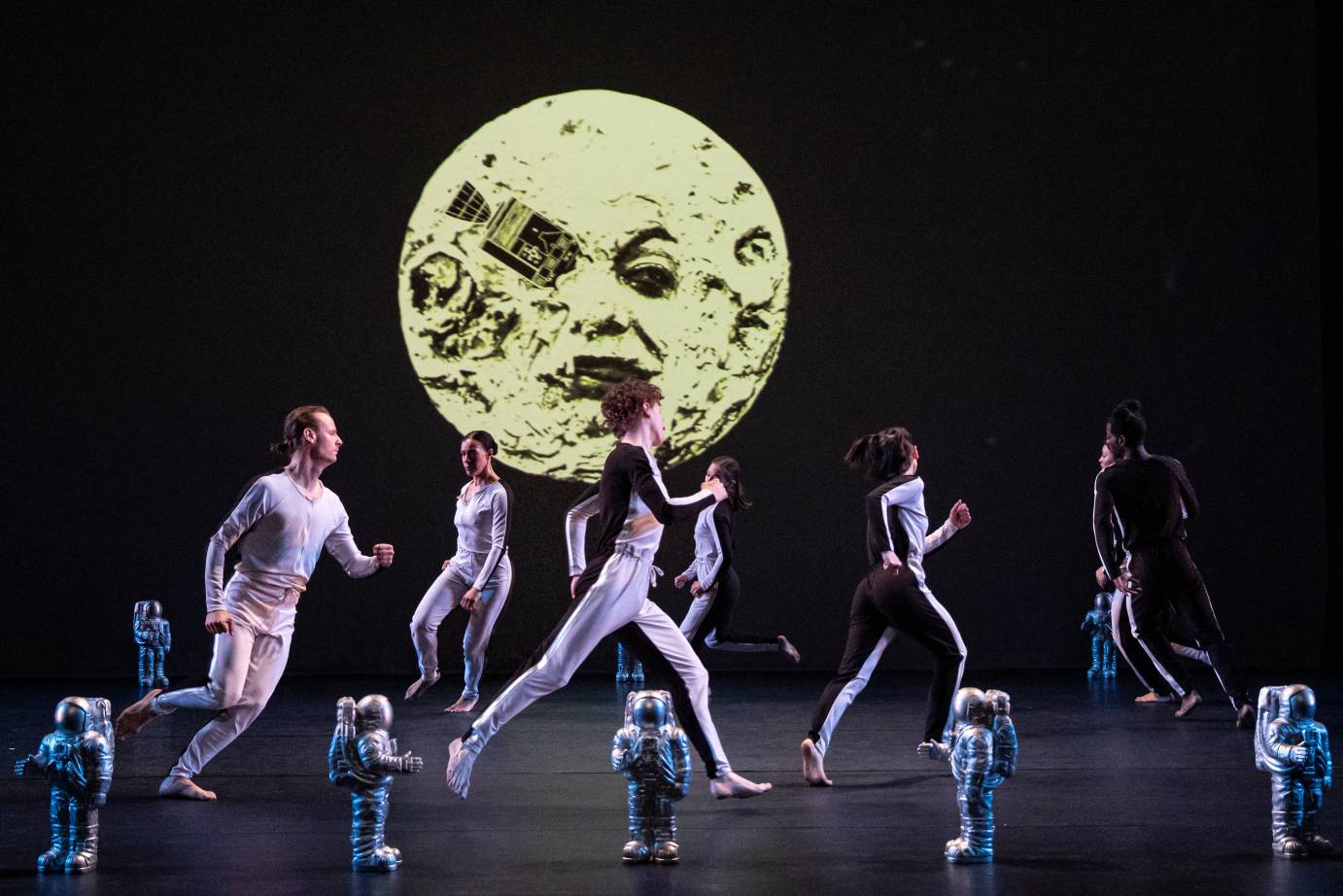
As the piece launches, we see a projected row of stars traveling up the backdrop. As they start to form a circle the colors clue us that they will soon become part of the Seal of the President of the United States. But the big surprise is what follows, an ascending image of President John F. Kennedy. The enormous ovation the likeness elicited from the opening-night audience felt only partially prompted by historical appreciation and more, I suspect, by the desire to register discontent with JFK’s contemporary counterpart. To a George Gershwin song proclaiming the “dawn of a new day, the American way,” the dancers perform an entertaining show-dance routine, referencing precision chorus-line work, marching band maneuvers, and 1930s movie-musical choreography.
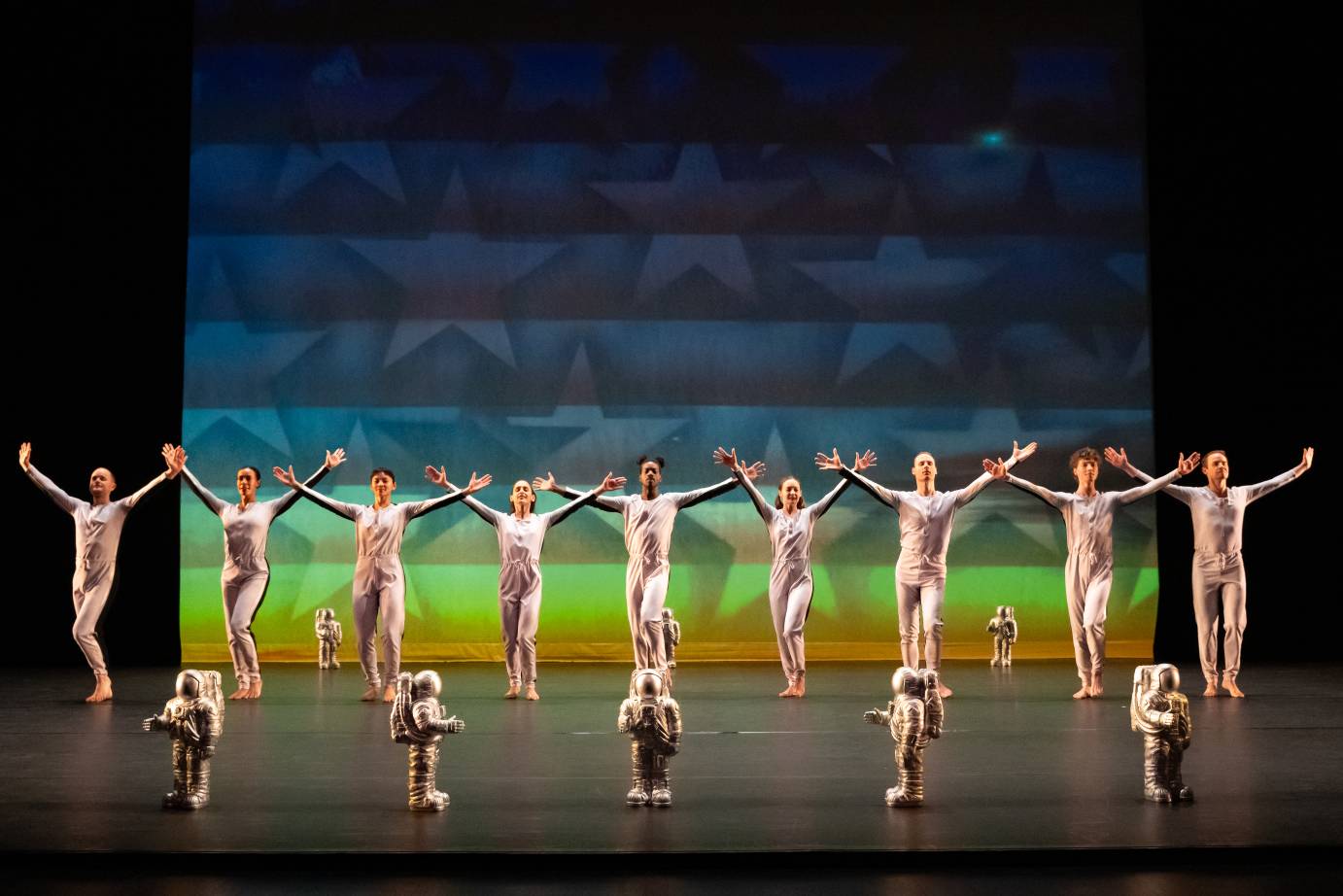
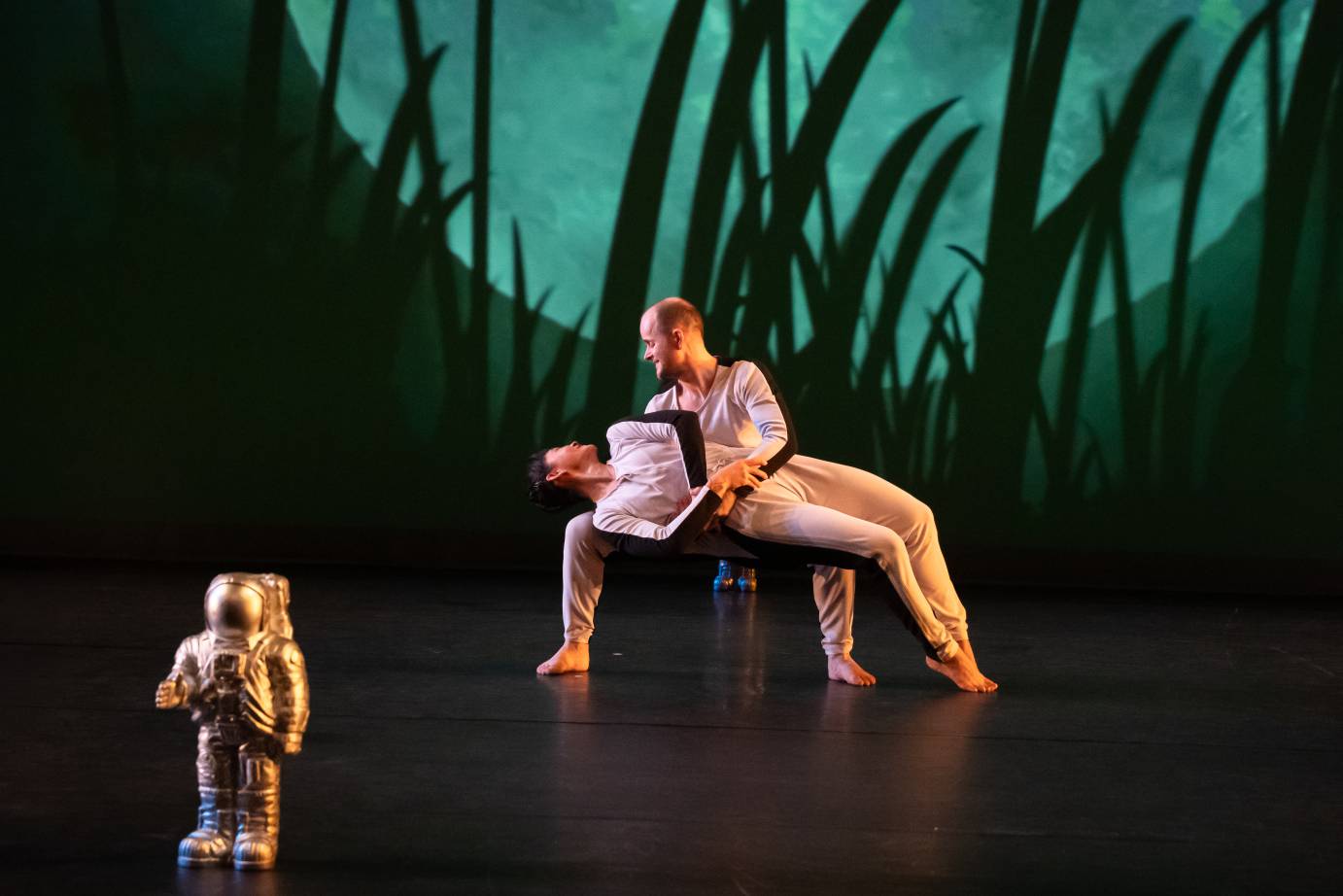
The piece proceeds as a series of very short episodes of three distinct types: ensemble modern dance choreography loosely suggesting a narrative between two tribes warily meeting for the first time; upbeat social-dance-based sequences performed to popular songs; and darkly-lit scenes in which dancers speed and spin across the stage on wheeled stools, to little effect.
In addition to eliminating those rolling-stool segments, I would prefer Morris hadn’t continually shifted from one type of dance episode to another. Though the “a few moments of this, a few moments of that” approach might work well for younger audiences, those of us with more extended attention spans would be more gratified to see each choreographic idea develop and play out fully, in a work comprising just a few major parts rather than a multitude of small bits. In the narrative sections, for example, the short snippets don’t allow time for one to figure out which group is the Earthlings and which the aliens. And the social dance portions feature a terrifically entertaining blend of vernacular steps and concert-dance aesthetics, so I wanted to watch those portions all in a row, to more carefully study how Morris employs the same vocabulary to convey slightly different “takes” on moon-related feelings.
While the MOON program’s subject matter is more enticing, the company’s second program proves richer choreographically. The opener, V, is a master class in crafting the well-made dance. It’s the kind of brilliantly constructed, astutely musical work that built Morris’s reputation as a supreme maker of modern dances. Set to an exemplary, Romantic-Era, Robert Schumann quintet for piano and strings (played live by the company’s first-rate Music Ensemble), Morris sets out a few easily discernible choreographic motifs for each of the quintet’s different movements. He then varies the motifs in strict adherence to the dictates of the music. The result is tremendously satisfying, and he makes it look so easy. Watch this, and you, too, can learn to choreograph a dance!
The curtain goes up on seven dancers standing in a “V” formation, each forming a strong diagonal line with their arms. They then round their arms and chests to make a circle. Later, they extend their arms in front of them and bend their wrists so their hands drop downward (think, Frankenstein’s monster). The septet is replaced by seven different dancers who repeat the thematic vocabulary. Then, a third motif grows out of the first two as dancers line-up along the side edges of the space with just one arm raised diagonally, but incorporating the broken-wrist position. As the movement develops, Morris captures the lilting quality of the music with weighted dropping and suspending, swing-like motions that live beautifully alongside the cutting actions of the sharp diagonal lines. It’s a formalist’s delight!
To the adagio tempo of the music’s second movement, Morris sends his dancers crawling across the stage in low lunges, resembling a sprinter’s “get set” position. This motif is soon transformed into vertical walks that, though performed upright, retain the lunges’ trudging quality. As the music grows lighter, the dancers arch their backs, in reversal of the original lunge shape, and the arch propels them into forward leaps, as we hear high sounds from the strings. When we hear low sounds, they leap backwards. As the movement draws to a close, one dancer is held aloft, frozen in the original lunge motif, and then placed gently back down onto the floor.
Mark Morris Dance Group performing V
When the music begins to race in the next movement, dancers lift one arm up and over, letting its downward path impel a little jump with one lifted knee that sends them into running patterns, as they kick they feet out in front of themselves. Sometimes they kick one leg forward then draw it inward before extending it out to the back. And lest we start to get too comfortable with the clarity of it all, in the work’s final section, Morris brings back all of the earlier movement motifs, and mixes and matches them with glorious intricacy.
Choreographically, Via Dolorosa is similarly impressive, and the overall aesthetic experience proffered by its combination of visual, musical, and kinetic components is awe-inspiring. But the piece can feel long, drawn-out, and demandingly solemn. Most amazing is its Nico Muhly score for solo harp, here played live by American harpist Parker Ramsay, a Nashville native. The range of sounds Muhly’s composition draws out of the instrument will shock even those well-acquainted with the solo harp repertoire. Conjuring a decidedly different mood for each section of the 14-part work, in addition to the expected “pretty” music, the harp produces painful low plucking sounds, ugly scraping noises, startling booms, rhythmic high-pitched tinkling, and soaring melodic phrases that underline the drama of Jesus’s journey. Also dramatically enhancing is the work’s painted backdrop (by Howard Hodgkin), its broad, primary-colored brushstrokes changing wildly in intensity and personality under Nicole Pearce’s mercurial lighting.
Stating the number and title of the Station to be portrayed, an unembodied voice announces the start of each of the work’s distinct mini-dances — from Station 1: “Jesus is Condemned to Death,” to “Station 2: “Jesus Takes Up His Cross,” through to “Station 11: “Jesus is Nailed to the Cross,” and ultimately Station 14: “Jesus is Laid in the Tomb.” Because we know exactly how many scenes there will be, from the get go we’re already counting down to the finish. Morris’s choreography is undeniably beautiful in its sometimes literal, sometimes abstract expression of Jesus’s story, with no single dancer playing Jesus, but rather different individuals or groups working collaboratively in the depiction of essential ideas. Nonetheless, I found myself too burdened by the graveness of it all to want to fully engage with Morris’s albeit ravishing telling of this age-old story.
Mark Morris Dance Group in Via Dolorosa