



More Audience Reviews

A first look at Ingrid Silva's new work for Accent Dance NYC
Vinnie Jones' "The Truth and the Light"
AUDIENCE REVIEW: Lessons From My Mothers
Company:
Jiva Performing Arts
Performance Date:
November 7-8, 2025
Freeform Review:
"Lessons From My Mothers" Weaves a Poignant Tapestry of Immigrant Life
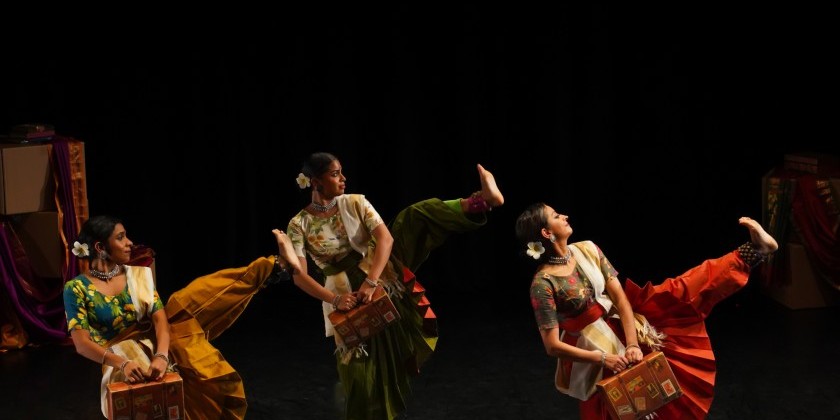
The world premiere of “Lessons From My Mothers,” presented by Jiva Performing Arts at Gibney Dance, NYC, is a deeply personal and moving exploration of immigration from India to the US. Conceived and choreographed by Sonali Skandan, the production expertly crafts an intergenerational narrative detailing the new lives of three sisters in a new country. The core creative team was strengthened by veteran artists Swati Seshadri as Rehearsal Director and Creative Collaborator, and Sreelakshmy Govardhanan as Creative Mentor.
A Recipe for Resilience
Skandan shares that the inspiration for the work was a dog-eared notebook she found in her parents’ home, containing recipes her mother and aunts had written. The margins were filled with notes on how to adapt and substitute ingredients unavailable in America at that time. Skandan explains, “This work is my way of honoring those women - my mother, my aunts, my grandmothers - whose lives shaped my own journey.”
This production is a true labor of love, created by pouring hours of thought, effort, and emotion into a work that stands as a powerful testament to the mothers and women who sacrificed so much for futures unseen.
Skandan, alongside proficient dancers Rithika Ashok and Aparna Shankar, interchange roles as these women. The stories seamlessly blend Abhinaya and voiceover narration (by Jeevika Bhat) with pure Nritta sequences, recounting the sacrifices, losses, joys, and adventures that culminate in the painstaking journey of learning to belong.
Innovative Movement and Nuanced Detail
In true Jiva Performing Arts fashion, every detail was meticulously considered, resulting in a truly holistic and cohesive production.
The choreography is an innovative and exciting interplay of unison movement, trios, duets, and solo moments. The movements are warm and earthy, effectively showcasing the strength and cross-training of all three dancers. Abstract ideas are cleverly depicted; for instance, the depiction of lonely train journeys and the monotonous passage of time was imaginative and creative. The choreography intelligently integrates elements of Kalaripayattu, Natya Sastra, and contemporary dance, thankfully avoiding the “grasshopper-type jumping” trend often seen today.
The production shines in its attention to recognizable snippets of immigrant life: cooking, oiling of hair, waiting for news, and receiving a letter (usually an aerogram) from home resonated deeply - the sharp pain of a mother combing tangled hair had many women in the audience laughing and flinching in recognition. The small details of cooking - putting water on the tava before cooking a chapati - come from an observed knowledge and memory of all three dancers. The dancers, all immigrants or daughters of immigrants, are extremely gifted performers who hold these massive stories with the requisite grace and tenderness.
Two solo, heartbreaking scenes—one of leaving a small child behind to immigrate, the other of receiving dreaded news about an aging parent—brought many in the audience to tears, highlighting Skandan's skill with nuanced and mature Abhinaya.
The music, beautiful and soothing in rendition, was composed and directed by Rajkumar Bharathi (with input from Bala Skandan and Shiv Subramaniam). Like the choreography, it was augmented by non-Carnatic classical elements, including the wonderfully surprising inclusion of a meaningful and relevant Gujarati garba song.
The lighting was minimal, using spotlights to enhance poignant moments, and the costumes, like the choreography, utilized warm, earthy tones. All three design elements enhanced the performance without overpowering the gravity of the stories.
The venue had technical issues - musical gaps between scenes led to awkward transitions and endings. Additionally, the left and right speakers were reportedly out of phase, causing improper stereophonic sound. We later found out these were a result of software malfunctions on behalf of the venue—issues one hopes Gibney Dance will promptly address. Crucially, these glitches did not detract from the overall emotional impact of the performance.
A Shared Journey of Belonging
This single, dog-eared recipe book serves as a tangible testament to the journey, struggles, adaptations, and eventual belonging-making of not only Skandan’s family but of all immigrants and refugees.
Just like cooking, where one starts from scratch, these women began their new lives from scratch, building them step-by-step, adjusting and adapting along the way, and in doing so, creating rich, full lives of community and legacies.
At a time where distances and divisions, boundaries and borders loom large in our global mindset, “Lessons From My Mothers” reminds us of what is possible and that the path forward will be borne from community and a shared, mutually-created belonging.
Future explorations for the piece could include a distinct lightscape and/or soundscape to differentiate between the ‘old world’ and the ‘new world’ or incorporating an older woman’s voice for the narration.
Author:
Aditi Dhruv
Website:
https://jivaperformingarts.org/
Photo Credit:
John Braile