



Related Features

IMPRESSIONS: Josie Bettman Presents "Swan, Pike, and Crab" at PAGEANT

IMPRESSIONS: PAGEANT Presents "Cavity" by Amelia Heintzelman with Dorothy Carlos

IMPRESSIONS: evan ray suzuki Presents "plot hole" at PAGEANT

By Kristen Hedberg/@kristen.hedberg on Instagram
View Profile |
More From This Author
Published on November 18, 2025
Photo by Nyah Maudrina Raposo
Choreography and Direction: evan ray suzuki
Performers: Amelia Heintzelman, Benin Gardner, Emma Lee, Sabrina Leira, Jade Manns (November 6), Cayleen Del Rosario (November 7), Owen Prum (November 7), evan ray suzuki, and Zo Williams
Original Music: Leo Chang
Costumes: Zo Roze
PAGEANT, Brooklyn
November 6, 2025
Inside PAGEANT, an artist-run performance space in Williamsburg, Brooklyn, my fellow audience members and I curiously gather in a kitchen at the back of the studio, where staff members share that “the dancing will begin here.” As the tightly-bound crowd grows and chatters, I wonder what worlds evan ray suzuki's plot hole will carry us through.
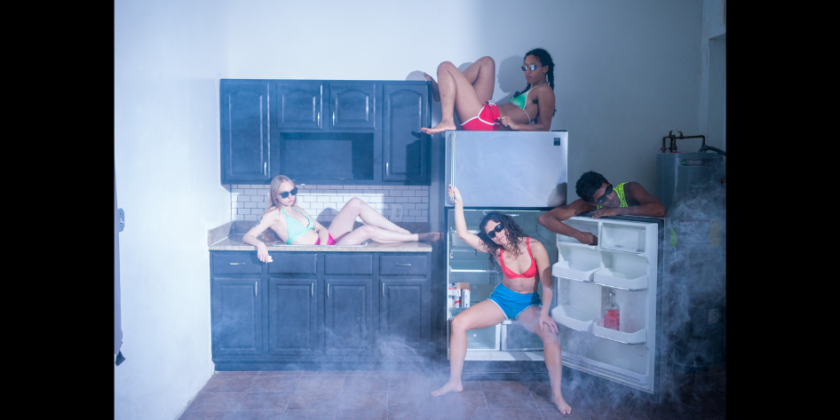
Without warning, Amelia Heintzelman, Benin Gardner, Sabrina Leira, and Zo Williams stride into the kitchen and arrange themselves in perplexing places: curled inside the sink, leaning into the center of the fridge, dangling against the fridge’s door, and relaxed on top of the freezer. We crane our necks, taking in their unmoving stances. They wear brightly-colored bras, mesh tops, booty shorts (a magenta pair of shorts reads plot hole across the back), and sunglasses. Gardner, lounging above the freezer, holds a can of White Claw, staring past all of us.

They remain static for several minutes, unbothered. After slow shifts into new shapes — perhaps a transition of weight from one leg to another — they trickle one by one out of the kitchen into the opposite side of the long room, where the remainder of plot hole unfolds. Their blank, potent gazes stick with me, unsettling and intriguing. I feel particularly amused as Jade Manns jumps into the kitchen, shutting herself inside a cabinet under the sink. The cabinet’s closure triggers a sudden squirt of dish soap, which oozes onto the floor. Whether happy accident or intentional, it rang with serendipity.
The evening-length dance work, rooted in suzuki’s self-described “butoh-ish” choreographic style, shifts from stark, statuesque shapes to warped action. The cast swaps their vibrant garments for more muted pedestrian clothing designed by Zo Roze, with each look carrying its own unique personality: a hoodie with shorts, a gray dress, a sheer tan tank top with capris. Everyone removes their sunglasses. Moving expansively, their vocabulary reads gnarly and raw, suspended and smooth; the atmosphere evokes dissociation.

Considering that suzuki’s work engages deeply with the anxieties of the post-internet age, I found myself contemplating questions surrounding our normalized hyperdigital existence. In a society where virtual connection is no longer novel, how can we continue to cultivate sincere experiences? How does extended time online affect our identities, relationships, and creativity?
The cast speaks to these themes with eerie and captivating force through their individual movement journeys and interactions (or lack thereof) with one another. While I feel compelled to watch each performer, each with their distinct expressive physicalities and focuses flickering between determination and detachment, I often feel they inhabit separate worlds. They cross paths occasionally, yet their connections feel fleeting. They convulse, twitch, roll across the floor, and stretch every limb into infinite space until the brink of collapse — with so many ideas occurring at once, it feels like sensory overload. All the while, a beatless, ambient hum casts overhead, built in the moment by Leo Chang.

Emma Lee. Photo: Nyah Maudrina Raposo
A moment of quiet occurs when Lee, in a gray dress and shining silver face paint, grasps a microphone and takes center stage. Lulled by her tender singing, I feel mellow and calm after experiencing a stretch of near-constant motion. Soon after, suzuki inches onstage from the back of the house wearing cowboy boots and a lampshade over his face. Could this surreal scene, like the stark images in the work’s opening, nod to the kinds of unexpected content we come across online? Or speak to the internet’s depth of imagination or the endless possibilities of its imagery? Lee drags suzuki slowly onstage; at the lampshade’s removal, we startlingly find that suzuki wears white face paint and sunglasses.

As plot hole approaches its close, the energy reaches a climax — or perhaps a vortex. suzuki slowly inches around the perimeter of the studio, contrasting the other performers’ voluminous movements as they charge across the floor. Physical touch arises in a lean or a collision, only to dissolve. At times, dancers take private moments of pause or extremely slow, sustained movement to capture an internal focus. These final images feel disjointed, unbound, and chaotic— an echo of the compulsion to scroll, swipe, and stare at endless pieces of content.
I leave PAGEANT reflecting on how we navigate life in the post-internet age, and on the digital and analog footprints we leave behind. I thank the entire cast for this reminder, and look forward to experiencing more of suzuki’s work in the future.