



Related Features

IMPRESSIONS: Fresh Tracks 2026 at New York Live Arts
IMPRESSIONS: Ishmael Houston-Jones’ "OO-GA-La Reimagined" and Heidi Latsky Dance's "Who Am I Now?"
THE DANCE ENTHUSIAST ASKS: Dorchel Haqq Before DraftWork Premiere at Danspace Project
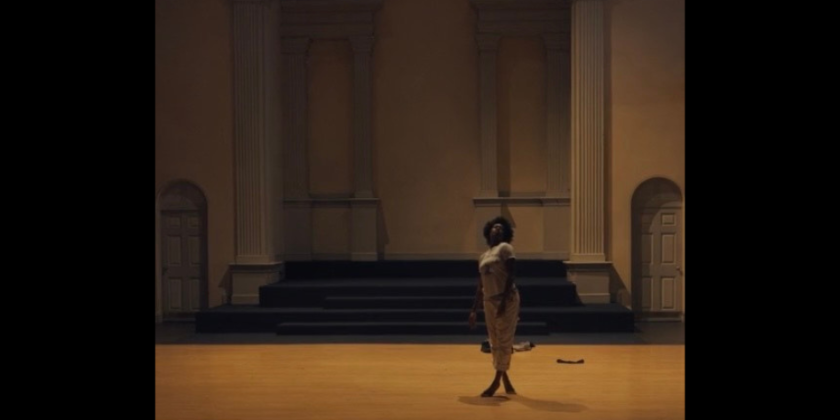
The Work-in-Progress Was Unveiled on October 25, 2025
Danspace Project’s DraftWork series invites choreographers to share in-progress ideas, inviting audiences into the creative process while works are tender and growing.
On October 25, 2025, DraftWork featured a new work-in-progress by Dorchel Haqq, a Harlem-raised dance artist and 2025 Movement Research Van Lier Emerging Artist of Color Fellow. Her work explores the body as a cultural archive, using improvisation, film, sound, and personal objects to activate the senses.
Rooted in formative training at LaRocque Bey School of Dance Theatre, Dance Theatre of Harlem, and Fiorello H. LaGuardia High School, Haqq refined her movement language at SUNY Purchase with additional studies in Berlin and Seoul that expanded her awareness of global perspective. She has been supported by residencies and organizations including Springboard Danse Montréal, Jonah Bokaer Arts Foundation, Gallim, Center for Performance Research, and Baryshnikov Arts Center. She danced with Kyle Abraham A.I.M., Sleep No More Shanghai, and is in her first season with David Dorfman Dance.
Following her DraftWork premiere, Dorchel sat down with Kristen Hedberg of The Dance Enthusiast to talk about her artistic process: world-buiding, improvisation and creating through care.
Kristen Hedberg for The Dance Enthusiast: Congratulations on your DraftWork premiere! How are you feeling, post-performance?
Dorchel Haqq: I’m feeling extremely grateful. I actually had the chance to watch a video of the premiere that same night. I’d hired a friend, Alexander Diaz, to film the DraftWork performance and afterward, I was able to view it surrounded by friends, which made the experience even more special.
How did viewing your DraftWork the same evening as the performance affect your perspective?
It helped me see what was actually there, instead of the swirl of ideas in my head. My partner is a painter, and he always reminds me how important it is to step back and see the whole picture. Because so much of what I do is improvised, witnessing it afterward is incredibly informative.
What was your process like, leading up to DraftWork?
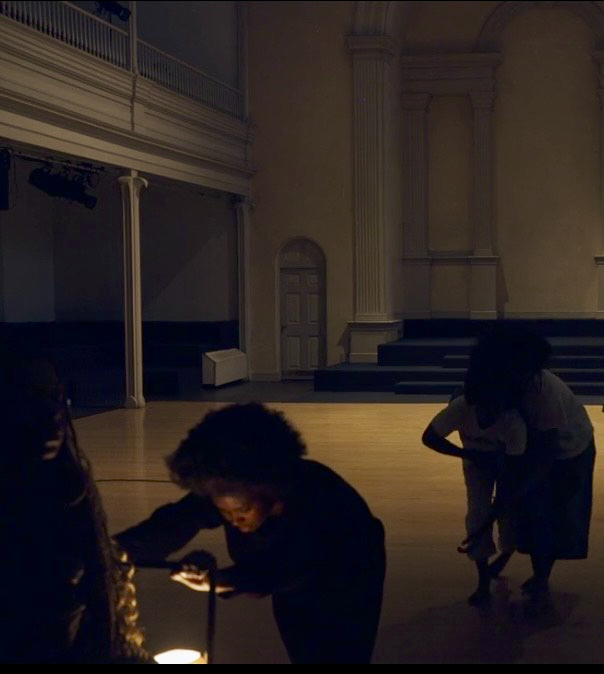
Part of my 2025 Van Lier Fellowship provides a stipend for taking classes, so I’ve been studying contact improvisation at Movement Research with my collaborator and dance partner, Kar’mel Small. We also attend improv jams on Saturday evenings. In the time leading up to DraftWork, I had the entire space (Danspace) to myself, where I used that time to dream and see the structure in the space.

I also worked with Kala, a live percussionist. While at Danspace, I filmed a description of how I wanted the sound to travel. Trust is a big part of communication and collaboration.
It all came together quickly. The week before DraftWork, I was in residency with David Dorfman in Connecticut. I try to stay fully present where I am, but that meant navigating a lot of changes once I returned to New York. One of my collaborators had a modeling conflict, and another missed their flight to New York for the performance. I had to reorganize, but I’m incredibly thankful for my collaborators and friends who stepped in — thank you to my Movers, Kar’mel, Eryn Danielle and Makaila Chiplan — and I also recognize improv is adapting to the present moment.
How it all came together so seamless and organically is a testament to the trust that you have in each other. Can you talk about that trust?
The trust is vital, especially considering that I largely work in improvisation and character embodied choreography. I cannot do this work alone. And I recognize that I have to let go of attachments in order for the bigger picture to come through…because this is bigger than me. I have to let things spill and work in ways that require me to discover or have me slip into the unknown.
Has choreography always been a passion of yours?
In high school at LaGuardia, I remember walking with a friend in the hallway saying I wanted to someday own a building that houses a theater, an artist residency space, a living space, and studios of different mediums. That dream is still alive, and I’ve always loved creating and making work. When I was young, I’ve always loved creating pieces for talent shows. But at SUNY Purchase, when Doug Varone taught my composition class my senior year, he unlocked something. He helped me see how wide the possibilities are. It has been very informative, having the tools to see where my work can expand. But the passion for building has always been there.

In addition to movement, your work activates space through objects, sound, projection. How does that world-building begin?
Usually the vision comes fast. For DraftWork, I knew I wanted a contact improv duet. I’ve observed that Black, Queer bodies are not often centered in that form, and I knew I wanted to be a part of it. Objects, props, and costumes often come from my family. The lamp in DraftWork was my aunt’s. I was investigating the balcony at Danspace and saw a Trader Joe’s shopping cart, and that inspired the constantly moving image of the light.
I want to activate multiple senses. Like with Kala’s percussion, that echoes the heartbeat. Film shifts the viewer’s gaze, and going forward I use film and projection to extend the body rather than distract from it. Sometimes I offer tea before and during the performance, so the experience includes taste. It becomes a world you experience from the inside, instead of observing from the outside.
You’ve talked about presenting your work in intimate spaces, such as art galleries. What draws you to that closeness?
Proximity. The electricity of shared space. Even before performing in immersive theater like Sleep No More Shanghai, I loved the idea of the audience being close enough to exchange energy. It sparks curiosity. It feels like life, not presentation.
I think dance can sometimes become “moves for moves’ sake, which I’m personally not drawn to as a viewer, and it’s not the kind of work I want to produce. When that happens it can feel two-dimensional, like something intangible. I want to really engage with the audience, inviting them to wonder, “How am I interacting with this person who is so close to me? How are we having a conversation through this performance?”
In a world where it is easy to feel spread-thin, to feel over-stimulated, what inspires you and feeds you?
I’ve been talking about this with my mentor Nora Chipaumire, and with my freelance friends. We are living in a time where funding is being cut, where the government is literally working against Black bodies, and so much death is happening everywhere around us, and it is easy to feel over-stimulated and spread thin. I’ve been asking what it means to be an artist in this time. Plenty of artists have said this over the millennium, but it is true: we have to keep creating.
If you think about a forest on fire, that the forest is being burned down and the ashes are what comes after that…sometimes the fire spreads so far that you cannot see the beauty that comes after. But beauty does come after the fire. There’s the dancers and messages that come from the flames. That’s where we are right now. There’s a fire. It’s this chaos. But I still see a through-line. I still see the water coming to put out that fire. I see the soil. I’m still able to dream, which I’m really thankful for. My younger child-self still has so many ideas, and that’s what keeps me going.
I want to speak to the times that we’re in. That’s what I want to do as an artist. I want to shed my own version, light, connection and care through all of the things we are goin through. We have to be the light. I just pray that my work does that for people.
Your work is raw, honest, and it certainly brings me that hope. We need you. Where can we see your work next?
Since January 2025, I have shown my work at least once a month. An experimental piece in November. On December 6th, I’m co-improvising with Joy Guidry, who is a bassoonist and experimental composer, and possibly traveling to Zimbabwe to connect with Nora Chipaumire. January is APAP and a winter intensive with David Dorfman Dance. In February, I am performing at the Park Avenue Armory with Joy Guidry. From April 30 to May 2, I have a three-day evening length showing produced by Triskelion Arts, where I will show a broadcast-style piece that reflects TV shows and radio stations in Black culture. Then, from May 15 to 16 is Fresh Tracks through New York Live Arts.

How do you practice self-care through these many exciting opportunities?
When my freelance life supports it, some days I can limit myself to doing one thing a day or nothing at all. I find recovery in acupuncture, Klien technique, Feldenkrais, and massage — taking that time is so vital.
I’m learning patience with myself while finding work that supports my life and my art. I want to start working the lights at clubs and DJing; that’ll add another element to my work, and it’s simply fun.
In this moment, I’m also really identifying joy. When I take a step back, I can confidently say that I’m proud of myself. Saying that and naming that feels really good, and I will continue to acknowledge comfort and joy in what I’m doing.
Is there anything else you would like to share with us as we follow your journey?
Improvisation is like turning over a stone, and finding another one underneath. There is always more. The child inside me keeps exploring. There is so much work to do, and I am excited to keep doing it.